Last updated: 15 October 2026
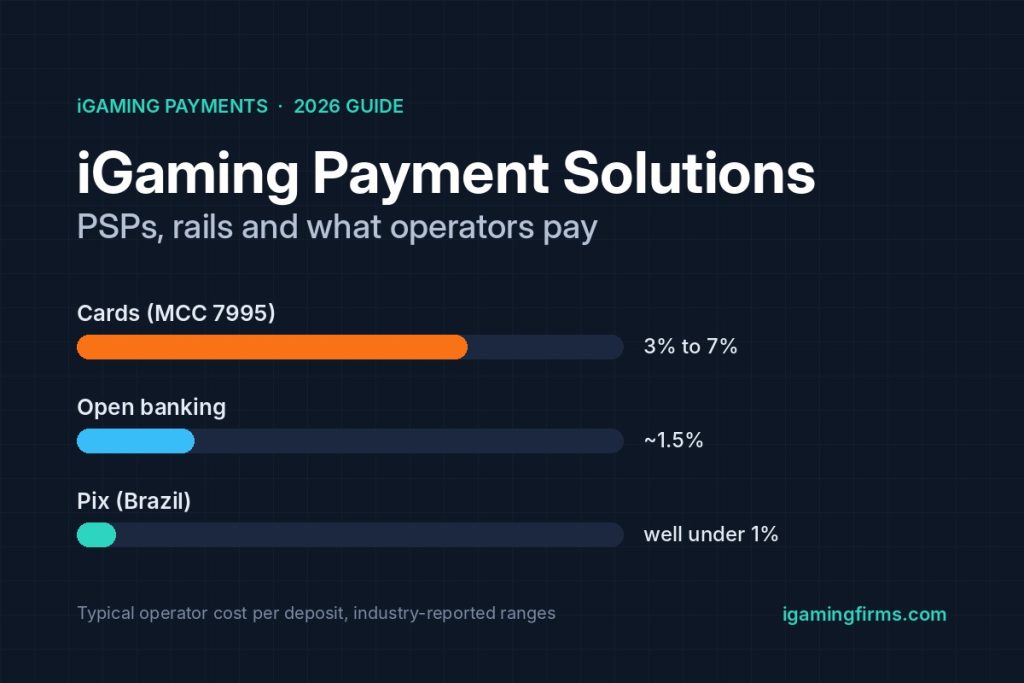
The short answer: iGaming payment solutions are the acquirers, PSPs, payment methods, orchestration and payout tools that let a licensed operator take deposits and pay withdrawals in gambling, a high-risk card category (MCC 7995). In 2026 your all-in cost depends more on your rail mix than on any PSP’s headline rate: gambling card deposits typically cost about 3% to 7% plus a rolling reserve, while bank rails such as open banking and ACH cost less and carry no card-scheme chargebacks.
Most operators only look hard at their payment stack when something breaks. An acquirer raises the rolling reserve without warning. A state bans credit card deposits a month before football season. A whole market switches off betting payments in a week, as Brazil did in October 2026. By then the cost is already in the P&L.
This guide is for the people who own that problem: founders, heads of payments and finance leads at operators. It explains how the payment stack works, which rails each major market allows, what each rail costs, and how the 2026 changes (Visa’s tighter dispute threshold, the US credit card exodus, Brazil’s betting ban, PSP consolidation) change the math. There is also a worked cost model you can rerun with your own numbers. If you already know the basics and want named vendors, go to our comparison of 12 iGaming payment providers and cashiers; this page is the explainer.
What operators pay by payment rail in 2026
Card deposits coded as gambling are the most expensive and most restricted rail. Bank-based rails such as open banking, Pix and ACH are cheaper, cannot be charged back through the card schemes, and are where regulation is pushing everyone anyway.
| Rail | Typical operator cost | Chargeback risk | Where it dominates | Evidence quality |
|---|---|---|---|---|
| Cards (MCC 7995) | About 3% to 7% blended, plus a 5% to 10% rolling reserve held 90 to 180 days | High; counts toward Visa VAMP | US (debit), Canada, most of Europe | Industry-reported ranges; ask for your own quote |
| Open banking / Pay by Bank | Often around 1.5% or a fixed per-transaction fee | No card-scheme chargebacks | UK, Nordics, Netherlands (iDEAL), Germany | Vendor and reseller pricing commentary |
| Pix (Brazil) | Well below card rates; general commerce average about 0.22%, gambling PSP quotes higher | No card-scheme chargebacks | Brazil, but betting use suspended since October 2026 apart from refunds | BIS/central bank research for general commerce |
| ACH / VIP Preferred (US) | Not publicly priced; usually free to the player | Returns (NSF) rather than chargebacks | US regulated states | Operator and player-facing documentation |
| E-wallets (Skrill, Neteller, PayPal) | Negotiated, not publicly priced for gambling | Low to medium | Europe, Canada, US (PayPal) | Ask in tender |
| Crypto / stablecoins | Varies by on-ramp provider | None at the scheme level | Offshore; limited US launches | Not allowed under many licences; check each regulator |
Treat the percentages as ranges for budgeting, not as quotes. No major PSP publishes gambling pricing, and every number above moves with your volume, chargeback history, licence and markets.
What “iGaming payment solutions” actually covers
The phrase gets used for everything from a single gateway to a full payments department. In practice an operator’s stack has five layers, and you can buy them separately or bundled.
- Acquirer. The bank or licensed institution that settles card transactions and carries the scheme risk. It must be registered with Visa and Mastercard to write gambling volume at all.
- PSP or gateway. Connects your cashier to acquirers and alternative payment methods (APMs). Some PSPs are also acquirers, such as Worldpay, Nuvei and Paysafe.
- APM and wallet providers. Open banking (Trustly, Volt), e-wallets (Skrill, Neteller, PayPal), US-specific rails (Sightline’s Play+ prepaid card, VIP Preferred ACH from Pavilion Payments) and local rails such as Pix.
- Payment orchestration. A layer that sits over several PSPs, routes each transaction to the best one and retries soft declines. Praxis, Primer, PaymentIQ, Corefy and Akurateco all sell into iGaming.
- Payouts, fraud and reconciliation. Withdrawals, KYC and AML hooks, chargeback tooling and finance reporting. This layer is where many cheap setups quietly fail.
PSP vs gateway vs orchestrator: what is the difference?
| Layer | What it does | Holds your money? | When you need it |
|---|---|---|---|
| Gateway | Passes payment data from your cashier to a processor | No | Always, but usually bundled inside a PSP |
| PSP | Gateway plus contracts with acquirers and APMs, settlement and reporting | Often, during settlement | From day one |
| Acquirer | Settles card volume and carries scheme risk; sets the reserve | Yes, including the rolling reserve | Whenever you take cards |
| Orchestrator | Routes and retries across several PSPs from one integration | Usually not | Second market, second brand or first serious outage |
If you are still choosing a platform, check which of these layers it bundles before you sign. Our guide to choosing an iGaming platform provider covers what turnkey deals usually include on the payments side.
How do iGaming payment solutions work?
A deposit and a withdrawal follow different paths, and most of the cost and risk sits in the checks along the way.

- Deposit request. The player picks a method in your cashier. The PSP or orchestrator decides where to route it based on country, method, amount and cost.
- Checks before authorisation. Your platform confirms the player is verified and within deposit limits; the PSP runs fraud screening and, for cards, 3DS.
- Authorisation. For cards, the acquirer sends the MCC 7995 transaction to the issuing bank, which can decline it purely because it is gambling. Bank rails are approved by the player inside their banking app.
- Wallet credit. The player’s balance updates once the rail confirms the payment. For bank rails, good providers also confirm the account holder matches the verified player.
- Settlement. The acquirer or PSP pays you, minus fees and any rolling reserve, on an agreed schedule. Bank rails usually settle faster than cards; get the exact terms in writing.
- Withdrawal. You run AML and source-of-funds checks, then pay out. Most operators send withdrawals back to the deposit method where possible (a “closed loop”), which is also a standard anti-money-laundering control.
Weak links in steps 2 and 6 are where operators get fined, so treat KYC and fraud tooling as part of the payment decision. See our guides to KYC providers for iGaming and iGaming fraud detection tools.
Why cards cost so much more for gambling
Every real-money gambling transaction carries merchant category code 7995. Visa and Mastercard treat it as high risk, so you pay a stack of charges instead of one rate:
- Interchange and scheme fees, the same base layer any merchant pays.
- A high-risk premium and acquirer markup, because fewer acquirers will take the volume.
- Per-event fees for 3DS, chargebacks, currency conversion and card payouts.
- A rolling reserve. Acquirers typically hold back 5% to 10% of settlement for 90 to 180 days to cover chargebacks that arrive after you have been paid.
- Declines you never see. Many issuing banks block MCC 7995 by default regardless of your licence. A failed first deposit is a lost player, which is an acquisition cost, but it is caused by the rail.
Independent iGaming payment datasets put the blended card deposit rate at roughly 3% to 7% in 2026. The spread is wide because it depends on your country mix, debit versus credit share, and chargeback ratio.
What is a rolling reserve, and how do you get it reduced?
A rolling reserve is a share of each settlement that the acquirer keeps for a fixed period, then releases on a rolling basis. It is not a fee, but it ties up working capital, and it is often the term that hurts a new operator most. Reserves come down when you can show months of low chargebacks and stable volume, so agree the review date and the conditions for reducing it before you go live, not after.
Visa’s 1.5% dispute threshold is now live
Visa replaced its old fraud and dispute monitoring programmes with the Visa Acquirer Monitoring Program (VAMP) in April 2025. The VAMP ratio adds fraud reports and disputes together and divides them by settled transactions. On April 1, 2026 the “excessive” threshold for merchants dropped from 2.2% to 1.5% in most regions, and acquirers are held to 0.5% (above standard) and 0.7% (excessive) across their whole portfolio.
That acquirer-level number is the one to watch. An acquirer near its own limit will tighten terms, raise reserves or offboard gambling merchants to protect itself, even if your individual ratio is fine. When you negotiate, ask what your acquirer’s portfolio ratio is, not just yours.
Which payment rails each market allows
Regulation decides your rail mix before any PSP does. Here is where the main markets stand in October 2026.
| Market | Banned | Main rails | What it means for your stack |
|---|---|---|---|
| United Kingdom | Credit cards, including credit-funded e-wallets | Debit cards, open banking, e-wallets that block credit | Every wallet partner must prove it blocks credit-funded deposits |
| United States | Credit cards in a growing list of states; most large operators dropped them nationwide | Debit, ACH / VIP Preferred, Play+, PayPal, Pay by Bank | Build for a debit and bank-first cashier; state-by-state rules still apply |
| Brazil | All new betting deposits since MP 1,394/2026 (September 2026); before that, credit cards, crypto, cash, boletos and third-party payments | None for new deposits; Pix and TED only for refunds and wind-down | Treat Brazil as closed; keep an authorised partner for refunds and a re-entry plan |
| Ireland | Credit cards and credit-funded e-wallets (from February 2026) | Debit, open banking, compliant wallets | Similar controls to the UK |
United Kingdom
The Gambling Commission banned credit card gambling on 14 April 2020, and the ban reaches through e-wallets: you may only accept wallet payments if the wallet can stop credit card funding. That rule pushed UK operators toward debit cards and open banking, and Pay by Bank is now a standard cashier option at many UKGC-licensed casinos. If you are entering the market, see our UK market guide and the UKGC licence requirements and fees.
United States
2026 is the year US credit card deposits effectively ended. DraftKings dropped them nationwide in August 2025. After Senator Elizabeth Warren wrote to 11 operators in February 2026 about cash advance fees (typically the greater of $10 or 3% to 5% per deposit, charged to the player), FanDuel followed on March 2, then BetMGM, bet365 on April 13, Caesars and, by July, Hard Rock Bet.
States are also writing it into law. Iowa, Maine, Massachusetts, Oregon, Rhode Island, Tennessee, Vermont and Virginia ban credit cards for online sports betting, Illinois and Ohio regulators have moved on rules, and New Jersey and New York have bills in play. Massachusetts has already fined DraftKings $450,000 for accepting credit card deposits.
The practical result: a US cashier now runs on debit cards, ACH (usually through VIP Preferred), Play+ prepaid cards, PayPal, and newer Pay by Bank options. Paysafe launched Pay by Bank for US iGaming and, in April 2026, a MoonPay-powered Pay with Crypto product for states where it is permitted. Payment vendors serving licensed operators also need approval in each state, so check vendor status state by state before you sign.
One more US risk sits outside licensed markets. On 19 August 2026 Florida’s Attorney General sued major sweepstakes casino operators and, in the state’s words, “the payment processors that enable them.” If any of your PSPs serve dual-currency sweepstakes merchants, read our breakdown of Florida’s 2026 enforcement.
Brazil
Brazil was the textbook Pix market until September 2026. Provisional Measure 1,394/2026, published on 25 September 2026, prohibits operating, offering, intermediating and advertising fixed-odds betting, covering both sports betting and online games. Existing authorisations end 30 days after publication, with player balances returned. Banco Central resolutions in early October 2026 then barred Pix, TED and boletos for betting, apart from refund and wind-down payments.
For your payment stack that means no new Brazilian deposits through any provider. Keep a Banco Central-authorised partner only for refunds, keep complete records of player fund returns, and do not accept a PSP’s offer to keep processing Brazilian players. The measure lapses unless Congress converts it into law within 120 days, and it faces court challenges, so the position can change. Our October 2026 regulation roundup tracks the lawsuits and the political timeline.
If the market reopens, the 2024 payment rules are the likely starting point. Ordinance SPA/MF 615/2024 allowed only Pix, TED, debit or prepaid cards and same-bank transfers, and banned cash, boletos, cheques, crypto, credit cards and payments from accounts the player had not registered. Pix carried the vast majority of betting deposits, and the test that mattered was whether the PSP bound the sender’s CPF to the verified player before crediting the wallet. Pix is also cheap: research by Brazil’s central bank and the BIS put it at about 0.22% per transaction for general merchants, against roughly 1% for debit and 2.2% for credit. Our Brazil market guide covers the wider rule set.
Worked example: what your rail mix is worth
This is the part most payment guides leave out. Here is a simple model for an operator processing $10 million a month in deposits. The assumptions are deliberately round so you can swap in your own quotes.

Assumptions: card deposits cost 3.0% all-in; open banking costs 1.5%; the acquirer holds a 10% rolling reserve on card volume for 90 days; open banking carries no reserve. Payout costs, FX and chargeback losses are left out to keep it readable.
| Scenario A: card-heavy | Scenario B: bank-first | |
|---|---|---|
| Rail mix | 80% card / 20% open banking | 50% card / 50% open banking |
| Monthly processing cost | $270,000 | $225,000 |
| Effective rate on deposits | 2.70% | 2.25% |
| Cash held in rolling reserve (steady state) | $2.4 million | $1.5 million |
Moving 30% of deposits from cards to bank payments saves $45,000 a month, or $540,000 a year, and frees about $900,000 of working capital from the reserve. It also cuts the number of card transactions that can generate VAMP disputes, which protects your acquirer relationship.
Two caveats keep this honest. First, shifting players to a new rail costs conversion if the bank flow is clunky, so test the cashier order before you force it. Second, open banking pricing is often a fixed fee per transaction, which favours larger deposits; if your market caps deposit sizes, run the model on transaction count as well as value.
For scale, public operators show the same pattern. DraftKings’ 2025 annual report says payment processing fees rose $65.4 million in dollar terms, yet cost of revenue fell as a share of revenue partly because payment fees shrank relative to revenue.
The PSP market is consolidating: what changed in 2026
When you sign a payments contract you are betting that the provider, its risk appetite and its integration will look the same in two or three years. 2026 made that bet harder.
- Global Payments now owns Worldpay. The deal closed on January 9, 2026 at a $24.25 billion enterprise value. Worldpay is one of the largest gambling acquirers, so expect contract reviews and pricing changes as the businesses integrate.
- Nuvei agreed to buy Payoneer. The $2.75 billion all-cash deal was announced on June 15, 2026 and is expected to close in mid-2027. Nuvei says it will combine its acceptance business with Payoneer’s cross-border payouts, which could matter for operators paying affiliates and suppliers.
- Paysafe is pushing beyond cards. Pay by Bank and Pay with Crypto in the US, an upgraded Skrill wallet in Ontario, and PaysafeWallet across 18 European markets. Its merchant-solutions volume rose 5% to $37.3 billion in Q2 2026, helped by iGaming.
- Payment companies are now enforcement targets. Florida’s August 2026 lawsuits target the payment processors behind sweepstakes casinos, not just the operators, and Brazil’s ban reached straight into the payment rails. Regulators increasingly treat the payment chain as part of the operator’s compliance problem.
Who are the biggest iGaming payment providers?
In regulated markets the names that come up most are Worldpay (now part of Global Payments), Nuvei and Paysafe for acquiring and wallets, Trustly for open banking, and PayPal for wallet coverage in the US and Europe. Size is not the same as fit, though: the best provider for you is the one approved in your markets with terms you can live with. Our ranked list of iGaming payment providers compares them vendor by vendor.
How to choose: questions to put in your PSP tender
Every PSP will claim iGaming experience. These questions separate the ones that can actually carry your volume.
- Is the acquirer registered for MCC 7995 in each of my target markets? Get it in writing, market by market.
- What is my all-in rate, and what sits outside it? Ask for 3DS, chargeback, refund, FX, payout and minimum monthly fees as separate lines.
- What reserve will you hold, for how long, and what earns it down? Agree the conditions for reducing the reserve before you go live.
- What is your portfolio VAMP ratio? An acquirer close to 0.7% is a termination risk for you.
- How fast are settlement and payouts, and on which rails? Players forgive a slow deposit far more easily than a slow withdrawal.
- For bank rails: do you match the sending account holder to my verified player, and block third-party payments?
- For the UK and Ireland: how do your wallets block credit-funded deposits?
- What happens to my reserve and data if either of us exits? Reserves are usually held for a further period after termination. Know how long.
- Do you serve sweepstakes or unlicensed operators anywhere? After Florida, your PSP’s other clients are part of your risk.
What licences should an iGaming payment provider hold?
At minimum, ask for three things. First, its own payments authorisation where it holds client funds, such as an e-money or payment institution licence (in the UK, from the FCA). Second, scheme registration with Visa and Mastercard to acquire MCC 7995 volume, if it touches cards. Third, any gambling-vendor approval your regulator requires, which is common in US states. A provider that cannot show all three for your markets is a risk to your licence, not just to your payments.
One PSP or an orchestration layer?
One PSP is fine for a single-market launch. Once you run several markets or several brands, a single provider becomes a single point of failure: one risk-policy change can switch off your deposits overnight. An orchestration layer lets you route by country, method and cost, retry soft declines on a second acquirer, and move volume if a provider tightens terms. It adds a fee and a system to manage, so the trigger is usually your second market or your first serious outage, not day one.
Red flags in a payments deal
- A single blended rate with no breakdown. The fees you cannot see are the ones that grow.
- Reserve terms that can change “at the acquirer’s discretion” with no notice period.
- A provider offering to process players from markets where you are not licensed, or from Brazil while betting payments are banned.
- A wallet partner in the UK or Ireland that cannot show how it blocks credit card top-ups.
- No payout SLA, or payouts only via slow bank wires.
- A provider that quietly processes for sweepstakes or unlicensed brands.
- Exit clauses that hold your reserve for longer than the chargeback window justifies.
What this means for you
The cheapest PSP on paper is rarely the cheapest stack. In 2026 the real savings come from three moves: shift deposits from cards to bank rails wherever players accept them, keep your card dispute ratio far below Visa’s 1.5% line, and avoid depending on one acquirer whose ownership or risk appetite may change. Brazil also showed that a market’s rails can close in days, so keep contracts flexible enough to exit a country cleanly. Run the cost model above with your own quotes before your next contract renewal, and ask every provider the tender questions in writing.
When you are ready to shortlist, compare 12 iGaming payment providers side by side in our vendor list.
This article is general information and analysis, not financial or legal advice. Fee ranges are industry-reported and vary by operator; confirm terms with your providers.