Your slot, table and cage systems know what happened on the floor last night, but your general ledger only learns it after the drop is counted, the revenue audit signs off and someone posts a journal.
The short answer: casino accounting software comes in two layers. The casino management system (CMS) captures meters, drop, cage and tax events, while a general ERP such as Sage Intacct or Microsoft Dynamics 365 holds the ledger. Choose the CMS for gaming accuracy and the ERP for the close. One change matters for 2026: the IRS W-2G instructions set a $2,000 minimum reporting threshold for payments made in calendar year 2026, indexed for inflation afterwards. Any jackpot or cage module still configured for the old $1,200 slot threshold now generates forms and handpay work you no longer need.
Vendor facts below come from each company’s own pages and filings, read in November 2026. No vendor paid to be included.
Casino accounting software compared
| # | Provider | Layer | Built for | Accounting scope | Compliance reporting | Route to the general ledger |
|---|---|---|---|---|---|---|
| 1 | CasinoTrac | CMS | Tribal and commercial land-based casinos, slot routes | Reconciliation module with 75+ reports, revenue audit | NV Tech Standard 3 compliant accounting module | Vendor says no third-party software is needed; ask how journals reach your ERP |
| 2 | IGT (ADVANTAGE) | CMS plus cash and AML tools | Casino and video lottery operators | Machine accounting, fills and jackpots, cage cash automation | W-2G handpays; Everi Entegrity CTR and SAR filing | GL interface stated for CashComplete Connect Retail Edition only |
| 3 | M3 Technology Solutions (m3t) | CMS | US land-based casinos and multi-location resorts | Slot, table, cashier, vault, ticketing and jackpot modules | W-2G and 1042-S from the jackpot module, per the company | Confirm export format in the demo |
| 4 | AMATIC (CMS) | CMS | Arcades and casinos, a few machines to 1,000 | Revenue accounting and control, cash centre, jackpot reports | Report set varies by jurisdiction; ask | Web-based BI modules; no GL link described |
| 5 | DR Gaming Technology (DRGT) | CMS | Slot and table floors, multi-venue estates | drAccounting: slots, tables, jackpots, revenue share, cage, count verification | Remote regulator access to reports | Third-party integration layer; no GL named |
| 6 | Konami Gaming (SYNKROS) | CMS plus Title 31 system | Destination resorts, cruise ships, pubs and routes | Cage, credit, vault, chips, FX, TITO, fills and jackpots | SYNK31: CTR, MTL, NIL, SAR, 8300, W-2G, 1042-S | Interfaces described in general terms |
| 7 | Oasis 360 (Aristocrat) | CMS | Boutique to large resort casinos | Slot accounting, vouchers, jackpots and fills, drop tracking | Automated tax forms and audit trails, per Aristocrat | POS and hotel PMS links described; GL to confirm |
| 8 | Win Systems (WIGOS) | CMS | Multi-country slot and casino groups | Winstats reporting, Wigos Collect cash control | AML support and multi-currency, per the company | APIs and standard protocols; ERP list on request |
| 9 | Sage Intacct | ERP | Multi-entity casino operators and franchise groups | GL, AP automation, multi-entity consolidation | Audit trails and role-based approvals | Native ledger; links to casino gaming systems |
| 10 | Arctic IT | ERP | Tribal casinos and resorts | Dynamics 365 Finance: GL, AP/AR, cash, fixed assets | Power BI reporting; AI-assisted reconciliation | Native ledger on Microsoft Dynamics 365 |
| 11 | Ensico | CMS | Slot venues and casinos (Slovenia-based vendor) | Cage accounting, real-time machine accounting, stacker tracking | Shift reports, trace and crosscheck | No GL link described |
Items 1 to 8 were in the earlier version of this comparison. Items 9 to 11 were added so you can see the ERP side next to the floor systems. Pricing is by quote for every vendor here, so it is covered in each profile only where the company states something concrete.
Casino management system or general ERP: which layer do you need?
A casino management system talks to the floor. It reads slot meters through protocols such as SAS, records ticket-in ticket-out (TITO) vouchers, logs handpays and fills, tracks players and runs the cage. Its accounting module turns that activity into drop, win and hold by machine, table, shift and day.
A general ERP talks to the business. It holds the chart of accounts, payables, payroll, fixed assets, bank reconciliation, budgets and consolidated statements. Sage’s casino page describes this split well from the ERP side: Sage Intacct offers dimensional reporting by location and gaming area and says you can link it with property management, POS and casino gaming systems.
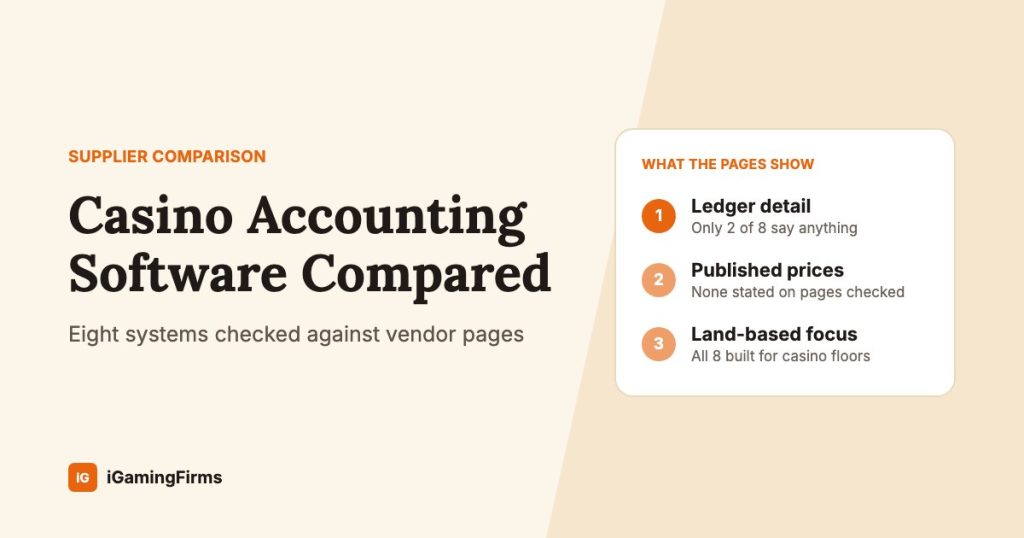
Most properties need both. The question that decides your month end is the bridge between them: does gaming revenue arrive in the ledger as an automated, mapped journal, or as a spreadsheet someone uploads after revenue audit? Of the eight CMS vendors from the earlier version of this list, six say nothing public about that bridge, which is why you should ask about it before you ask about dashboards.
The 11 systems, reviewed
1. CasinoTrac
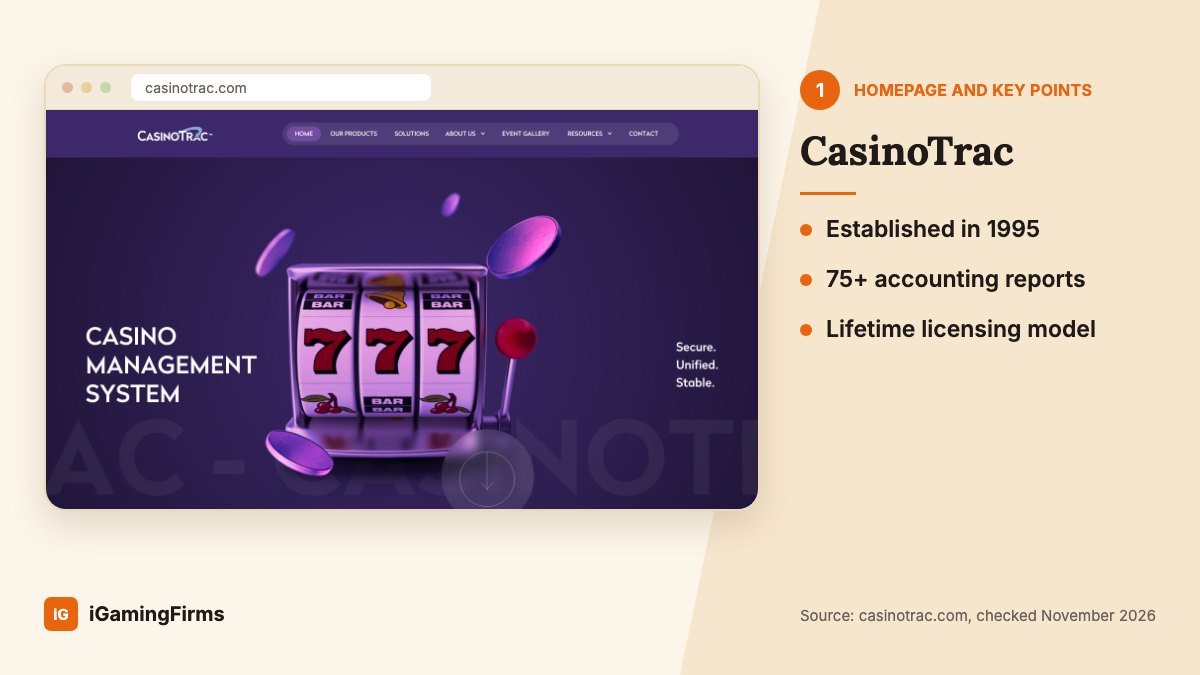
CasinoTrac is the casino management system of Table Trac, Inc. The company’s Q3 2026 Form 10-Q says it was formed in Nevada in June 1995 and has offices in Minnetonka, Las Vegas and Oklahoma City. The CasinoTrac homepage says 300 casinos in 13 countries and 41 Native American tribes run the system.
The solutions page lists an accounting module with a simplified reconciliation method, 75+ reports, multi-game and multi-denomination statistical reporting and full-time US-based audit support. It says the module is NV Tech Standard 3 compliant, needs no third-party software and cuts the number of reports needed to close an audit. Its cashless wagering system is described as approved, without naming the jurisdiction.
On cost, the 10-Q says licensing and technical support are sold under separate license and service contracts. Maintenance was the largest revenue line for the nine months to 30 September 2026 at about $4.7 million of $10.6 million total, so budget for a recurring support fee, not just a one-off system price. US customers made up 91.3% of Q3 2026 revenue. In Nevada, Table Trac announced in August 2025 that Barton’s Club 93 was upgrading to its latest system.
What to confirm: “no third-party software needed” tells you the reports run inside CasinoTrac. It does not tell you whether revenue journals export to your ERP in a mapped format.
2. IGT (ADVANTAGE)
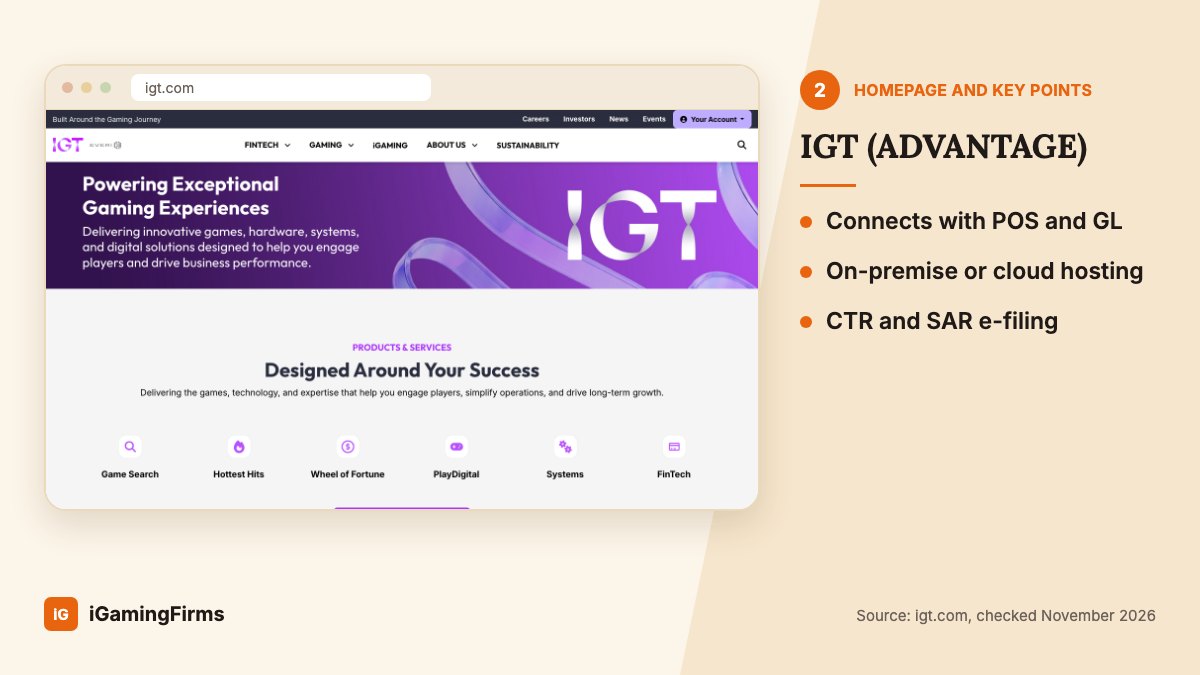
IGT’s ADVANTAGE system is aimed at casino and video lottery operators. Its Machine Accounting module gives the accounting team task-based checklists for audits, paging, work orders and machine management, plus enhanced filtering for regulatory and operational reports. A separate Fills and Jackpots module handles W-2G processing for handpays through a mobile app.
The cash and AML pieces sit with Everi, now part of the same ownership group as IGT’s gaming business. Everi’s Entegrity platform includes a CTR Manager that runs batch creation, review, e-filing, history and audit. Its “Potential Edits” feature alerts you when someone changes the multiple transaction log after the fact, which matters because a late MTL edit can change whether a CTR was due. A SAR Manager covers the back-office SAR lifecycle and Floor Monitor is a real-time MTL and negotiable instrument log.
On the cage side, Everi’s cash management range includes CageConnect dispensers and CashComplete back-office recyclers. CashComplete Connect Retail Edition is the one product described as interfacing with GL systems, with end-of-shift reconciliation against POS data. It is built for retail outlets, so confirm in writing whether the same GL link exists for the main cage.
3. M3 Technology Solutions (m3t)
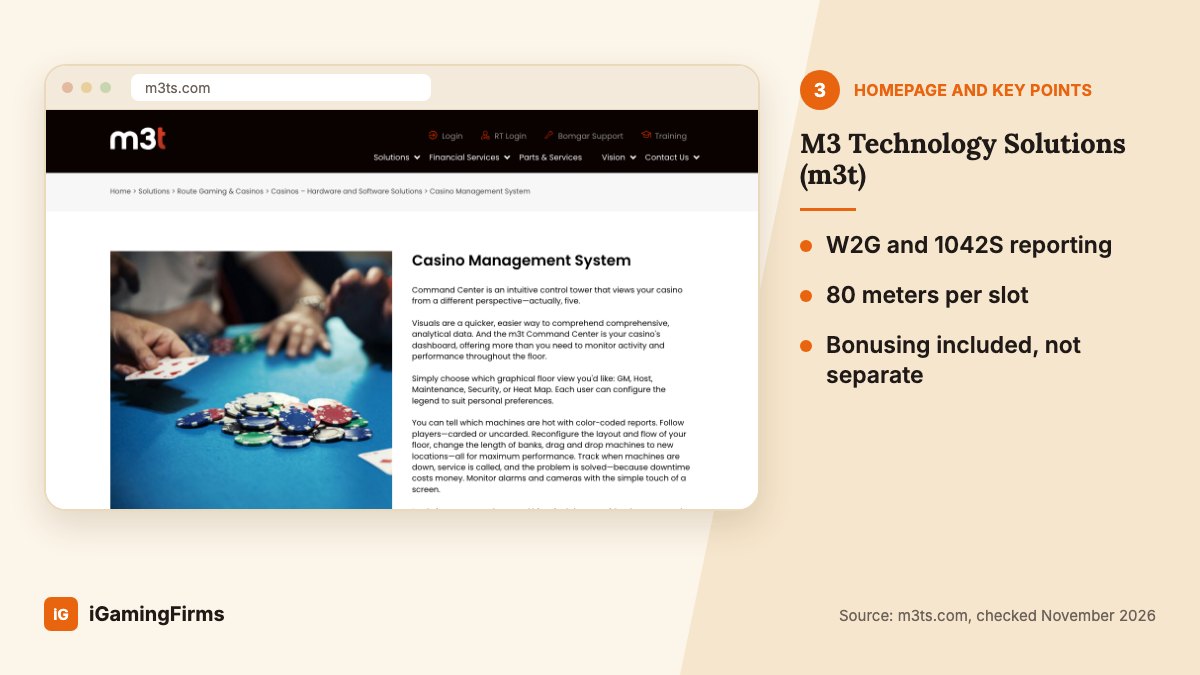
m3t describes itself as a provider of kiosks, casino management systems and financial services with more than 20 years in the business. The company says its system covers slot accounting, player tracking, cashier, vault, ticketing, jackpot and table accounting. Its table module shows credits, drops, chip position and net win per table.
The detail m3t emphasises is slot metering: the company says each machine reports 80 meters to the database every seven seconds, with SAS and system-to-system (S2S) protocols on one ticket server. It also says its jackpot module produces W-2G and 1042-S forms automatically. A separate AML and KYC product, TruCom, is sold alongside it. Bonusing is described as included rather than priced as an add-on.
What to confirm: m3t has said multi-site player club and vault links are live while deeper multi-site casino management is still in development. If you run several properties, ask for a list of what is in production today. Also ask whether the jackpot module’s W-2G trigger has been moved to the 2026 threshold.
4. AMATIC (CMS)
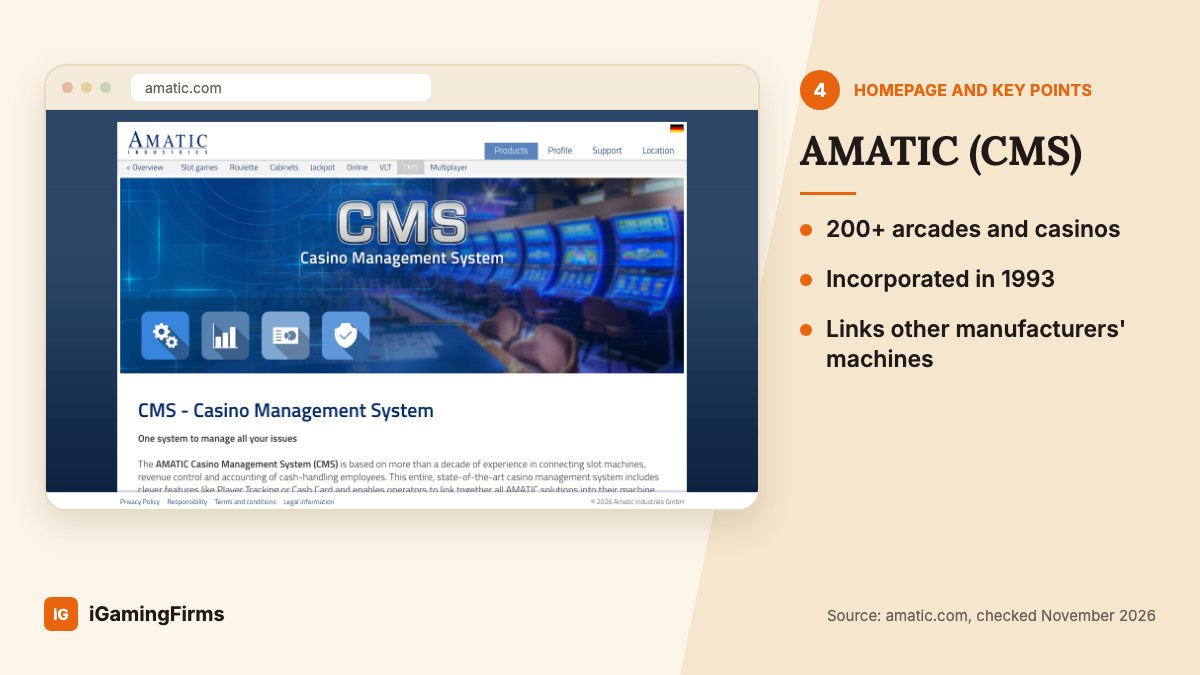
Amatic Industries is better known for slot cabinets, but its casino management system is installed in more than 200 arcades and casinos, according to the company. It is a modular client-server system that scales from arcades with a handful of machines to 1,000-machine casinos. Several casinos can be controlled from one central server. Machines from other manufacturers can be linked in too.
The accounting features listed are a customer-based online accounting system, revenue accounting and control, a cash centre for ticket pay-outs and an integrated jackpot solution with its own handling and reports. Web-based business intelligence modules sit on top. AMATIC’s terms and conditions say all prices are without engagement and quoted ex works without sales tax, so treat any early figure as indicative.
What to confirm: tax and regulator reports are not detailed publicly. Ask which jurisdictions’ report packs are already configured.
5. DR Gaming Technology (DRGT)
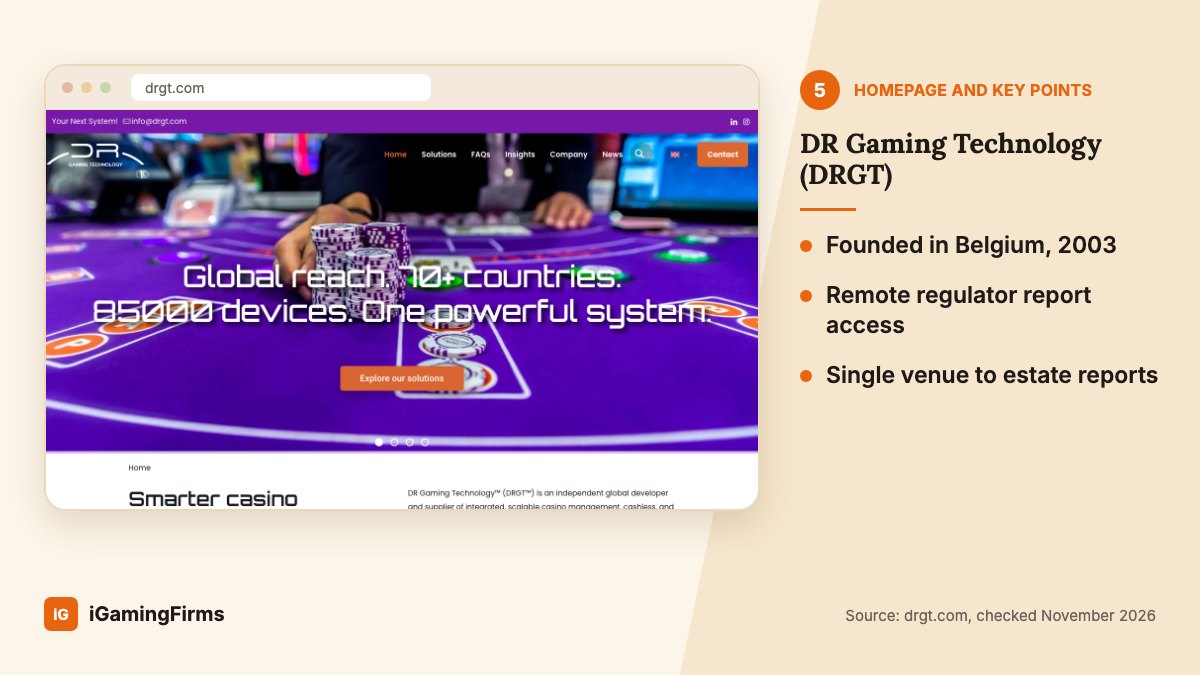
DRGT was founded in Belgium in 2003 and now has more than 150 staff and offices in Austria, Belgium, Colombia, Malta, Mexico, Paraguay, Peru, South Africa and Uruguay. Its homepage cites 70+ countries, 1,400+ sites and 85,000+ devices.
The drAccounting reporting covers revenue and transaction data for slots, tables, jackpots, tournaments and participation or revenue-share agreements, plus cash desk and cage activity. Count verification covers ticket, bill, coin and cashless. It also tracks ticket and points liability year on year or month to month and compares results with budget. Reports run for one venue, several venues or a whole estate. Regulators can get remote web access to reports and game play data, scoped by the operator in line with local rules.
What to confirm: the CMS page says the platform integrates third-party software into a unified view but names no ERP. Revenue-share machines need a liability posting each period, so ask how that reaches your payables ledger.
6. Konami Gaming (SYNKROS)
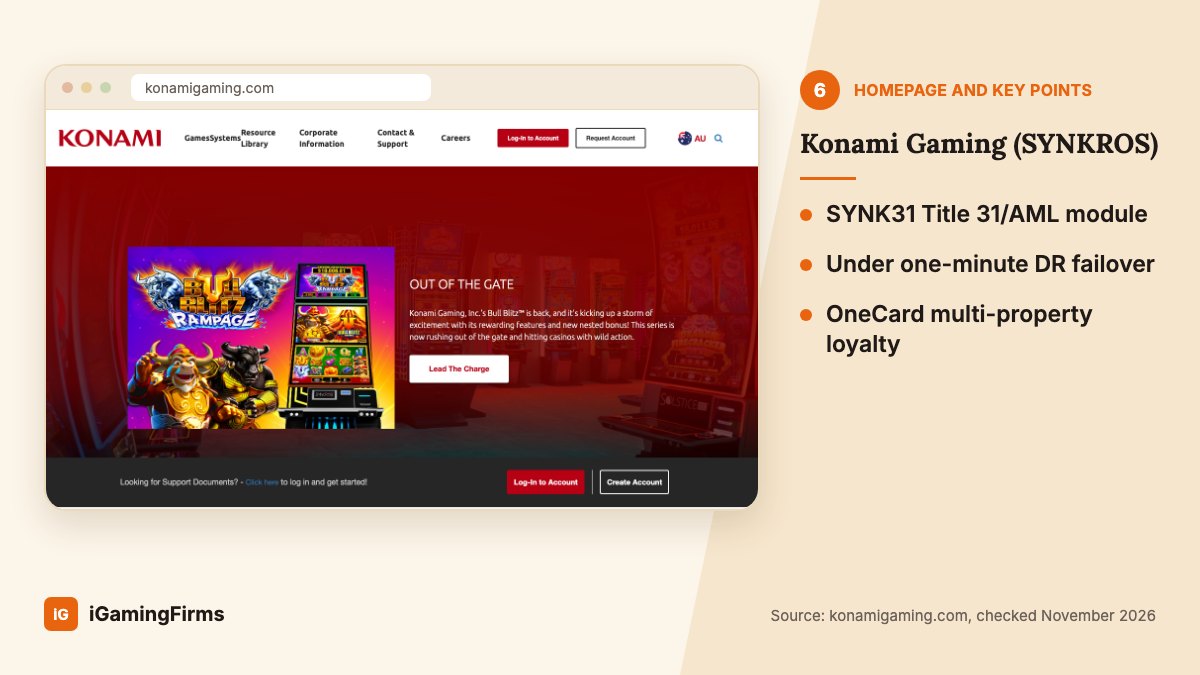
Konami’s gaming division has been in casino systems since 2001 and says SYNKROS supports nearly 400 venues, from local casinos to cruise ships and multi-property portfolios. Of the CMS vendors here, it publishes the most detail on cage and compliance.
The Cage and Credit module handles cancel credits, jackpots, slot fills, TITO redemption, chip inventory (including chips marked for destruction), foreign exchange with variable buy and sell rates, pouch pays and cashless deposits. It issues W-2G, 1042-S and 1099-MISC forms. The credit side covers credit lines, markers, front money and the check and marker lifecycle.
SYNK31 is the Title 31 and AML layer. It combines a patron’s daily transactions from cage, slots, tables and MTLs against a CTR threshold set per property, raises MTL alerts at $10,000.01, logs negotiable instruments of $3,000 or more, sets 90-day review and 120-day filing dates on continuing-activity SARs and creates FinCEN 8300 forms. Konami says it works whether or not you run SYNKROS. The architecture page claims 99.9% availability and a switch to the disaster recovery site in under one minute, so ask how both are defined in the service contract.
7. Oasis 360 (Aristocrat)
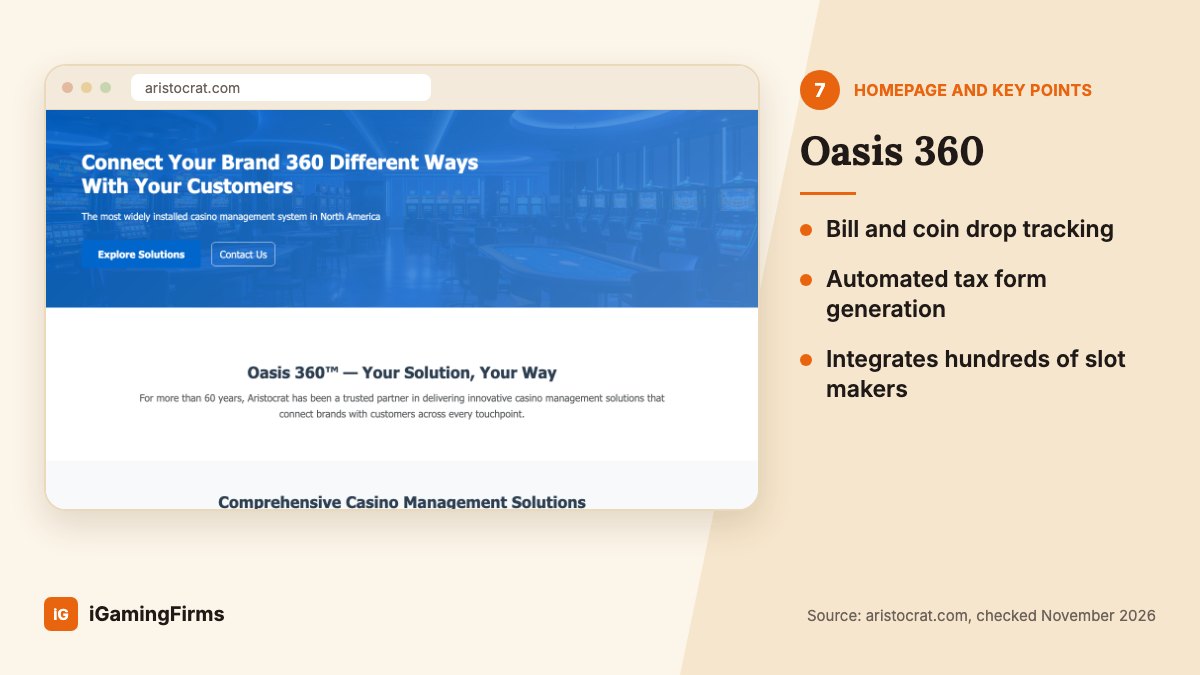
Oasis 360 is the casino management system of Aristocrat’s land-based gaming business. Aristocrat describes it as covering slot accounting, voucher processing, jackpots and fills, real-time revenue tracking, bill and coin drop tracking, PersonalBanker transactions, audit tools and audit trails. Table operations cover the pit, markers and check cashing. Aristocrat also lists automated tax form generation and compliance reporting.
The company pitches an open architecture with links to POS, hotel property management and sports betting systems. That is useful for a resort, because food, beverage and room revenue can be reconciled against player comps. A general ledger interface is not described publicly, so it belongs on your question list.
What to confirm: which tax forms are generated and for which jurisdictions. Also ask whether the W-2G trigger is a setting you control or a vendor release.
8. Win Systems (WIGOS)
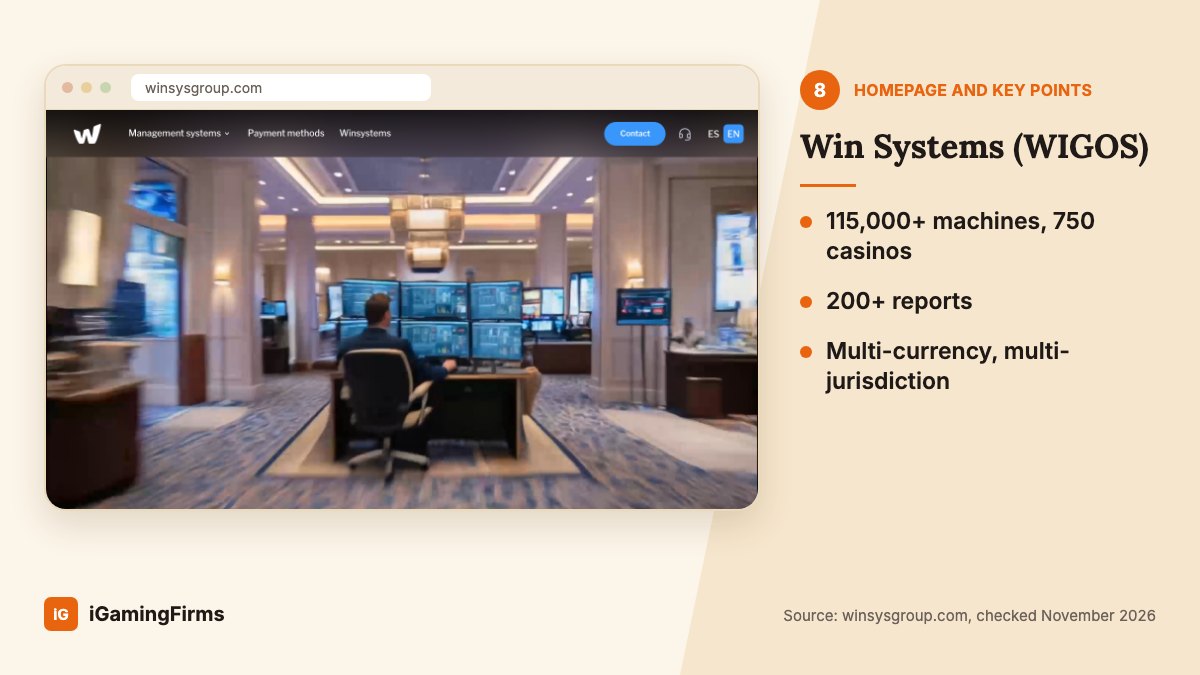
Win Systems is a Barcelona-based supplier whose Wigos platform centralises machine, player, table, cashier and jackpot data. The company says it has offices in Argentina, Mexico and the US and more than 115,000 connected machines in about 750 casinos. Its Winstats reporting tool is described as offering more than 200 reports across machines, tables, cashier, players, campaigns and jackpots, with support for regulatory compliance and money laundering prevention.
Wigos Collect manages cash collection and flags discrepancies. Wigos ONE is described as multi-currency and built for international regulation, which is the main reason a Latin American or multi-country group would shortlist it.
What to confirm: the company says Wigos connects through proprietary APIs and standard protocols. Ask whether your ERP is already on that list and how multi-currency results are converted before they post.
9. Sage Intacct
Sage Intacct is a cloud ERP that Sage markets to multi-entity casino operators and franchise groups. It is not a floor system. Its casino page lists dimensional reporting by location, gaming area, food and beverage or department, real-time monitoring of slot revenue and gaming margins, audit trails, role-based approvals and automated AP invoice intake across properties. It automates multi-entity consolidation and offers standard charts of accounts for onboarding new sites.
Sage says Intacct links with property management, POS and casino gaming systems through open APIs and integration partners. Its Copilot AI feature is pitched at surfacing risks and outliers. Pricing is by consultation. Pair it with any CMS above when your problem is consolidation and AP, not meters.
10. Arctic IT
Arctic IT sells casino accounting built on Microsoft Dynamics 365 Finance and Supply Chain Management, aimed largely at tribal gaming. It puts gaming, hotel, retail and food and beverage revenue in one ledger with AP/AR, procurement, banking and cash management, fixed assets, Power BI reporting and AI-driven account reconciliation.
Arctic IT names Snoqualmie Casino and Santa Ana Star Casino Hotel as clients, the latter moving off a legacy on-premises system. Costs have two parts: Dynamics 365 subscriptions billed per user per month and implementation services. The company puts typical implementations at 6 to 18 months, which is a useful planning number for any ERP change.
11. Ensico
Ensico is a casino management vendor based in Ljubljana, Slovenia. Its accounting module covers cage accounting for tickets, cashless, coins, handpays and jackpot payouts with multi-currency support and dynamic conversion rates. It offers real-time gaming machine accounting with history records, bill stacker tracking with clearance analysis and crosscheck validation. Detailed shift reports sit on top. Ensico says it has 20 years of experience filtering machine data. It suits European slot venues that want cage and machine accounting without a large US-style suite.
How cage, drop and count accounting works
The cage is the casino’s bank. Every chip, ticket, fill, credit and marker passes through it. It must balance by shift. For tribal operations, the National Indian Gaming Commission’s minimum internal control standards in 25 CFR Part 543 spell out what the software has to support:
- Drop and count (§ 543.17): counts are done by at least two agents (three for the largest tier), count team members rotate and are independent of the department counted. The cage agent receiving the drop must not know the total before verifying it.
- Cage and vault accountability (§ 543.18): all cage transactions are summarised each shift with documentation. Inventories are counted by two agents and signed. Variances are documented and investigated.
- Kiosks: reconciliation reports must be available on demand by day, shift and drop cycle.
- Front money: patron deposits are reconciled at least daily.
In software terms, you want blind count entry, shift-level cage balancing, variance thresholds that force a reason code and a report that ties drop to win by device.
Slot accounting and jackpot tax forms
Slot accounting compares three numbers for each machine: what the meters say, what the count room found and what tickets and handpays took out. The CMS polls meters, the revenue auditor investigates differences and the net figure becomes win. m3t’s claim of 80 meters every seven seconds and IGT’s task-based audit checklists are both aimed at narrowing that gap.
Handpays are where tax enters. According to the IRS, the minimum W-2G threshold for payments made in 2026 is $2,000 and will be adjusted for inflation each year. Regular 24% gambling withholding does not apply to bingo, keno or slot winnings, but backup withholding at 24% does if the winner gives no correct taxpayer ID. Winnings paid to nonresident aliens are generally reported on Form 1042-S with 30% withholding, apart from table games such as blackjack, baccarat, craps and roulette, which are exempt. Your jackpot module should hold these rules as settings with an effective date, not as hard-coded values.
GGR and gaming-tax reporting
Gaming tax is levied on a defined revenue figure. The definition varies. Nevada’s NRS 463.0161 defines gross revenue as cash received as winnings, contest and tournament entry fees and payments on gaming credit, less cash paid out as losses to patrons and certain prize and periodic-payment amounts. Counterfeit chips, foreign coins and uncollected baccarat commissions are excluded.
The practical issues for your software are timing and deductions. Free-play credits, comps, progressive jackpot accruals and wide-area jackpot contributions may or may not reduce taxable revenue depending on the state or country. A good system lets you configure each deduction per jurisdiction and produces the regulator’s return straight from audited data, rather than from a spreadsheet built after the fact. Ask each vendor to show the tax return for your jurisdiction from the demo database.
Title 31, CTR and SAR in the US
US casinos and card clubs fall under the Bank Secrecy Act rules in 31 CFR Part 1021, usually called Title 31. The numbers your system must handle:
- Currency transaction reports: file for each transaction in currency of more than $10,000, cash in or cash out (§ 1021.311). Multiple transactions by or for the same person in one gaming day are aggregated (§ 1021.313).
- Suspicious activity reports: required where a transaction involves or aggregates at least $5,000 and you suspect illegal activity or structuring. File within 30 calendar days of detection and keep records for five years (§ 1021.320).
- Records: extensions of credit over $2,500 and certain instruments of $3,000 or more must be logged (§ 1021.410).
- Program: a written compliance program with internal controls, independent testing, training and a named compliance officer (§ 1021.210).
This is why aggregation across cage, slots, tables and MTLs matters. Konami’s SYNK31 and Everi’s Entegrity both automate it. Check that late edits to an MTL trigger a review, as Entegrity’s “Potential Edits” alert does. For the customer identity side, our guide to iGaming KYC requirements covers what online operators must collect.
AML reporting outside the US
Outside the US the logic is similar but the thresholds differ. In Great Britain, regulation 27 of the Money Laundering Regulations 2017 requires casinos to apply customer due diligence on stakes or collected winnings of £2,000 or more. Uncollected winnings that are re-staked are not counted. Across the EU, the new Anti-Money Laundering Regulation (EU) 2024/1624 replaces national rules from 10 July 2027, so systems sold into Europe will need their thresholds and record fields reviewed before then. Win Systems’ and DRGT’s multi-country footprints make this a direct question for them.
Online GGR reconciliation with PAM and payment providers
None of the eight original CMS vendors is built for online-only operators. Online, the player account management (PAM) platform takes the role of slot meters and the count room. It records every bet, win, bonus and wallet movement, which gives you the player-side view of GGR.
Finance then runs a three-way reconciliation:
- PAM to game providers: bets and wins per game round must match each studio’s or aggregator’s statement, because supplier fees are billed on those figures.
- PAM to payment providers: deposits and withdrawals in player wallets must match settlements from your payment providers, after fees, chargebacks and currency conversion.
- Payment provider to bank: settlement reports must match what actually lands in the operator account.
Common breaks are day cut-off timing (UTC against local time), bonus money counted as cash and chargebacks posted to the wrong period. An ERP such as Sage Intacct or Dynamics 365 can hold the result, but the matching logic usually lives in the platform’s reports or a dedicated reconciliation tool. Our comparison of online casino software platforms shows which platforms bundle back-office finance reports.
Audit trails and revenue audit
Tribal MICS give a clear benchmark for audit design. Under 25 CFR 543.23, operations must keep accurate, complete and permanent records of all gaming revenue transactions. Internal auditors independent of the departments they audit must review each department at least annually. Under § 543.24, revenue audits are done by agents independent of the transactions and supporting records are reconciled daily.
Translated into software requirements: every adjustment carries a user, time stamp and reason. Revenue auditors get read-only access to the data they test. Post-audit corrections flow to the ledger as separate entries rather than overwrites. Sage lists role-based approvals and audit trails. Aristocrat lists audit trails for Oasis 360. Ask every vendor to show you an adjustment history for one machine day.
Certifications, approvals and named clients
A gaming system is approved per jurisdiction, usually after testing by an independent lab, so a vendor’s licence in one state tells you little about yours. Of the vendors here, CasinoTrac publicly claims NV Tech Standard 3 compliance for its accounting module. The others do not publish a jurisdiction list, which does not mean they lack approvals. Ask for the certificate numbers and the lab that issued them. Our testing labs comparison explains what each type of certificate covers.
Named clients that could be verified from vendor pages or filings are Barton’s Club 93 for CasinoTrac plus Snoqualmie Casino and Santa Ana Star Casino Hotel for Arctic IT. Ask the other vendors for a reference site that runs the same ERP you do.
What does a casino accountant do?
A casino accountant turns floor activity into audited financial statements. Daily work covers reviewing the revenue audit, reconciling the cage and vault, booking drop and win, accruing progressive and jackpot liabilities and posting comps and promotional costs. Monthly work adds gaming tax returns, regulator reports, bank reconciliations and the close. Compliance staff, often in a separate team, handle Title 31 reports, KYC reviews and SAR decisions. Software reduces the keying, but the accountant still owns the variance investigation.
What are the top 3 accounting software options for a casino?
For the ledger itself, the casino-specific options here are built on Sage Intacct and Microsoft Dynamics 365, which are the two ERPs whose vendors or partners publish casino pages. The third choice is not an ERP at all: it is the accounting module inside your CMS, such as SYNKROS, Oasis 360 or CasinoTrac, which feeds whichever ledger you pick. Generic small-business packages can keep the books for a very small venue, but they hold none of the gaming detail an auditor or regulator will ask for.
What is the best accounting software for a casino hotel?
A casino resort has three revenue engines: gaming, rooms and food and beverage. The cleanest setup feeds each source system (CMS, hotel property management system and POS) into one ERP with a department or location dimension. Arctic IT’s Dynamics 365 setup puts gaming, hotel and retail revenue in one ledger. Sage Intacct offers dimensional reporting by gaming area and food and beverage. On the CMS side, Oasis 360’s POS and hotel links help when comps are redeemed in restaurants or rooms.
What is iGaming software?
iGaming software runs online casino, sportsbook, poker and lottery products. Its core is a PAM holding accounts, wallets, bonuses and transaction history, surrounded by game content, payments, KYC, CRM and reporting. Many suppliers in our list of casino software providers serve both online and land-based operators.
What are the five functional areas of casino operations?
There is no official list, but operations are commonly split into gaming (slots, tables and the floor), finance and cage (count room, revenue audit, accounting and compliance), security and surveillance, marketing and player development and hospitality. Accounting software touches all five, which is why it usually sits inside the CMS.
W-2G thresholds, ledger links and AML limits
The 2026 W-2G threshold. The IRS minimum for payments made in 2026 is $2,000, indexed after that. Any process still built around “W-2G at $1,200” is out of date. A system that cannot change the threshold by setting and effective date will create needless forms and handpay delays.
The ledger bridge. Casino accounting products sit in one of two layers, the casino management system or the ERP, and buyers need to know which. Only Everi (for a retail cash product) and Sage describe a link to a general ledger or to gaming systems at all. The posting method is the question that decides your close, so put it first.
AML thresholds differ by market. Britain’s casino due diligence threshold is £2,000 under regulation 27, while US CTR aggregation starts above $10,000. The EU’s single AML rulebook applies from July 2027. A system sold as “AML ready” needs to show you the threshold it uses for your market.
Questions to put in writing before you sign
- Does the system keep its own ledger or export journals to ours? Which ERPs have live connections today?
- Is posting summary by day and property, or detailed by machine, table and revenue type?
- Who maps gaming revenue, free play, jackpot liabilities and revenue-share payables to our chart of accounts?
- How do post-audit adjustments reach the ledger? Can we trace each one to a user?
- Which jurisdictions’ tax returns and AML thresholds are configured now? Who changes them when the law moves?
- What happens to our audit history if we leave? In what format do we get it?
Your next step
Decide which layer you are buying first. If your problem is floor accuracy, shortlist two or three CMS vendors and ask each to run a full gaming day from meters to tax return in the demo. If your problem is the close, shortlist an ERP and ask your CMS vendor for a mapped journal export. In both cases, send the six questions above in writing and make the answers part of the contract.