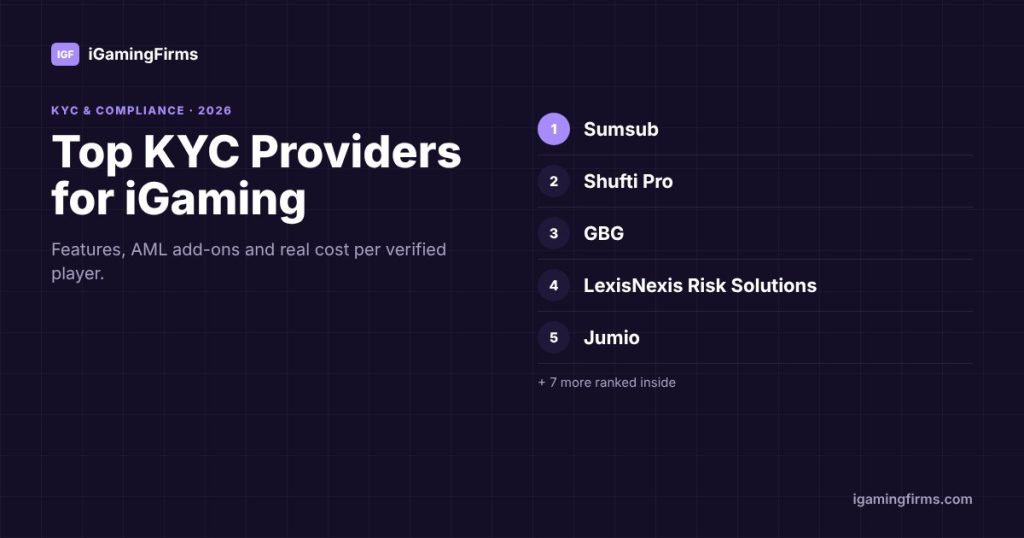
The short answer: Sumsub, Shufti Pro and GBG are the strongest KYC providers for iGaming operators in 2026 on public evidence, with LexisNexis Risk Solutions, Jumio and Veriff close behind. Trulioo, Entrust (formerly Onfido), IDnow, iDenfy and Didit each fit specific markets or budgets, and ComplyAdvantage is a strong AML screening layer to pair with any of them.
The right choice depends on three things: whether the vendor covers the verification methods your markets require, how it bills (per attempt or per verified player), and how much of your AML and responsible gambling checks it handles out of the box. Get KYC wrong and you face regulator fines; make it too heavy and genuine players abandon sign-up before their first deposit.
This guide compares twelve vendors, shows what a verified player really costs on each pricing model, maps market rules to the KYC features you need to buy, and lists the questions to ask before you sign. If you need the regulator rules themselves, jurisdiction by jurisdiction, read our companion guide to iGaming KYC requirements by jurisdiction; this page is about the vendors.
Everything here comes from each vendor’s own documentation, pricing pages and case studies, third-party review sites like G2, trade coverage, and primary regulatory texts, and none of the vendors paid to be included.
Top KYC providers for iGaming 2026 at a glance
| # | Provider | Best for | Pricing | Standout strength |
|---|---|---|---|---|
| 1 | Sumsub | Operators that want KYC, AML and RG flags in one platform with public pricing | From $1.35 per verification | All-in-one scope, billed only on successful checks |
| 2 | Shufti Pro | Operators needing self-exclusion and source-of-funds workflows built in | From $1.50 per verification | GAMSTOP, CRUKS and Spelpaus integrations (vendor) |
| 3 | GBG | UK operators that want silent age checks and affordability screening | Quote only | Database verification plus affordability and vulnerability checks |
| 4 | LexisNexis Risk Solutions | Large operators that need deep AML and affordability data | Quote only | RiskNarrative with WorldCompliance screening and RG scoring |
| 5 | Jumio | Tier-1 operators needing proven scale for peak events | Quote only | Strongest adoption claim among European operators |
| 6 | Veriff | Operators wanting fast automated checks and transparent pricing | From $0.80 per verification | Published tiers with AML add-ons |
| 7 | Trulioo | Global operators needing database and eID coverage | Quote only | Broad eIDV, eID and age estimation |
| 8 | Entrust (Onfido) | Operators wanting document and biometric checks with workflow tools | Quote only | Established document and selfie verification |
| 9 | IDnow | Operators focused on Germany and France | Quote only | AutoIdent and VideoIdent for DACH markets |
| 10 | iDenfy | Budget-conscious operators wanting pay-for-approved pricing | From $1.35 per verification | Transparent add-ons and enterprise pricing from $0.50 |
| 11 | Didit | Start-ups and cost-led operators | $0.33 KYC bundle, 500 free checks a month | Lowest published price |
| 12 | ComplyAdvantage | Operators adding a dedicated AML screening layer | Quote only | Sanctions, PEP and adverse media screening and monitoring |
List prices were re-checked on 15 October 2026. Most vendors negotiate at volume, so treat them as a starting point.
Feature matrix: what each vendor documents publicly
“Yes” means the vendor documents it on its own site. “Partial” means a related capability or a feature limited to certain plans. “Not stated” means we could not find public documentation, which does not prove it is missing.
| Provider | Document + liveness | Database / eIDV | eID schemes | Age estimation | AML screening | Ongoing monitoring | Affordability / SoF | Public pricing |
|---|---|---|---|---|---|---|---|---|
| Sumsub | Yes | Yes | Partial | Yes | Yes | Yes | Not stated | Yes |
| Shufti Pro | Yes | Yes (Enterprise) | Partial (NFC) | Yes | Yes | Yes | Partial | Partial |
| GBG | Partial | Yes | Not stated | Yes | Yes | Not stated | Yes | No |
| LexisNexis Risk | Yes | Yes | Not stated | Not stated | Yes | Yes | Yes | No |
| Jumio | Yes | Not stated | Not stated | Not stated | Not stated | Not stated | Not stated | No |
| Veriff | Yes | Not stated | Not stated | Not stated | Yes (add-on) | Yes (add-on) | Not stated | Yes |
| Trulioo | Yes | Yes | Yes | Yes | Partial | Not stated | No | No |
| Entrust (Onfido) | Yes | Not stated | Not stated | Not stated | Partial | Partial | Not stated | No |
| IDnow | Yes | Not stated | Partial | Not stated | Not stated | Not stated | Not stated | No |
| iDenfy | Yes | Not stated | Not stated | Not stated | Yes (add-on) | Yes (Enterprise) | Not stated | Yes |
| Didit | Yes | Yes | Not stated | Yes | Yes | Yes | Not stated | Yes |
| ComplyAdvantage | No | No | No | No | Yes | Yes | No | Not stated |
Two gaps stand out. Very few vendors publicly document affordability and source-of-funds checks, which UK operators now need at fairly low deposit levels, and AML screening is often an add-on rather than part of the base price. Both change your real cost, so check them early.
What does a KYC provider do for an iGaming operator?
A KYC provider verifies that a player is who they claim to be, is old enough to gamble, and is not barred, sanctioned or politically exposed, then keeps checking as the relationship continues. In iGaming that usually covers five jobs:
- Identity and age verification. Document and selfie checks with liveness, database (eIDV) checks or national eID schemes, depending on the market.
- Self-exclusion checks. Querying national registers such as GAMSTOP, CRUKS, OASIS or Spelpaus at registration and, in some markets, at every login.
- AML screening. Sanctions, politically exposed person (PEP) and adverse media checks, with ongoing monitoring.
- Affordability and source of funds. Financial risk checks and documentation as deposits grow.
- Duplicate and fraud signals. Catching multi-accounting and synthetic identities. Device and bonus-abuse tools are covered in our iGaming fraud detection guide.
Most vendors now recommend a layered, risk-based flow: a silent database check first, document and selfie checks only when the data check fails or risk rises, and ongoing screening in the background. That keeps friction low for the majority of genuine players while still giving you an audit trail.
How much do KYC providers cost per verified player?
Headline per-check prices are misleading on their own. What changes your bill is whether the vendor charges per attempt or per verified player, and whether AML screening and monitoring are included or sold as add-ons.
Assumptions for this illustration: 10,000 sign-ups, 1.3 verification attempts per sign-up because of retries (13,000 attempts), and 85% ending as verified players (8,500). AML screening is charged once per verified player. Monthly minimums are ignored. The 1.3 and 85% figures are illustrative, not industry benchmarks, so plug in your own.
| Vendor and plan (list price) | How it is billed | Total | Per verified player |
|---|---|---|---|
| Sumsub Compliance, $1.85 (AML and monitoring included) | Successful verifications only: 8,500 × $1.85 | $15,725 | $1.85 |
| Veriff Essential, $0.80 + PEP and sanctions $0.64 + monitoring $0.09 | 13,000 × $0.80 + 8,500 × $0.73 | $16,605 | $1.95 |
| Shufti Pro Essentials, from $1.50 (AML included) | Billing basis not stated: 8,500 × $1.50 if per success, 13,000 × $1.50 if per attempt | $12,750 to $19,500 | $1.50 to $2.29 |
| iDenfy Basic, $1.35 + PEP and sanctions $0.45 | 13,000 × $1.35 + 8,500 × $0.45 | $21,375 | $2.51 |
| Didit, $0.33 bundle + AML $0.20 + monitoring $0.07 | 500 free, then 12,500 × $0.33 + 8,500 × $0.27 | $6,420 | $0.76 |
The lesson: a vendor with a higher headline price but success-only billing and AML included can cost less than a cheaper per-check price once retries and add-ons are counted. Raise the retry rate to 1.5 and per-attempt pricing gets noticeably more expensive, while success-only pricing stays flat. Enterprise vendors such as Jumio, GBG and LexisNexis do not publish prices, so ask them to quote against this same scenario.
How this list was built
We started from the vendors in the current Google results and the comparison pages ranking for this topic, most of which are written by KYC vendors or affiliate sites, then checked each vendor against the same criteria:
- Verification coverage and methods: documents, countries, eIDV, eID schemes and age estimation.
- AML and iGaming compliance features: screening, monitoring, self-exclusion, affordability and source of funds.
- Conversion and speed: documented verification times and automation.
- Evidence of operator adoption: named iGaming clients and case studies.
- Pricing transparency: whether pricing is published.
Sources checked: vendor websites and pricing pages, G2 and Trustpilot, press releases and trade coverage, and primary texts from the UK Gambling Commission, Brazil’s Secretariat of Prizes and Bets, the Netherlands’ KSA, Germany’s GGL, Ontario’s AGCO and Sweden’s Spelinspektionen. Trustpilot scores for KYC vendors mostly come from players who were rejected or delayed, not from operators, so we do not rely on them. We did not run test verifications, and no vendor reviewed this article before publication.
How the ranking was decided
Each vendor was graded on the strength of public evidence for five weighted criteria: verification coverage and methods (25%), AML and iGaming compliance features (25%), conversion and speed (20%), operator adoption in iGaming (20%) and pricing transparency (10%). “Strong” means detailed public documentation backed by third-party sources or named regulated clients, “Documented” means the vendor documents it, and “Limited” means little or no public detail.
| # | Provider | Coverage (25%) | AML and iGaming (25%) | Conversion (20%) | Adoption (20%) | Pricing (10%) |
|---|---|---|---|---|---|---|
| 1 | Sumsub | Strong | Strong | Documented | Documented | Strong |
| 2 | Shufti Pro | Strong | Strong | Documented | Documented | Documented |
| 3 | GBG | Strong | Strong | Documented | Documented | Limited |
| 4 | LexisNexis Risk | Strong | Strong | Documented | Documented | Limited |
| 5 | Jumio | Strong | Documented | Documented | Strong | Limited |
| 6 | Veriff | Strong | Documented | Documented | Documented | Strong |
| 7 | Trulioo | Strong | Documented | Documented | Limited | Limited |
| 8 | Entrust (Onfido) | Documented | Documented | Documented | Documented | Limited |
| 9 | IDnow | Documented | Documented | Documented | Documented | Limited |
| 10 | iDenfy | Documented | Documented | Documented | Limited | Strong |
| 11 | Didit | Documented | Documented | Documented | Limited | Strong |
| 12 | ComplyAdvantage | Limited | Strong | Documented | Limited | Limited |
Where grades tie, iGaming adoption decided the order, then UK gambling focus. ComplyAdvantage ranks last because it screens rather than verifies identity; it is best read as an add-on layer, not a competitor to the others. Vendors can change a grade by publishing the missing documentation.
The 12 best KYC providers for iGaming reviewed
1. Sumsub
Sumsub is an all-in-one verification platform covering KYC, AML and transaction monitoring, with a dedicated gaming product and one of the few public price lists in this category.
- Best for: operators that want identity, AML and responsible gambling red flags handled by one vendor with predictable pricing.
- Coverage (vendor claims): 220+ countries, document and liveness checks, non-document verification through ID numbers, bank and government apps, and age estimation from a liveness scan.
- AML and iGaming: watchlist and PEP screening, ongoing monitoring, transaction monitoring, and RG red flags such as deposits above declared salary and self-exclusion breaches. The vendor claims a 75%+ reduction in duplicate accounts and 30-second average verification.
- Clients (vendor claim): testimonials from Kaizen Gaming and Rivalry. Sumsub is also an associate member of the European Gaming and Betting Association.
- Pricing: Basic $1.35 per verification with a $149 monthly minimum; Compliance $1.85 with a $299 minimum, including AML screening, monitoring and address checks. Billed only for successful verifications.
- What users say: G2 4.6/5 from about 128 reviews. Its low Trustpilot score (1.2/5) comes mainly from players whose documents were rejected, not from operators.
- Watch for: affordability and source-of-funds tooling is not described publicly.
2. Shufti Pro
Shufti Pro publishes the most explicit iGaming feature set of any vendor here, from self-exclusion register checks to source-of-funds triggers.
- Best for: UK and European operators that want self-exclusion and financial risk workflows built into KYC.
- iGaming features (vendor claims): GAMSTOP, CRUKS and Spelpaus integrations with daily re-checks, source-of-funds workflows triggered at UK financial-risk thresholds, 1:N face matching to catch duplicates, NFC passport reading, document-free eIDV and age estimation.
- AML: screening against 4,000+ watchlists, 215+ sanctions regimes and 50,000 adverse media sources.
- Certifications: iBeta Level 3 liveness (May 2026), SOC 2 and PCI DSS.
- Clients (vendor claim): Penn National, White Hat Gaming and BigCash.
- Pricing: a free tier with 10 checks a month, Essentials from $1.50 per verification including AML screening and age checks, and custom Enterprise plans that add eIDV.
- What users say: G2 4.5/5 from 154 reviews. Ask for gaming-specific references to confirm the self-exclusion register integrations in your markets.
- Watch for: the billing basis (per attempt or per success) is not stated publicly.
3. GBG

GBG is a UK-listed identity data company with long roots in UK gambling, best known for database verification that confirms identity and age without asking the player for documents.
- Best for: UK-led operators that want silent age and identity checks plus affordability and vulnerability screening.
- Features: identity confidence scoring, silent age checks, PEP, sanctions and adverse media screening, affordability screening using bad debt and insolvency data, a shared trust network (GBG Trust) to spot bonus abuse, and vulnerability screening. GBG says it covers 195+ countries.
- Clients (vendor claims): NSUS Group, which GBG says achieved a 30% uplift in genuine player pass rates, and Atlantic Lottery, whose pass rate GBG says rose from 68% to 82%.
- Pricing: quote only.
- What customers say (from GBG’s site): case studies focus on pass rates and reducing manual document requests.
- Watch for: self-exclusion register integrations are not detailed on its gaming page.
4. LexisNexis Risk Solutions

LexisNexis Risk Solutions, part of RELX, combines identity verification, AML data and gambling-specific financial risk checks in its RiskNarrative platform. It completed its acquisition of document verification firm IDVerse in February 2025.
- Best for: large regulated operators that need the deepest AML and affordability data in one orchestrated platform.
- Features: eIDV in hundreds of countries, document and selfie checks, WorldCompliance and Bridger screening for PEPs, sanctions, adverse media and close associates, plus affordability, income and financial distress checks and a dynamic responsible gambling score.
- Fraud: its ThreatMetrix device intelligence is covered in our fraud detection guide.
- Pricing: quote only.
- What customers say (from LexisNexis’s site): materials focus on combining identity, AML and affordability decisions in one workflow.
- Watch for: enterprise pricing and implementation effort can be heavy for smaller operators.
5. Jumio

Jumio is a California-based identity verification company with the strongest public adoption claim in European gaming.
- Best for: tier-1 operators that need proven scale during peak events.
- Adoption (vendor claims): 9 of the top 10 European gaming operators, several large US sportsbooks, and tens of millions of transactions during the 2026 World Cup. Named gaming clients include WINBET Romania (January 2026), Bet do Milhão in Brazil and Casumo, which reported an 80% increase in KYC handling capacity.
- Features: document and biometric verification with liveness at global scale.
- Pricing: quote only.
- What users say: G2 4.1/5 from 34 reviews. Ask for gaming references in your target markets.
- Watch for: AML screening, eIDV and affordability features are not detailed publicly for gaming.
6. Veriff
Veriff is an Estonian identity verification company with transparent published tiers and a dedicated gaming product. It acquired business verification specialist Vespia in February 2026.
- Best for: operators that want fast automated verification with clear pricing.
- Features: 12,500+ supported documents in around 50 languages, iBeta-conformant liveness, age, self-exclusion and sanctions checks, defences against multi-accounting and chip dumping, and passwordless return for verified players.
- Clients (vendor claim): case studies with Stake (Easygo) and Gana777.
- Pricing: Essential $0.80 per verification ($49 minimum), Plus $1.39 ($99 minimum) and Premium $1.89 ($209 minimum). PEP and sanctions screening costs $0.64 extra and ongoing monitoring $0.09. Enterprise pricing starts at 5,000 checks a month.
- What users say: G2 4.5/5 from 59 reviews. Player-facing complaints centre on selfie capture, worth testing on your own mobile flow.
- Watch for: AML is sold as add-ons, so compare total cost per verified player.
7. Trulioo

Trulioo is a Vancouver-based verification network known for global database and electronic ID coverage.
- Best for: operators expanding across many countries that need database, eID and document checks through one API.
- Features: KYC data checks, documents and biometrics, electronic ID, bank verification, age verification and estimation, and business verification (useful for vetting B2B partners and affiliates).
- Certifications: SOC 2 Type II and ISO 27001:2022.
- Pricing: quote only.
- What users say: G2 4.4/5 from 40 reviews. Users praise global coverage and the API; complaints include weaker match rates outside top markets, watchlist false positives and cost.
- Watch for: no named gaming clients are published.
8. Entrust (formerly Onfido)
Entrust completed its acquisition of Onfido in April 2024, bringing a well-known document and biometric verification product into its identity portfolio.
- Best for: operators wanting established document and selfie verification with a visual workflow builder.
- Features: document and biometric checks with liveness, workflow orchestration and watchlist screening options.
- Clients (vendor claim): Onfido served 1,200+ customers including gaming at the time of the acquisition; Soft2Bet is a named gaming client.
- Pricing: quote only.
- What users say: G2 4.4/5 from 155 reviews.
- Watch for: gaming-specific evidence has thinned since the acquisition, so ask for recent iGaming references.
9. IDnow
IDnow is a Munich-based verification provider, majority-owned by Corsair Capital since a $295 million deal in March 2025, with particular strength in Germany and France.
- Best for: operators licensed in Germany, France and neighbouring markets.
- Features: automated document and biometric verification (AutoIdent) and agent-led video verification (VideoIdent), plus eID options.
- Clients (vendor claim): Lottoland is a long-standing gaming client.
- Pricing: quote only.
- What customers say (from IDnow’s site): materials focus on regulatory acceptance in DACH markets.
- Watch for: confirm integrations with Germany’s OASIS and LUGAS systems directly.
10. iDenfy
iDenfy is a Lithuanian verification provider with transparent pricing and an option to pay only for approved verifications.
- Best for: cost-conscious operators that want document and liveness checks with clear add-on pricing.
- Features: document and liveness checks across 200+ countries, PEP and sanctions screening, 3D liveness and proof of address as add-ons, ongoing AML monitoring on Enterprise plans, and API, SDK or iFrame integration.
- Pricing: Basic $1.35 per verification ($135 minimum). PEP and sanctions add $0.45, pay-for-approved-only adds $0.50, 3D liveness $0.20 and proof of address $0.90. Enterprise pricing from $0.50.
- What users say: G2 4.9/5 from 241 reviews, one of the highest ratings in the category.
- Watch for: few named iGaming operator clients are published.
11. Didit

Didit is a low-cost verification provider that ranks prominently for this topic thanks to aggressive published pricing and a lot of self-published comparison content.
- Best for: start-ups and cost-led operators that need full KYC at the lowest list price.
- Features: ID verification, passive liveness, face match and device and IP checks in one bundle, AML screening, ongoing monitoring, age estimation and self-exclusion checks (vendor).
- Pricing: 500 free full-KYC checks a month (unused checks do not roll over), then $0.33 per bundle. AML screening $0.20, ongoing monitoring $0.07 per user per year and age estimation $0.10.
- What users say: G2 4.8/5 from 33 reviews.
- Watch for: some Didit blog pages describe core KYC as “unlimited free”, which does not match its own pricing page (500 free a month). No named iGaming clients are published, so validate regulatory acceptance in your markets.
12. ComplyAdvantage
ComplyAdvantage is an AML screening and monitoring specialist rather than an identity verification vendor. Operators typically pair it with a document or database KYC provider.
- Best for: operators that want a dedicated, configurable AML layer alongside their KYC vendor.
- Features: sanctions, PEP and adverse media screening with ongoing monitoring and risk scoring.
- Pricing: quote only.
- What users say: G2 4.3/5 from 96 reviews.
- Watch for: it does not verify identity or age, so it cannot be your only KYC vendor.
Other options worth knowing
- Signicat: strong in Nordic eID schemes such as BankID and MitID, and acquired NFC specialist Inverid in July 2025.
- Experian: credit and identity data with affordability use cases, and acquired KYC360 in October 2025.
- Persona, Incode, Au10tix and Ondato: credible identity platforms with less published iGaming evidence.
- GeoComply: essential for US geolocation compliance rather than KYC; see our fraud detection guide.
Which KYC features does each market force you to buy?
Regulators decide which verification methods and registers your vendor must support. The table below translates the main rules into vendor features; the full rule set for each regulator, including documents, timing and thresholds, is in our KYC requirements guide.
| Market | The rule in brief | What your KYC provider must support |
|---|---|---|
| UK | Age and identity verified before any gambling, including free-to-play. Financial vulnerability checks from £150 net deposits in a rolling 30 days. GAMSTOP checks. | Fast eIDV or document checks at sign-up, GAMSTOP integration and affordability screening |
| New Jersey and other US iGaming states | Players must be 21+, identity verified before the account is used for gaming, and play allowed only inside the state. | US database checks (name, address, date of birth, SSN), state exclusion lists, plus a separate geolocation provider |
| Ontario | Players must be 19+, with identity verified before an account is created and authenticated before play. | Pre-account verification with Canadian data and document coverage |
| Netherlands | CRUKS exclusion register check, with exclusions lasting at least six months. | CRUKS integration at registration and login |
| Germany | OASIS exclusion file and LUGAS limit system. Default cross-operator deposit limit of €1,000 a month; higher limits need proof of income. | OASIS and LUGAS connectivity and income documentation workflows |
| Sweden | Spelpaus check at registration and every login. | Spelpaus integration and Swedish eID (BankID) support |
| Brazil | Portaria SPA/MF 722/2024: players 18+, CPF validation and facial recognition before registration, re-authentication after inactivity. | CPF database checks, facial biometrics and step-up authentication |
Primary sources for the UK rows: the Gambling Commission’s age and identity verification rules and financial vulnerability checks. If you are still choosing where to license, our UKGC licence guide and gambling licence cost comparison show how each regulator’s KYC burden fits into the wider licensing picture.
How do KYC providers integrate with your platform?
Most operators do not call a KYC vendor directly from the front end. The vendor plugs into your player account management (PAM) system, which triggers checks at registration, deposit, withdrawal and login, and stores the result against the player record.
- Integration options: nearly every vendor here offers a REST API plus web and mobile SDKs; some (iDenfy, Sumsub) also offer hosted or iFrame flows that cut front-end work.
- Pre-built connectors: ask whether your platform or white label provider already has a certified connector to the vendor. That usually saves more time than any feature difference.
- Orchestration: larger operators often run two vendors behind one workflow (for example a database vendor first, a document vendor as fallback), which is what LexisNexis RiskNarrative and Sumsub’s workflow builders are designed for.
- Payments link: name matching between the verified identity and the payment account is one of the simplest AML controls, so involve your payment provider early.
How to choose a KYC provider
- UK-led operator: shortlist GBG, LexisNexis and Shufti Pro for database checks, affordability and GAMSTOP.
- US-licensed operator: prioritise vendors with deep US identity data or US gaming references (LexisNexis and GBG, which owns US-based IDology, on data; Jumio, which claims several large US sportsbooks, on adoption) and budget separately for geolocation.
- Multi-market European operator: shortlist Sumsub, Jumio and Veriff, and add Signicat or IDnow for Nordic or German eID needs.
- Brazil: confirm CPF validation and facial recognition support with every vendor on your list.
- Start-up or Curaçao-licensed operator on a budget: compare Didit, iDenfy and Veriff Essential using the cost model above, and check what your Curaçao licence requires before choosing the cheapest option.
- Strong AML requirements: pair your KYC vendor with ComplyAdvantage or LexisNexis screening.
Questions to ask in every demo
- Are you billed per attempt or per verified player, and what is included in that price?
- What is your pass rate and average verification time for players in our markets?
- Which self-exclusion registers (GAMSTOP, CRUKS, OASIS, Spelpaus) do you integrate with natively?
- How do you handle affordability and source-of-funds checks, and at what thresholds?
- How do you detect duplicate accounts and synthetic identities across our brands?
- Which liveness and deepfake standards are you certified against?
- Do you have a ready connector for our PAM or platform provider?
- Where is player data stored, and can we export verification records for audits?
Red flags when choosing a KYC provider
- Pricing that looks cheap per check but bills every retry and charges AML separately.
- No native self-exclusion register checks for your licensed markets.
- No independent liveness certification.
- Verification flows that force document uploads where a silent database check would do.
- No audit trail you can hand to a regulator.
- Comparison content from a vendor that ranks itself first. Most pages ranking for this topic are written by KYC vendors or affiliate sites.
Next steps
Model your cost per verified player with your own retry and pass rates, shortlist three vendors, and test each on your real sign-up flow before signing. KYC connects closely to payments and fraud, so read our guides to iGaming payment providers and fraud detection as you design your onboarding, and check the KYC rules for each jurisdiction you plan to enter.