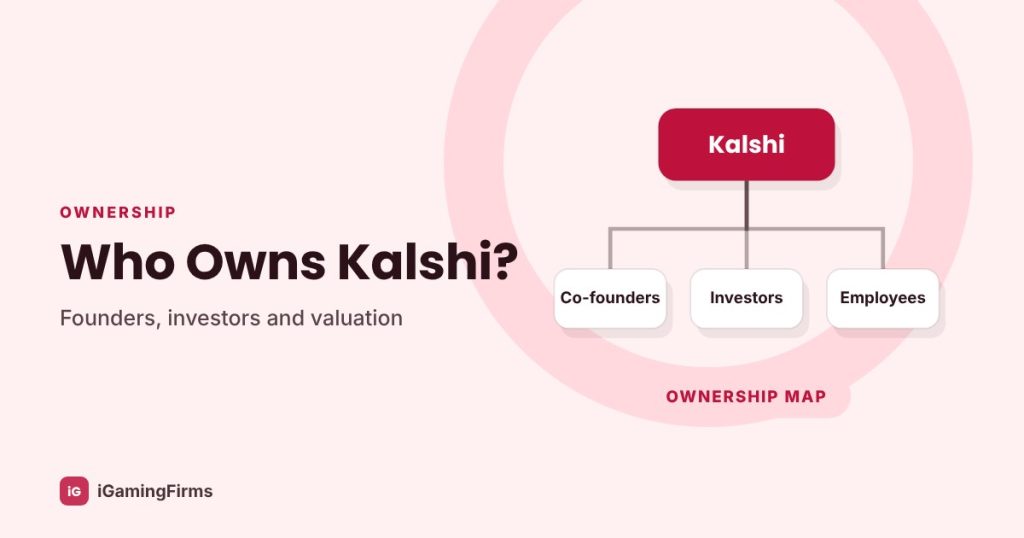
Kalshi is a private company owned by its two co-founders, CEO Tarek Mansour and COO Luana Lopes Lara, together with the venture firms and individuals that have funded it, led by Sequoia Capital, Paradigm, Andreessen Horowitz and Coatue. Kalshi has never published a cap table; Forbes estimates each founder holds roughly 12%, and the last closed round, in May 2026, valued the company at $22 billion, with a new round at about $40 billion reported as being finalised on 30 September 2026.
If you run a sportsbook, an affiliate site or an SEO team, the ownership question is more than trivia. It tells you who sits on the board, which legal entity a state is actually suing, how much capital is behind the company taking sports handle off regulated operators, and how close it is to a listing. This guide covers the corporate entities, the founders, every funding round with its source, the investor list, the valuation history against Polymarket, the board, the IPO question and what all of it means for your business.
Who owns Kalshi: the short version
Ownership splits into three groups, and only one of them has a published number.
- The founders. Tarek Mansour and Luana Lopes Lara each hold about 12%, according to Forbes estimates published on 7 May 2026. Kalshi has not confirmed the figure, so treat it as a reported estimate, not a disclosed stake.
- Venture investors. Sequoia Capital (an investor since the 2020 Series A), Paradigm (lead of the Series C and Series E), Andreessen Horowitz (co-lead of the Series D) and Coatue (lead of the May 2026 round) are the largest institutional names. None has disclosed a percentage.
- Individuals, employees and secondary buyers. Charles Schwab, Henry Kravis and Citadel Securities CEO Peng Zhao are among the named individual backers. Employees hold equity, and at least a dozen special purpose vehicles have filed with the SEC since 2022 to buy Kalshi shares, which means many smaller holders own Kalshi indirectly through funds.
Pages that say Kalshi is “owned by” Sequoia or by Donald Trump Jr. are wrong. No investor has a reported controlling stake, and Trump Jr. is an adviser, not a reported shareholder of size (more on that below).
The Kalshi entities: who you are actually dealing with
“Kalshi” is a brand used by several legal entities. When a state files a lawsuit, or when you sign a data or marketing agreement, the counterparty is one of these.
| Entity | What it does | Status and source |
|---|---|---|
| Kalshi Inc. | The Delaware parent company, incorporated in 2018. It issues the shares investors buy. | Form D filings with the SEC (CIK 1806928); address 416 West 13th Street, New York |
| KalshiEX LLC | The exchange. It lists the event contracts and is the defendant in most state lawsuits. | CFTC designated contract market (DCM) since November 2020 |
| Kalshi Klear LLC | The clearinghouse that holds customer funds and settles trades. | Registered by the CFTC as a derivatives clearing organization on 29 August 2024 |
| Kalshi Prime | A futures commission merchant launched in June 2026 to support margin-backed perpetual futures. | CFTC-registered FCM, per Kalshi’s 12 August 2026 announcement |
The CFTC’s registration order for Kalshi Klear describes KalshiEX as its affiliate, which confirms the two-entity split between exchange and clearing. Lawsuits in New Jersey, Nevada, Ohio and other states name KalshiEX LLC, not Kalshi Inc.
Who founded Kalshi?
Kalshi was founded in 2018 by Tarek Mansour and Luana Lopes Lara, who met as students at MIT. It went through Y Combinator’s Winter 2019 batch, received its CFTC designation in November 2020 and opened to the public in July 2021.
Tarek Mansour, co-founder and CEO
Mansour was born in California in 1996 and spent his early years in Lebanon, according to Kalshi’s own About page. He returned to the US in 2014, graduated from MIT in 2018 in mathematics and computer science, interned at Goldman Sachs and traded at Citadel before starting Kalshi. One of the pages ranking for this question calls him “Algerian-born”; Kalshi’s About page says otherwise.
Luana Lopes Lara, co-founder and COO
Lopes Lara was born in Belo Horizonte, Brazil, in 1996. She trained for eight years at the Bolshoi Ballet school in Joinville, studied computer science at MIT and interned at Bridgewater Associates and Citadel Securities. Her title is chief operating officer; one ranking page calls her president, which Kalshi has not used publicly.
Are the Kalshi founders billionaires?
Yes, on paper. Forbes put each founder’s net worth at about $2.6 billion after the May 2026 round, up from about $1.3 billion in December 2025, when it named Lopes Lara the world’s youngest self-made woman billionaire. That $2.6 billion is the answer Google currently gives for Tarek Mansour’s net worth, and it is simply 12% of a $22 billion valuation.
If the reported $40 billion round closes, a 12% stake would be worth about $4.8 billion before dilution from the new shares. That is an arithmetic estimate on Forbes’ stake figure, not a reported net worth.
Kalshi funding rounds: every round with its source
Kalshi has raised about $2.5 billion in primary capital across its announced rounds since 2020, not counting the round under negotiation in October 2026. The table below uses Kalshi’s SEC Form D filings where they exist, because they show the amount actually sold, and named news reports for leads and valuations.
| Date | Round | Lead | Amount | Valuation | Source |
|---|---|---|---|---|---|
| Winter 2019 | Accelerator | Y Combinator | Standard YC deal | Not disclosed | Y Combinator company page |
| March 2020 | Seed (including SAFE conversion) | Not disclosed | $6.1m | Not disclosed | Form D, first sale 4 March 2020 |
| Dec 2020 to Feb 2021 | Series A | Sequoia Capital | $30m | Not disclosed | Form D filed 23 February 2021; Neo, 19 February 2021 |
| June 2025 | Series C | Paradigm | $185m | $2bn | Bloomberg, 25 June 2025 |
| October 2025 | Series D | Sequoia and Andreessen Horowitz | $300m ($294.5m sold per Form D) | $5bn | Form D, first sale 8 October 2025; InterGame, 13 October 2025 |
| December 2025 | Series E | Paradigm | $1bn ($820.8m sold at filing) | $11bn | Kalshi, 2 December 2025; Form D, 4 December 2025 |
| May 2026 (reported from March) | Series F | Coatue | $1bn | $22bn | WSJ, 19 March 2026; Forbes, 7 May 2026 |
| Reported 30 Sept 2026 | Pre-IPO round (not closed) | Sequoia and Wellington Management (in talks) | About $1bn | About $40bn | Bloomberg and Reuters, 30 September 2026 |
Three notes on the table. First, no Series B has been announced; pages that list one give no amount, date or lead. Second, the $22 billion round was first reported by the Wall Street Journal as “ongoing” on 19 March 2026 and announced on 7 May 2026, which is why you will see both dates. Third, one data provider lists a $1.5 billion “Series G” in August 2026; no news report or filing found for this article supports that, so it is left out.
Has Kalshi raised money recently?
Yes. The last closed round was the $1 billion Coatue-led raise announced in May 2026. As of 10 October 2026, Kalshi is reported to be in final negotiations on a further round of about $1 billion at roughly $40 billion, co-led by Sequoia and Wellington Management, with Tiger Global and Dragoneer also expected to take part, according to Bloomberg’s 30 September report and Reuters. Kalshi had not announced a close when this article was updated.
Who are Kalshi’s investors?
Grouped by role, the named investors look like this.
- Lead venture investors: Sequoia Capital (Series A lead, Series D co-lead, in every major round since), Paradigm (Series C and Series E lead), Andreessen Horowitz (Series D co-lead), Coatue (Series F lead).
- Growth and crossover funds: Meritech Capital, IVP, CapitalG (Alphabet’s growth fund), ARK Invest, Anthos Capital, Morgan Stanley, plus Wellington Management, Tiger Global and Dragoneer if the current round closes as reported.
- Early and crypto-focused funds: Y Combinator, Neo, SV Angel, Multicoin Capital, Bond, Mantis VC, General Catalyst and Coinbase Ventures.
- Individuals: Charles Schwab and Henry Kravis (both in the Series A), Peng Zhao of Citadel Securities (Series C).
The Series E announcement is the most complete first-party list: Paradigm leading, with Sequoia, Andreessen Horowitz, Meritech, IVP, ARK Invest, Anthos, CapitalG and Y Combinator participating.
Robinhood, Coinbase and Webull are often listed as “Kalshi investors” on summary pages. They are distribution partners that route customer orders to Kalshi markets. Coinbase Ventures took part in the Series D, but none of the three brokers has a reported strategic stake.
Does Donald Trump’s son own Kalshi?
No reported ownership stake of any size. Donald Trump Jr. joined Kalshi as a strategic adviser on 13 January 2025. Reports in 2026 said the role came with equity, but neither Kalshi nor he has disclosed how much. He is also an adviser to Polymarket, where his venture firm 1789 Capital is a lead investor, so he is linked to both of the two largest US prediction markets. He does not appear as a director or executive officer on any of Kalshi’s Form D filings.
Kalshi valuation history, and how it compares with Polymarket
Kalshi’s valuation went from $2 billion in June 2025 to $22 billion in May 2026, an eleven-fold rise in under a year, and the reported pre-IPO round would take it to about $40 billion. PitchBook analysis cited by Fortune on 24 September 2026 put a possible value of up to $42 billion on Kalshi, but only if it survives the Supreme Court fight over state jurisdiction.
| Date | Kalshi valuation | Polymarket valuation (nearest round) |
|---|---|---|
| June 2025 | $2bn | About $1bn (2024 round) |
| October 2025 | $5bn | About $9bn post-money (ICE deal, 7 October 2025) |
| December 2025 | $11bn | About $9bn |
| April to May 2026 | $22bn | $15bn (April 2026) |
| Sept to Oct 2026 | About $40bn (in final talks) | $21bn (reported 31 August 2026, not confirmed closed) |
Polymarket held the higher valuation for a few months after Intercontinental Exchange’s investment in October 2025. Kalshi passed it in the December 2025 round and, on the reported numbers, would be worth almost twice as much if the current round closes. For the ownership side of the rival, see our breakdown of who owns Polymarket.
The valuations follow revenue. Kalshi told Forbes its annualised revenue topped $1.5 billion in May 2026. Bloomberg reported a run rate of about $4 billion as of August 2026, with gross margins near 90%, citing documents seen by investors. Kalshi claims more than 90% of US prediction market activity, and sports made up more than 70% of trading in May 2026.
How does Kalshi make money?
Kalshi charges a fee on each trade rather than taking the other side of bets. Its standard taker fee is 0.07 × number of contracts × price × (1 − price), rounded up, so a 100-contract trade at 50 cents costs $1.75. That model is why ownership and valuation track volume so closely: more contracts traded means more fee revenue, with no bookmaking risk on Kalshi’s balance sheet. Our Kalshi vs Polymarket comparison works through the fee formulas on the same trade.
Who runs Kalshi: leadership and board
Kalshi’s executives are Tarek Mansour (CEO) and Luana Lopes Lara (COO), who run an unusually flat company: Business Insider reported in July 2026 that more than 100 employees report to both founders directly. Jeff Bandman, a former CFTC division director who helped secure Kalshi’s 2020 designation, became CEO of Kalshi Prime in August 2026. Revelio Labs counted about 278 employees in March 2026.
The board has five members. Kalshi’s December 2025 Form D lists them as:
- Tarek Mansour, co-founder and CEO
- Luana Lopes Lara, co-founder and COO
- Alfred Lin, Sequoia Capital, on the board since the Series A (he is the only outside director on the February 2021 filing)
- Michael Seibel, Y Combinator
- Matt Huang, co-founder of Paradigm
With the founders holding two of five seats and the three outside directors each representing a different fund, no single investor controls the board. Kalshi has not disclosed whether the founders hold shares with extra voting rights.
Former CFTC commissioner Brian Quintenz sat on Kalshi’s board after leaving the agency. When President Trump nominated him to chair the CFTC in 2025, Quintenz said he would step down from the board if confirmed. The White House withdrew the nomination in autumn 2025, and he is not listed as a director on Kalshi’s October or December 2025 Form D filings.
Is Kalshi publicly traded, and can you buy Kalshi stock?
No. Kalshi Inc. is a private company with no stock exchange listing and no ticker symbol. Pages showing a “KALSHI” or “KLSH.PVT” quote are tracking private-market indications, not a listed share.
Kalshi shares do change hands privately. Secondary platforms such as Forge Global and Nasdaq Private Market publish indicative prices, and SEC filings show at least a dozen SPVs formed since 2022 to buy Kalshi stock, most of them in 2026. These are open only to accredited or institutional investors and depend on Kalshi’s consent to transfers. This is a description of the market structure, not investment advice.
Is Kalshi planning to go public?
An IPO is being prepared but has not been filed. Mansour told CNBC in June 2026 that Kalshi was considering a listing and ruled out a 2026 debut, and the reported $40 billion round has been described as its last private raise before an IPO, possibly in 2027. Until an S-1 is filed, the founders’ and investors’ exact stakes will stay undisclosed.
Kalshi’s regulatory position in brief
Ownership and valuation both rest on one legal question: whether Kalshi’s federal status overrides state gambling law.
- Federal status: KalshiEX is a CFTC-designated exchange, which is why Kalshi says it works like a regulated futures market rather than a sportsbook. In September 2024 a federal judge in Washington ruled for Kalshi against the CFTC over election contracts; the D.C. Circuit declined to pause that ruling in October 2024, and the CFTC dropped its appeal in May 2025.
- The circuit split: the Third Circuit sided with Kalshi against New Jersey in April 2026. The Ninth Circuit (28 August 2026, Nevada) and the Sixth Circuit (25 September 2026, Ohio and Tennessee) ruled that states can apply their gambling laws.
- Supreme Court: New Jersey’s petition, Flaherty v. KalshiEX (No. 26-299), was filed on 2 September 2026. Kalshi’s response is due on 9 November 2026, and amicus briefs from Ohio and other states, the NFL, the American Gaming Association and 145 tribes and tribal organisations were filed in early October.
For the state-level detail, see whether Kalshi is legal in California and our monthly iGaming regulation roundup.
What Kalshi’s ownership means for operators and affiliates
If you are an operator. Kalshi raised about $2.5 billion between June 2025 and May 2026, and its investors are pricing it as if sports event contracts survive in court. That capital funds sports league and team sponsorships, broker distribution and lobbying, all aimed at handle that would otherwise go to licensed sportsbooks. To see where a $22 to $40 billion private valuation sits against the listed groups, compare it with our list of the largest gambling companies by revenue.
If you are thinking about partnering. Kalshi’s growth runs through distribution: Robinhood and Webull act as futures commission merchants that route orders to Kalshi markets, Coinbase offers them too, and CNN, CNBC and Fox use Kalshi data. The partner leverage cuts both ways. Robinhood accounted for about 16% of Kalshi’s June 2026 volume, caps its own event-contract fees at 1 cent, and is reported to be building its own exchange. Any deal you sign is with KalshiEX or a broker, not with the investors in the table above.
If you are an affiliate or publisher. Large sports media groups, including CBS Sports, already run Kalshi promo-code pages, so the affiliate channel exists. The risk sits with the promoter. States suing Kalshi treat its sports contracts as illegal betting, and the CFTC was reported in September 2026 to be preparing action on misleading prediction-market promotions. Check which states your traffic comes from, and do not market to anyone under 21 in states where that is the betting age, even though Kalshi accepts users at 18.
If you are an SEO or content lead. This topic changes every quarter. The facts most likely to move next are the close of the $40 billion round, the Supreme Court’s decision on whether to hear Flaherty v. KalshiEX, and an S-1 filing that would finally disclose the cap table. Date-stamp every number you publish.
Next step
Kalshi’s ownership will only become fully public when it files to list. Until then, the useful signals are its Form D filings, its funding announcements and the Supreme Court docket.