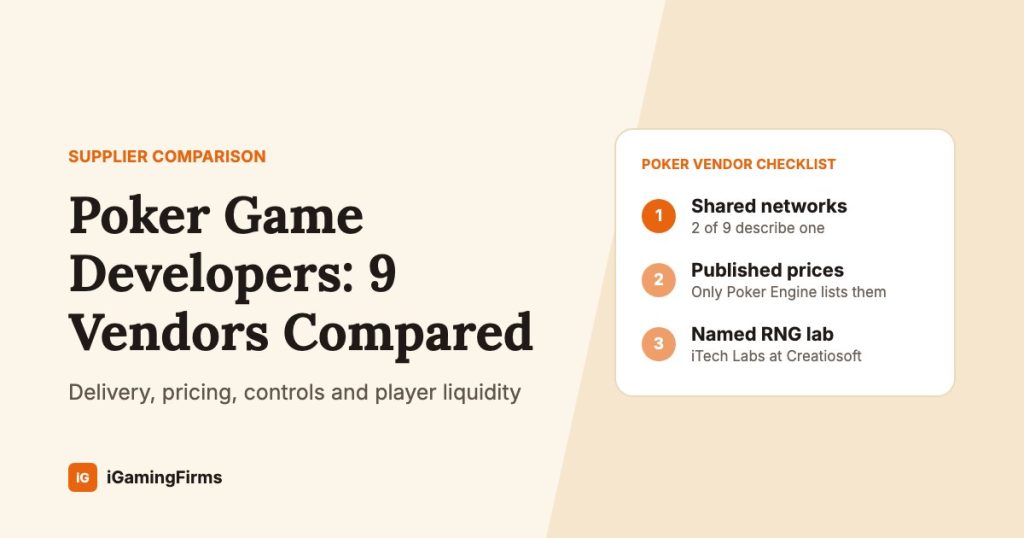
You want a poker game built to your spec. Every studio’s sales page promises the same Hold’em table, the same “certified RNG” and the same anti-cheat badge.
The short answer: the poker game developers worth shortlisting are the ones that put scope, testing and integrity in writing. Game-Ace is the only custom studio here that publishes prices and timelines for a regulated poker build. Online Poker Script is the only one with a public licence price list. Creatiosoft is the only one that names its RNG test lab in its page text. Under the UK Gambling Commission’s technical standards, a real-money room that seats its own bots must tell players so, yet at least one vendor here sells scheduled table-filling bots as a feature. Ask about bots before you ask about price.
This page covers studios and agencies that build or license poker games for you to run. If you want to join an existing network or rent a ready-made room, read our separate comparison of poker software providers and networks. Facts below come from each company’s own pages and from regulators, read in November 2026. No company paid to be listed.
Poker game developers compared
The numbers match the order of the profiles below.
| # | Developer | What you commission | Real money or social | RNG and testing | Integrity controls stated | Stated cost or commercial terms |
|---|---|---|---|---|---|---|
| 1 | Game-Ace | Custom poker game, code handed over at close | Regulated real money; separate social poker builds | Builds RNG documentation; works with your chosen lab | Server-side game state only | From €40,000 (single variant); about €80,000 to €200,000+ (multi-variant) |
| 2 | Mobzway Technologies | Custom build or white label platform | Both, per its PokerPro Arena case study | Client handles licences and approvals (company’s account) | AI anti-collusion, device fingerprinting (case study) | Tailored quote |
| 3 | Bettoblock | White label or custom build | Real money and social poker | “RNG certified technology” claim, no lab named | “Anti-collusion safeguards”, no detail | Quote per project; says zero revenue share and 100% ownership |
| 4 | BR Softech | White label with themes or custom app, including club-style clones | Real money and play money | “RNG-certified” claim, no lab named | Anti-fraud system for transactions | Up to $10,000 for a PPPoker-style app (its FAQ) |
| 5 | Creatiosoft | White label platform plus custom work; source code licence by agreement | Real money and US sweepstakes | RNG certified by iTech Labs | Chip-dumping checks, device and VPN checks, Sumsub KYC | No setup fee; price given on a call |
| 6 | Innosoft Group | White label or custom build | Real money, social and blockchain poker | “RNG-certified gameplay” claim | Encryption, fraud detection, “AI-driven fair play” | Says zero commission or licensing fees (general iGaming page) |
| 7 | Online Poker Script (Poker Engine) | Self-hosted licence; source on higher tiers | Operator decides; KYC and AML tools included | Cryptographically secure shuffle; no certificate stated | Server-authoritative play, fraud review queues, scheduled bots | €2.500/yr, €5.000/yr or €10.000 once, ex VAT, no revenue share |
| 8 | PokerInfra | Cloud white label, Enterprise source code or custom build | Online rooms plus offline Edge console | No certificate stated | Anti-collusion monitoring, fraud detection (Enterprise) | Enterprise: no recurring licence fee, no revenue share |
| 9 | Playtech (iPoker Network) | Poker network seat with network management, not a bespoke build | Regulated real money | Compliance claimed across European markets | Handled at network level | Network agreement by contract |
The 9 poker game developers, reviewed
1. Game-Ace
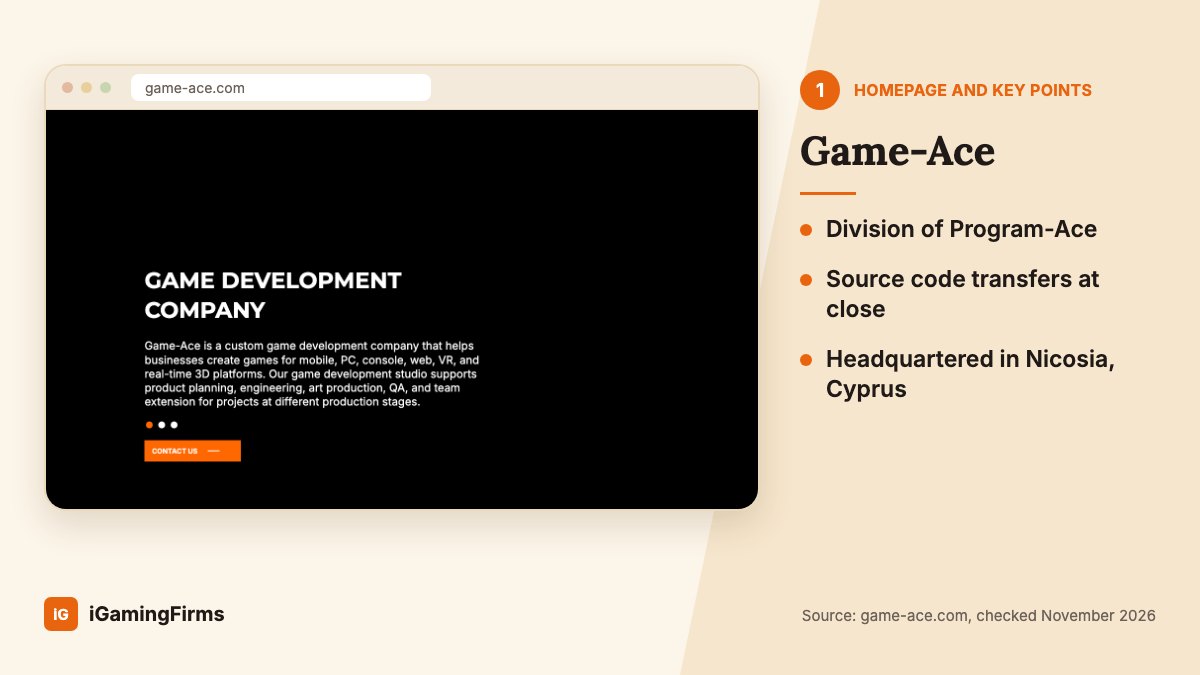
Game-Ace is a custom game studio founded in 2005 and headquartered in Nicosia, Cyprus. It describes itself as a division of Program-Ace with 120+ in-house specialists and 200+ delivered games. Poker is one service inside a wider iGaming practice, so you are hiring a production team rather than buying a product.
It is the most transparent studio here on cost and schedule. Its poker page says a focused single-variant game with core multiplayer starts from €40,000. Multi-variant operator platforms with tournaments and regulated RNG documentation run from about €80,000 to €200,000 or more. It quotes three to five months for a single-variant title from design sign-off and six to ten months for a multi-variant platform.
Variants on offer are Texas Hold’em, Omaha Hi and Hi-Lo, Seven-Card Stud and custom rules. For free-to-play products its social casino page lists Hold’em and Omaha with friend rooms, leaderboards and a virtual chip economy. On ownership, Game-Ace says source code, art and documentation transfer to you on agreed milestones and that it keeps no licence or usage rights after handover.
What to press on: the poker page explains server-side game state and RNG documentation but does not describe collusion, chip-dumping or bot detection. On testing it says European markets usually reference eCOGRA, BMM or iTech Labs standards and that it works with the lab you choose. Budget for that lab yourself.
2. Mobzway Technologies
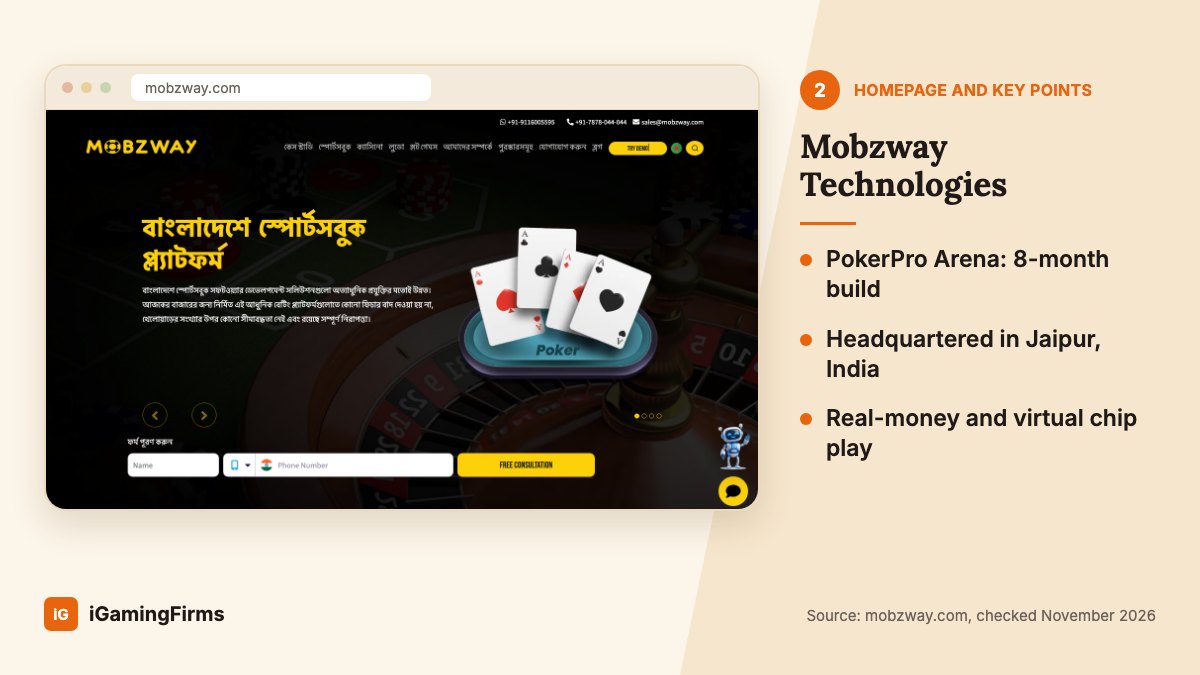
Mobzway Technologies describes itself as a poker and casino game development company. It sells custom poker builds and a white label poker platform alongside rummy, Teen Patti and ludo products.
Its main poker evidence is a case study it publishes for PokerPro Arena. By the company’s account, that was an eight-month build for a North American client on web, Android and iOS, with real-money and virtual chip modes. Mobzway says the build covered Sit & Go, cash games, freerolls, knockouts and multi-table tournaments. It also says the spec included AI-based anti-collusion detection, device fingerprinting and an admin fraud-monitoring panel.
Those details could not be confirmed from Mobzway’s public pages in November 2026. Treat them as company claims and ask for the case study in writing. Mobzway also says clients are responsible for every licence and regulatory approval, so a quote from it covers software, not market entry.
What to press on: which of the case study’s fraud tools ship as standard on the white label product and which were custom work billed to that one client.
3. Bettoblock
Bettoblock is an iGaming developer with a listed office in Indore, India. Its homepage claims 100+ iGaming developers and promises “100% ownership and zero revenue share”. Beyond poker it builds sportsbook, casino and other card-game platforms.
Its poker development page offers both a customisable white label and a custom build. The variant list is long: Texas Hold’em, Omaha, Seven Card Stud, Pineapple, Crazy Pineapple, Chinese Poker, Razz, Five Card Draw, Triple Draw Lowball and video poker. Tournament formats include Sit & Go, multi-table, rebuy, shootout, satellite and heads-up. The stated stack is React or Angular on the front end with Node.js, PostgreSQL or MySQL and Golang for calculations, hosted on AWS, Google Cloud or DigitalOcean.
It also offers social poker and blockchain poker builds. It lets you hire developers full-time, part-time or by the hour, which suits a founder who wants a team extension rather than a fixed-scope project.
What to press on: the page claims “RNG certified technology” and “anti-collusion safeguards” without naming a lab or describing detection. Its admin section also mentions chips that players can “redeem for real-world value”. That one line moves a social build into real-money or sweepstakes territory, so settle the legal model before scoping.
4. BR Softech
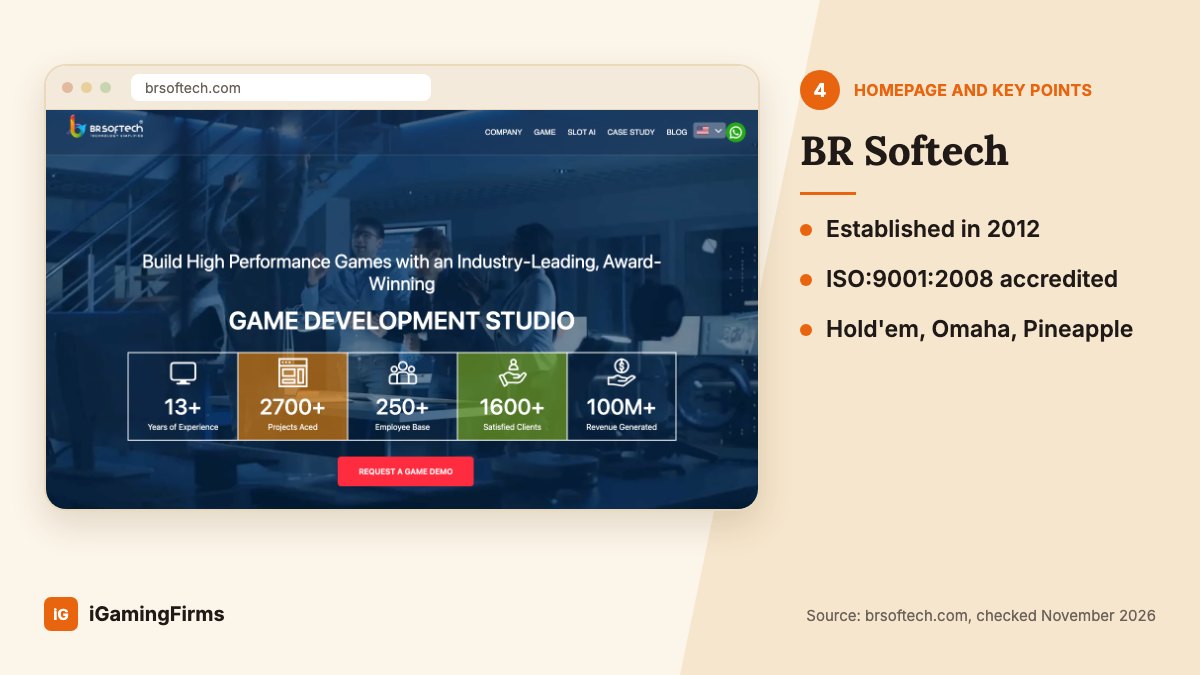
BR Softech is a game and app developer that says it has worked in gaming since 2012. Its poker page lists offices in Boston, Singapore and Morwell in Australia. It builds poker apps for Android, iOS, Windows and Mac.
It sells ready-made white label poker with customisable themes alongside custom work. Listed variants include Texas Hold’em, Omaha, Pineapple, Seven Card Stud and video poker. It also markets clones of club-style and brand-name apps such as PPPoker and 888 Poker. Its Texas Hold’em page mentions daily tournaments and challenges. A Poker Stud case study shows one completed app.
BR Softech is one of the few to print a number. Its poker FAQ says a PPPoker or CG Poker style app costs “up to $10,000”. Its Omaha page gives $3,000 to $5,000. Read those as entry prices for a template app, not a certified real-money room.
What to press on: “RNG-certified” games with no lab named. Its anti-fraud system is described only for payments. Ask how collusion and bots are detected at the table.
5. Creatiosoft
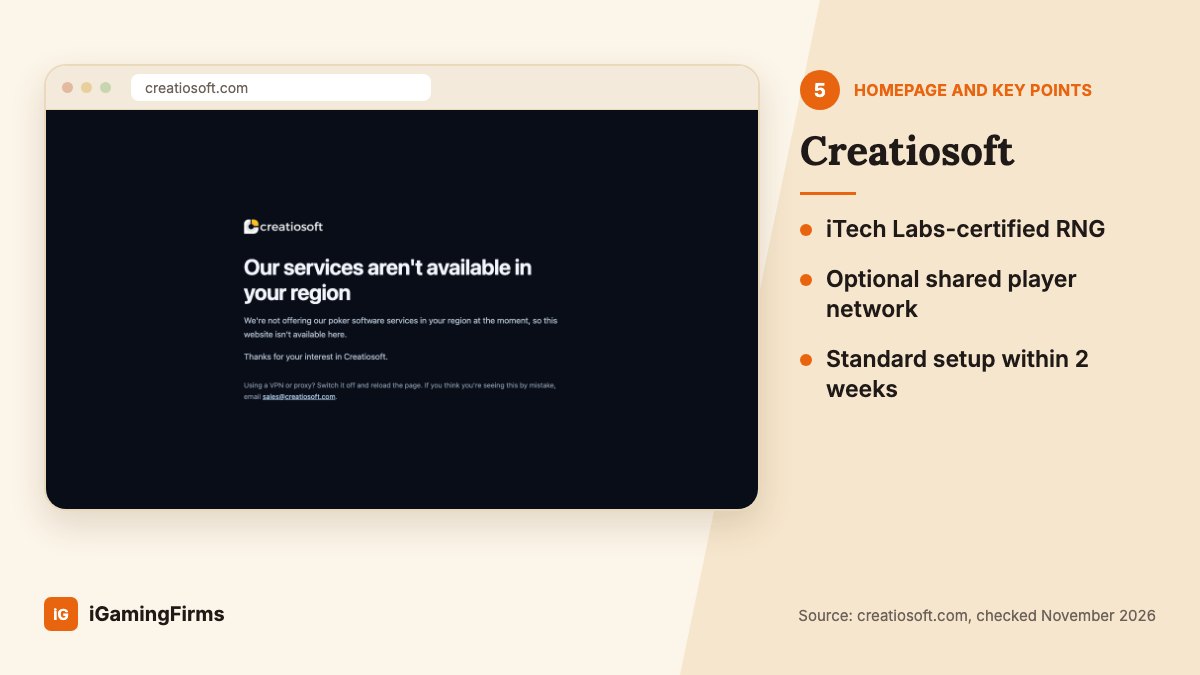
Creatiosoft has built poker technology since 2012, with an office in Noida, India and another in Mountain View, California. It says it powers 10+ live operators, naming PokerBoss, Raize Poker, VG Poker and Hijack Poker.
It sells a white label platform with custom features on top. A standard setup can go live within two weeks, with longer timelines for heavy customisation, approvals or app store review. There is no setup fee. Hosting, maintenance, updates and support are covered, while customisation is quoted separately. Operators with their own engineers can license the code under a technology partnership, with code ownership agreed per deal.
It is the only developer here that names its test lab in its page text: the RNG that shuffles and deals is certified by iTech Labs. Creatiosoft itself notes that this is not an operator licence. Integrity tools include automated chip-dumping checks, Radar checks for location spoofing, emulators, rooted devices, VPNs and remote access, plus Sumsub KYC. Variants are Hold’em, Omaha (PLO4, PLO5, PLO6), Big O and mixed games, with bomb pots and double-board tables.
It also sells sweepstakes poker software for the US dual-currency model: Gold Coins for fun, redeemable Sweeps Coins and a free alternative method of entry. Operators can join the shared Creatiosoft Poker Network or run a closed pool. Ask how network rake is split.
6. Innosoft Group
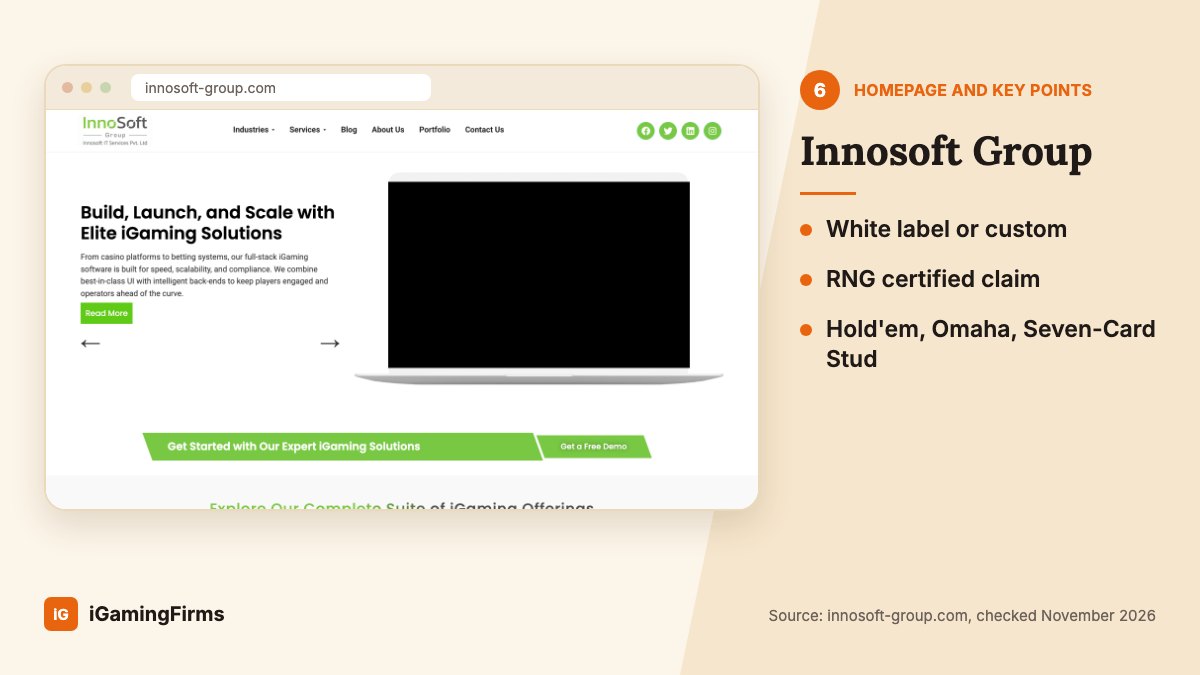
Innosoft Group lists offices in Hoofddorp in the Netherlands and Indore in India. It offers a ready-to-launch white label poker product with your branding or a custom build.
The variant list matches Bettoblock’s: Texas Hold’em, Omaha, Seven Card Stud, Razz, Five Card Draw, Crazy Pineapple, Chinese Poker, Triple Draw Lowball and video poker. Tournament formats are Sit and Go, multi-table, rebuy, shootout, satellite and heads-up. It also sells social-first poker, a blockchain poker platform with NFT options and AI-powered opponents.
On terms, its iGaming development page promises “Zero Commission or Licensing Fees” and says you keep full ownership of the product it builds. Those lines sit on a general page, not the poker page, so ask for them in the poker contract.
What to press on: AI opponents are fine in a social game. In a real-money peer-to-peer room they are house players and trigger the disclosure rules covered below. Also ask which lab issued the RNG certificate behind its “RNG-certified gameplay” claim.
7. Online Poker Script (Poker Engine)
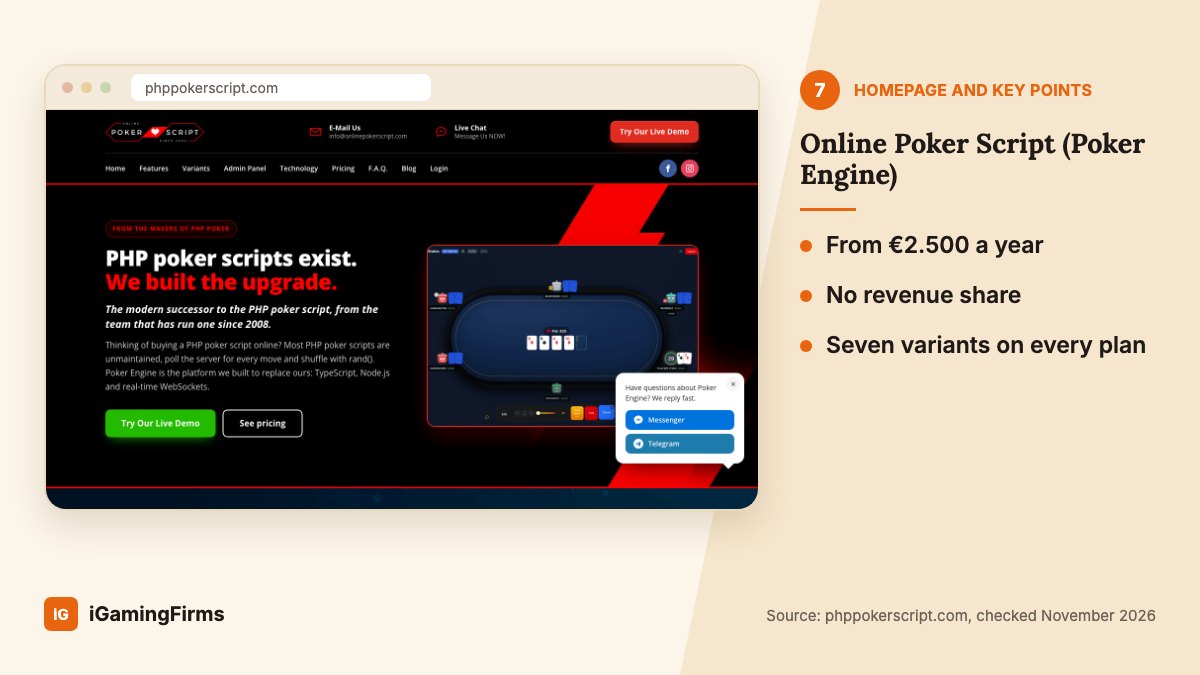
Online Poker Script says its code has been around since 2008. It bought the PHP Poker copyright and renamed the product in 2013. Today it sells Poker Engine, a self-hosted platform written in TypeScript on Node.js, React 18, PostgreSQL 16 and Redis 7.
It is the only vendor with a public price list. Starter is €2.500 a year for the signed release without source. Professional is €5.000 a year with full TypeScript source for the server, web client and React Native app. Enterprise is €10.000 once and adds lifetime updates plus an integration API for single sign-on and balance sync. Prices exclude EU VAT, there is no revenue share and payment is in crypto only. One licence covers one domain.
Every tier includes seven variants (Hold’em, Omaha, Omaha Hi-Lo, Short Deck, Seven-Card Stud, Stud Hi-Lo and H.O.R.S.E.) in no-limit, pot-limit and fixed-limit, plus tournaments, Sit & Go and satellites. Native apps target iOS 15+ and Android 8+. Install is one Docker command, with a Helm chart for Kubernetes. The server decides every hand. Cards are shuffled with a cryptographically secure Fisher-Yates shuffle. The admin panel has KYC, AML, sanctions and fraud review queues, plus agent sub-operator networks for club-style models.
What to press on: it sells bots with six strategy profiles that you can schedule “to fill quiet tables”. No RNG certificate is stated. Both points matter if you plan a licensed real-money room.
8. PokerInfra
PokerInfra lists an address in Surrey, British Columbia. It sells PokerInfra Cloud (managed white label), PokerInfra Enterprise (source code), PokerInfra Edge (an offline console for venues) and custom development.
It runs an open-core model. Its hand evaluator is public on GitHub, so your engineers can inspect part of the stack before you sign. The Enterprise source code page says you avoid ongoing licensing costs and keep all platform revenue. It supports Hold’em, Omaha, Omaha Hi-Lo, Seven Card Stud, Short Deck and custom formats. Deployment can be on public cloud, private servers, dedicated hardware or hybrid setups. Security features listed are anti-collusion monitoring, fraud detection and secure payments.
The homepage pitches a launch “in the next 2 weeks”. That applies to the managed Cloud product, not a self-hosted Enterprise install.
What to press on: no RNG certificate is stated. If you take the source code, you also take the certification work for each market.
9. Playtech (iPoker Network)
Playtech is a FTSE 250 gambling technology group that cites more than 25 years in the industry. It is on this list as the benchmark, not as a build-to-order studio. Its poker product is sold as a place on the iPoker network with network management for each brand.
Playtech says iPoker was established in 2004 and supports over 80 brands. It describes formats such as Hold’em and Omaha cash games, knockout and progressive knockout tournaments, a three-handed turbo Sit & Go and Twister jackpot games. It also says its poker software meets regulatory requirements across markets including the UK, Italy, France, Spain and Denmark.
Why it matters to a founder: if your plan is a licensed European real-money room, the realistic alternative to commissioning a custom build is joining a network like this. You give up control of the client and the rules. In return you get tested software and opponents from day one.
Real-money, social or sweepstakes poker: what changes in the build
Decide the legal model before you send a brief. It changes the scope more than any feature list.
- Real-money poker. You need a licence in each market, a certified RNG, KYC, payments, responsible gambling tools and integrity logging. The software usually has to connect to a player account management (PAM) system. Game-Ace’s €80,000 to €200,000+ band for multi-variant regulated platforms reflects that load.
- Social poker. Chips have no cash value and cannot be cashed out. Game-Ace says social products can run play-money economies without regulated gambling requirements. App store rules and consumer law still apply.
- Sweepstakes poker. A US model where Sweeps Coins can be redeemed for prizes and players get a free alternative method of entry. Creatiosoft’s own page warns that a growing number of states restrict or ban online sweepstakes gaming. Check our tracker of sweepstakes casino legality by state before you fund a build.
What is a club or app-based poker model?
Club apps put the operator role in the hands of club owners or agents. Players download one app, join a private club with a code and play at tables the club runs. The app owner earns from the clubs, while agents manage players and chips. This is the model behind apps such as PPPoker. Studios now sell clones of it. BR Softech markets PPPoker-style builds. Online Poker Script ships agent sub-operator networks with per-table rake reports.
The build is cheaper than a regulated room. BR Softech quotes up to $10,000 for this type of app. The legal exposure is not cheaper. If chips can be bought or settled for money through agents, the app is real-money gambling in most markets. Whoever runs it needs a licence. The studio contract will usually put that duty on you.
Does a poker game need RNG certification?
For real money in a regulated market, yes. The UK Gambling Commission’s RTS 7 requires random outcomes that are “acceptably random”, shown by recognised statistical tests. Mapping of random numbers to outcomes (here, to the deck) must follow the stated probabilities. US and many other regulators rely on independent labs testing against standards such as GLI-19, Gaming Laboratories International’s standard for interactive gaming systems, now at version 4.0.
The labs you will hear about are GLI, iTech Labs and BMM Testlabs, plus eCOGRA in some European markets. Two points trip up founders. First, a vendor’s certificate covers the vendor’s build at a point in time. Your customised version may need its own testing. Second, labs test against a named jurisdiction’s rules, so ask which markets the certificate covers. Our comparison of iGaming testing labs and RNG certification explains scope, cost drivers and timelines.
How do poker games detect collusion and bots?
The clearest public rulebook is the UKGC’s RTS 11, which applies to peer-to-peer gaming. It requires measures to deter, prevent and detect collusion and cheating. Systems must keep records that allow investigation and be able to suspend accounts. The guidance suggests recording who sat at which tables and money won from and lost to each account. It also suggests flagging players who often share tables, players from the same address at one table, chip dumping and unusual statistics.
Turn that into a build requirement. You need hand histories stored at action level, a rules engine that scores suspicious patterns, a case-management screen for your risk team and the power to freeze accounts and claw back funds. Device and network checks catch multi-accounting, as Creatiosoft’s Radar integration shows. Our guide to iGaming fraud detection covers the signals.
Bots need their own controls. RTS 16 requires operators to tell players which third-party software is allowed and to detect banned tools. Requirement 16C goes further. If the operator itself uses programs to play on its behalf, it must display that clearly. The guidance names poker robots as the example.
Is there an AI for poker?
Yes. That is the reason bot detection belongs in your spec. In 2019 Facebook AI and Carnegie Mellon University announced Pluribus, the first AI to beat elite professionals in six-player no-limit Hold’em. Its creators said it was trained in eight days on a 64-core server for less than $150 of cloud computing. Strong poker AI is now cheap, so assume some players will try to run it at your tables.
For a builder, AI shows up in three places: as opponents in social games, as house bots that fill real-money tables or as models that detect bot-like play. Only the last one is a safe default for a real-money room.
How much does it cost to build a poker game?
Only a few developers publish numbers. They describe very different products:
- Template or club-style app: BR Softech quotes $3,000 to $5,000 for an Omaha game and up to $10,000 for a PPPoker-style app.
- Licensed self-hosted platform: Online Poker Script charges €2.500 to €5.000 a year, or €10.000 once for Enterprise, with no revenue share. Hosting, certification and customisation sit on top.
- Custom single-variant game: Game-Ace starts at €40,000.
- Custom multi-variant regulated platform: Game-Ace puts this at about €80,000 to €200,000 or more.
- White label with hosting: Creatiosoft charges no setup fee and gives pricing on a call. Bettoblock and Innosoft say they take no revenue share.
The commercial model matters as much as the headline. Fixed-price projects suit a frozen spec. Team extension or hourly hiring, which Bettoblock offers, suits a product you will keep changing. Licences shift engineering cost to you. White label shifts control to the vendor.
How long does poker game development take?
Game-Ace quotes three to five months for a single-variant title with core multiplayer and six to ten months for a multi-variant platform. Mobzway says its PokerPro Arena build took eight months. Creatiosoft says a standard white label setup can go live in two weeks. PokerInfra’s Cloud makes a similar claim. Add the time for lab testing, licensing and app store review, which none of these figures include.
Can you own the source code?
Ownership terms vary more than prices. Game-Ace transfers code, art and documentation and keeps no rights after handover. Bettoblock and Innosoft both promise full ownership. Online Poker Script gives full source on its Professional and Enterprise tiers but keeps the product itself. PokerInfra licenses Enterprise source code. Creatiosoft licenses code under a partnership and agrees ownership of new code per deal. Ask for these terms in the contract, not on a marketing page.
Bot disclosure, RNG approval and anti-collusion data
House bots must be disclosed
Some poker studios sell bots as a growth feature. Under RTS 16C, a UK-licensed operator that runs its own programs at peer-to-peer tables must tell players clearly, on home pages and in game help. Online Poker Script sells schedulable bots. Innosoft sells AI opponents. Before you switch either on in a real-money room, read your regulator’s rules and get legal advice from a gambling lawyer.
A vendor’s RNG badge is not your approval
Creatiosoft is explicit that its iTech Labs certificate is not an operator licence. Game-Ace says it works with whichever lab you appoint. A badge on a vendor’s footer does not tell you which build, version or jurisdiction was tested. A customised build may need fresh testing.
Anti-collusion is a data requirement
RTS 11 expects records detailed enough to investigate who sat with whom and where the money went. If your studio’s scope does not include action-level hand histories, retention rules and a review screen, you cannot meet that later without rework. Game-Ace, Bettoblock, BR Softech and Innosoft do not describe those deliverables on their poker pages.
How to vet a poker game studio
- Write down your legal model (real money, social or sweepstakes) and target markets before the first call.
- Ask for the RNG certificate, the lab’s name, the build version and the jurisdictions covered.
- Ask for a written list of integrity controls: hand-history depth, collusion scoring, chip-dumping alerts, device checks and the bot policy.
- Get cost, timeline and payment milestones in a statement of work, plus who pays for lab testing.
- Put source code ownership, escrow and post-launch support in the contract.
- Ask for a live demo and a reference you can call, not a quote on a website.
Your next step
Pick three developers from the table that match your legal model. Send each the same six questions above in one email and compare the written answers side by side. If none can name its RNG lab or explain its collusion controls in writing, look at a network route through the poker software providers comparison linked at the top of this page instead.