You want a sportsbook built to your own specification. Every agency that quotes you claims sports betting experience.
The short answer: the best sports betting software development company for a custom build is one that puts IP terms, an engagement model and a lab certification plan in writing before you sign. CrustLab, Software Mind and Symphony Solutions show the deepest betting delivery records among the studios below. GLI published a draft of GLI-33 version 2.0 on 30 June 2026. It adds source code access for test labs and mandatory multi-factor login, so a platform scoped today against version 1.1 may need rework before it is certified.
This guide is for founders and operators commissioning a custom build. If you would rather license a running platform, start with our comparison of the best sportsbook software providers. If speed matters more than ownership, read our guide to white label sportsbook platforms. Every vendor fact below was checked on the vendor’s own site in November 2026. No company paid to be listed.
Sports betting software development companies compared
The first seven companies build to order. The last three are platform vendors that also sell custom work, source code or API access. They are included because many founders end up choosing between a studio and a platform.
| # | Company | Type | Engagement model | Code and IP terms | Published cost or timeline | Trading and risk |
|---|---|---|---|---|---|---|
| 1 | CrustLab | Custom studio (Poland) | Discovery-led scope, milestone delivery, maintenance contract | Bespoke code and IP transferred; reusable components on perpetual licence | Three-month minimum engagement; no prices | Stays with your platform or trading provider |
| 2 | Software Mind | Engineering firm (Poland) | Dedicated teams, outsourcing, US nearshore | Agreed per contract | QA centre set up in under three months; no prices | Custom builds; no managed trading stated |
| 3 | Symphony Solutions | Custom studio plus own platform (BetSymphony) | Managed augmentation, managed team, managed service | BetSymphony sold as a full source code licence with zero revenue share | Quote on request | No managed trading stated |
| 4 | Chetu | Custom developer (Florida) | On-demand developers, dedicated teams | Agreed per contract | Scope defined before budget; no prices | Builds AI odds prediction and fraud detection; no managed trading |
| 5 | Biz4Group | Custom developer (Florida) | Shaped per project scope | Agreed per contract | $25,000 to $350,000+ per sportsbook | Builds odds engines; no managed trading |
| 6 | Suffescom Solutions | Custom developer (New York address) | Hire-a-developer and project builds | Agreed per contract | $60,000 to $150,000 for mid-level builds; 3 to 12 months | No managed trading stated |
| 7 | GammaStack | Custom builds plus GammaBet white label and turnkey | Project builds, hire developers, on-demand customisation | Full ownership handed over on custom builds; white label stays with GammaStack | Custom 6 to 12+ months; white label 2 to 8 weeks | No managed trading stated |
| 8 | Kambi | Platform vendor that now licenses source code | Turnkey licence or source code licence | Allwyn holds a perpetual global source code licence | Allwyn deal: upfront payment in 2027 plus milestones | AI-driven trading and risk supplied by Kambi |
| 9 | Digitain | Platform vendor with bespoke API | Turnkey, iFrame API, Bespoke API, region-specific builds | Licensed platform | Quote on request | In-house trading units working 24/7 |
| 10 | SoftGamings | Platform vendor with unified API | Turnkey under your licence or API | Licensed platform | Turnkey live in 1 to 2 weeks | AI-driven risk checks on every wager |
Prices are the vendors’ own published estimates. Your quote depends on scope, markets and integrations, so get every term in writing.
The 10 companies, reviewed
1. CrustLab
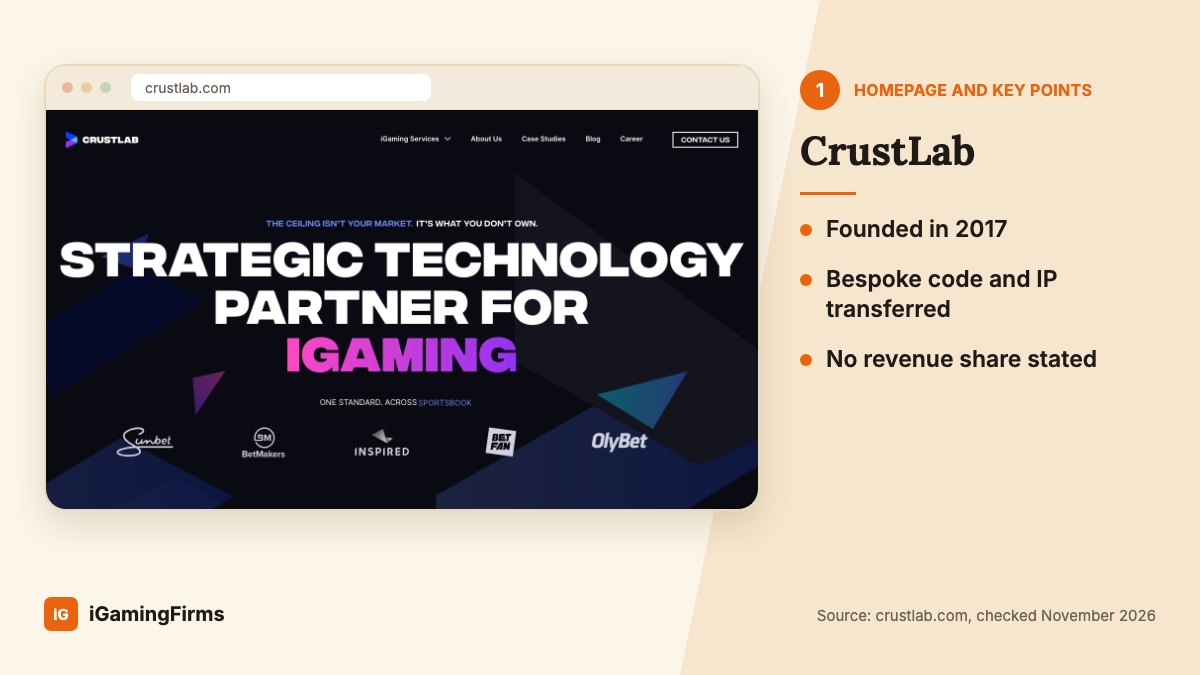
CrustLab is a Polish studio that has worked in betting since 2017. Its sports betting development page lists 60+ iGaming projects and 20+ custom frontends. It builds the product layer on top of a core you already license. Named work includes the BETFAN web frontend with Betradar and SIS live streams, an LSports integration layer for Pick24, apps using the Kambi SDK and GeoComply, a fixed-pool betting platform with PAM for BetMakers and one app base for OlyBet across the Baltics, Croatia and France.
Its IP terms are the clearest in this list. Bespoke code and IP pass to you by contract. Reusable CrustLab components come with a perpetual licence and modification rights. Third-party platforms and SDKs stay under their own terms. Engagements start at three months, run on milestones after a discovery phase and move to a maintenance contract with P1 to P3 priorities.
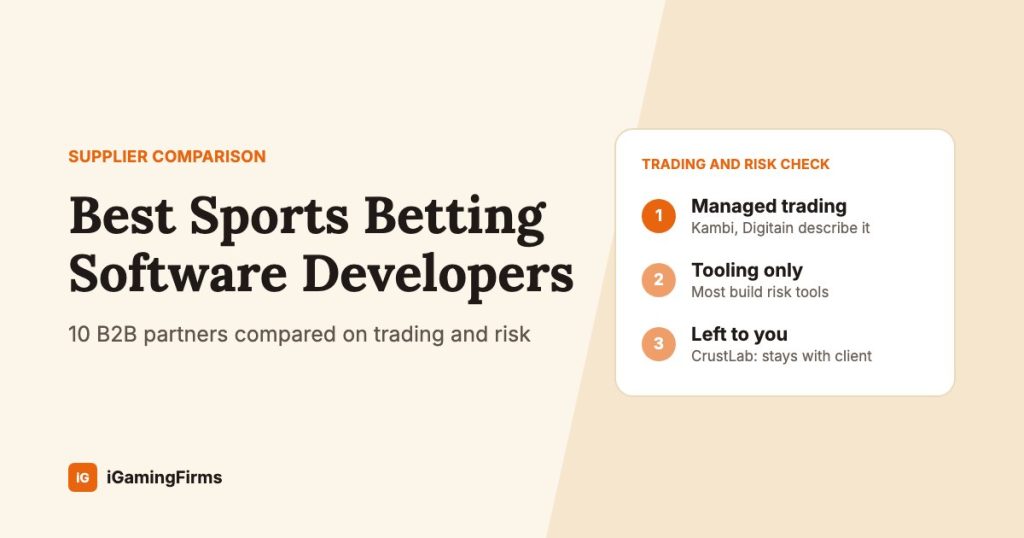
CrustLab does not price markets. It says trading, pricing and risk stay with your platform or trading provider. Bet settlement and the wallet stay with the sportsbook platform. The gambling licence stays with you. That makes it a fit when you already hold a licence and a core platform but want your own apps and frontend.
2. Software Mind
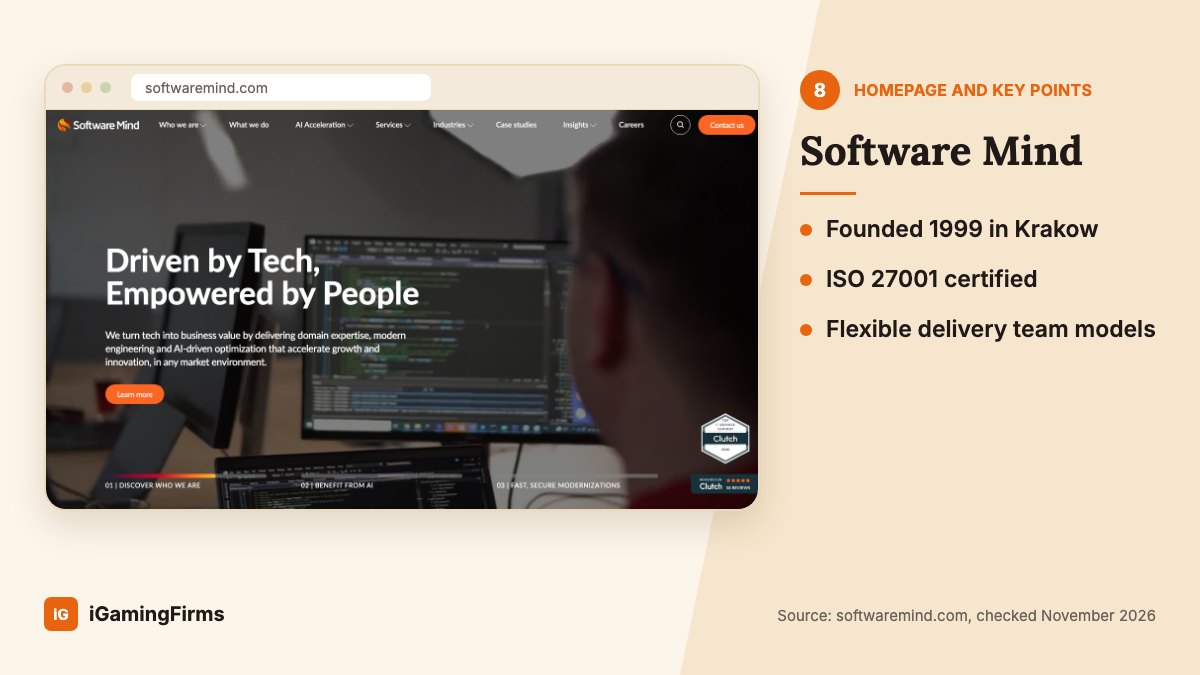
Software Mind is a large engineering firm that cites 25+ years in business, 1,600+ experts and 350+ clients. Its betting case studies cover a fixed odds sportsbook back end with phone betting that later moved to Google Cloud, a mobile-first managed wagering solution, a custom sportsbook for Asian markets and a land-based operator’s platform built from scratch. It also set up an offshore QA development centre for a sports betting client in under three months.
Engagement options include dedicated development teams, full outsourcing and US nearshore delivery from Latin America. That suits an operator who wants to own the roadmap and staff it with an external team. The page says it can build systems compliant for a specific state or territory but does not name US states, so ask for regulator approvals in writing.
Client logos on the page include OpenBet, Sporting Index and Bettech Gaming. Treat logos as a starting point. Ask which modules the team built for each and whether you can speak to the client.
3. Symphony Solutions
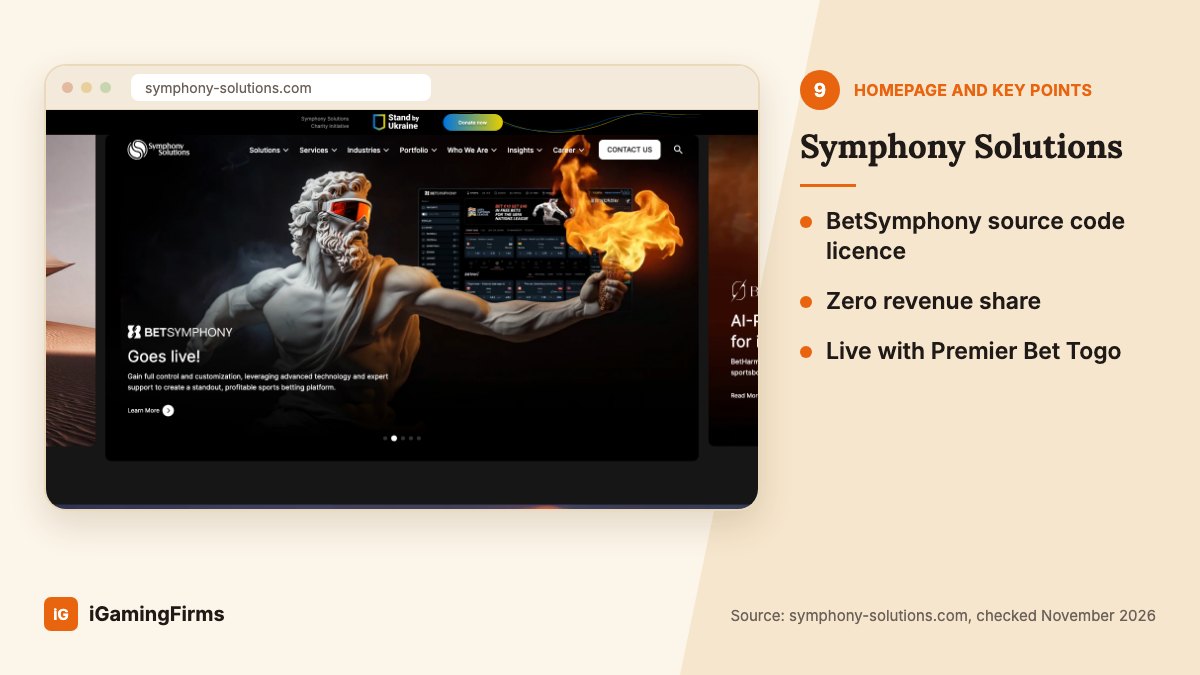
Symphony Solutions lists an Amsterdam contact address and about 230 staff. It runs two tracks. The first is custom development under three models: managed augmentation, where you keep delivery oversight; managed team, where Symphony makes team and technical decisions; and managed service, which covers set problems within agreed service levels. Client logos include Ladbrokes Coral, William Hill, Entain and Caesars.
The second track is BetSymphony, a sportsbook and casino platform first built in 2015. Symphony sells it as a full source code licence with zero revenue share and says it is live with Premier Bet in Togo. LSports is named as an official data partner. The company states it is ISO 27001 compliant.
BetSymphony is a middle path for founders who want code they can change without paying for a build from zero. Note the difference between a licence and ownership: ask whether you can sell, sublicense or hand the code to another developer.
4. Chetu
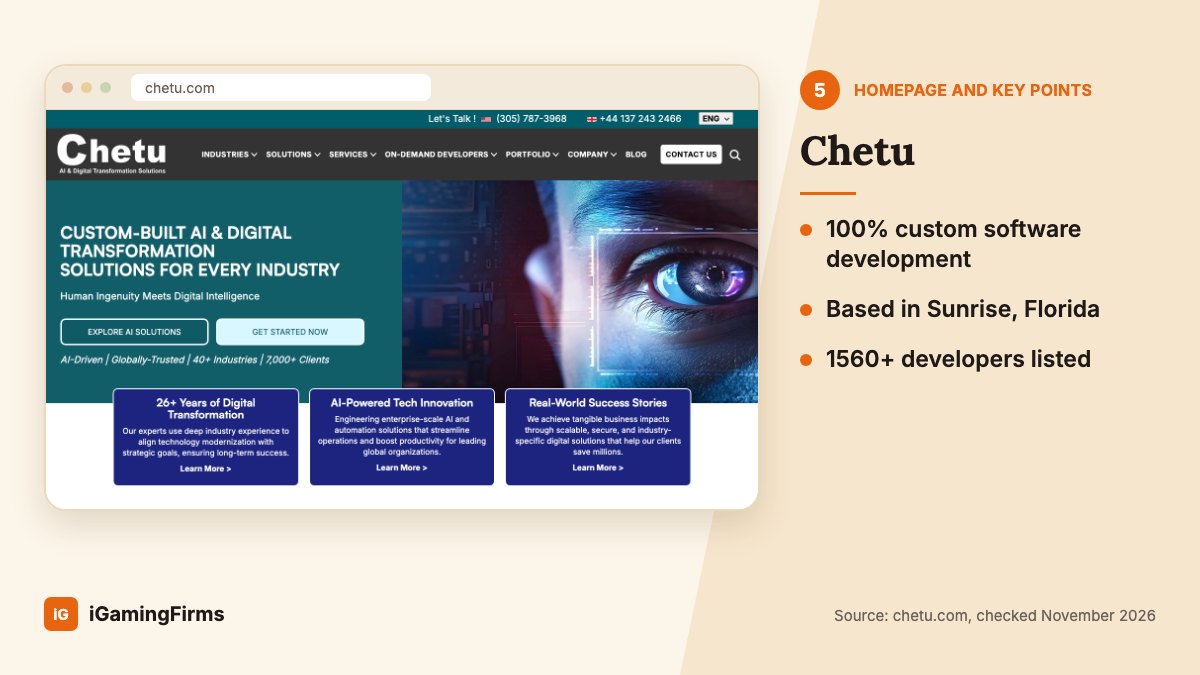
Chetu is based in Sunrise, Florida. It calls itself an AI-first, 100% custom software company with 26+ years of experience. It builds sports and race betting software for web, mobile and self-service kiosks, plus AmTote pari-mutuel integrations. You can hire on-demand developers or a dedicated team. Its FAQ says scope is defined before effort and budget are estimated.
Its casino games page cites 7,000+ clients and says its systems comply with GLI, BMM, MGA, GDPR and PCI standards. No certificate numbers or dates are shown. The same page describes a build for SWX Technologies: a stock-market-style betting product with buy and sell wagers, Flutter iOS and Android apps and an operator platform.
Chetu fits a founder who has a written specification and wants a large team to execute it. Ask which test lab certified each system it built and under which standard version.
5. Biz4Group
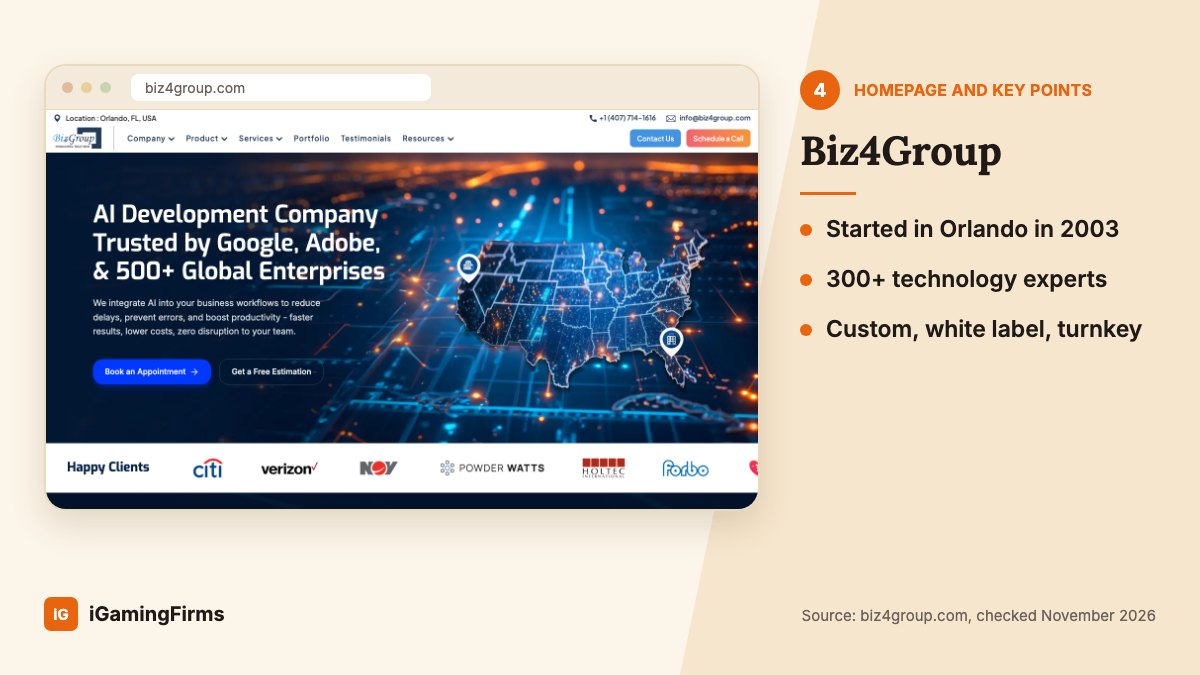
Biz4Group is an Orlando firm with 20+ years in technology, 300+ staff and 1,000+ delivered projects. It offers custom, white label and turnkey sportsbook builds. Its betting case studies are Predictex, an AI prediction platform; Quick Start Bets, a betting insights product with live NHL odds; All Chalk, a pick’em app; and Juicy Slots, a casino platform. Sportradar is named as a data provider it has worked with.
Biz4Group publishes more cost detail than any other studio here. Its service page puts a sportsbook at $25,000 to $350,000+. Its cost breakdown, updated 3 November 2026, gives $20,000 to $45,000 for an MVP and $160,000 to $250,000+ for an enterprise sportsbook. It adds lab certification at $5,000 to $25,000+ and upkeep at 15% to 25% of the build price each year.
Its Technical Strategy Director’s bio says she has contributed to more than 50 sports betting solutions for regulated US operators. That is a personal claim, not a company list of state approvals, so ask which states its builds went live in.
6. Suffescom Solutions
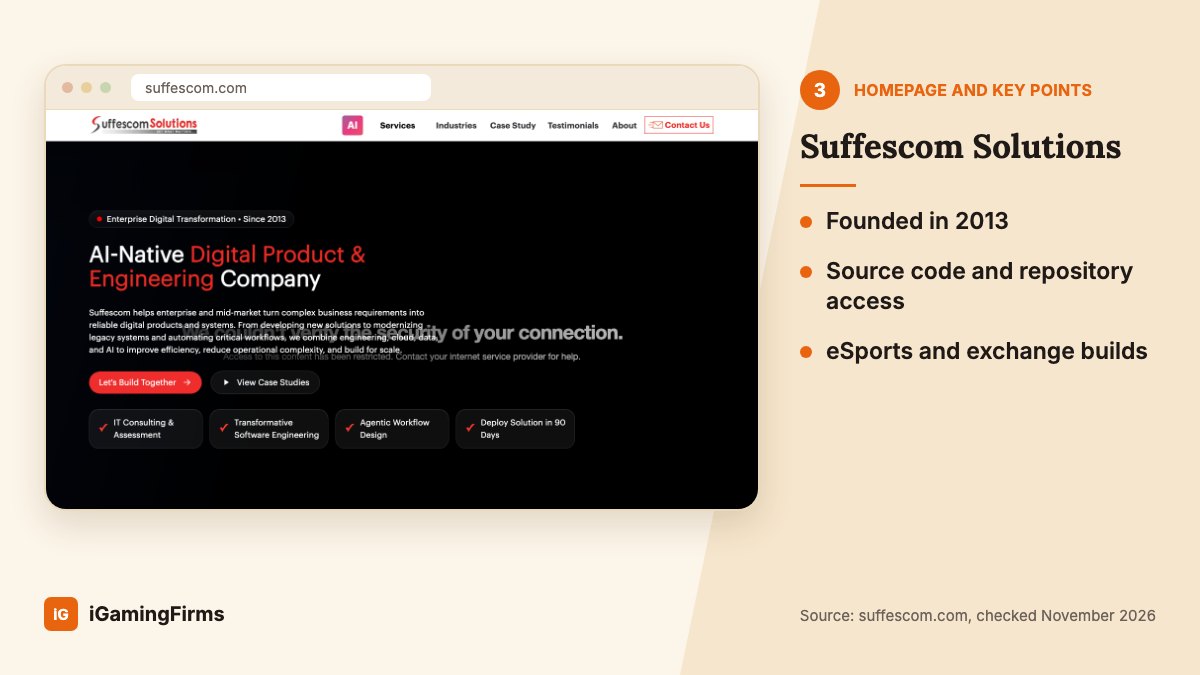
Suffescom Solutions lists a New York address with phone lines in the UK, India and the UAE. It claims 13+ years of experience and 250+ iGaming developers. It builds sportsbooks, casinos, poker, eSports betting for titles such as Counter-Strike 2, League of Legends, Dota 2 and Valorant, plus back-and-lay betting exchanges.
Its iGaming page gives planning estimates rather than fixed prices: $30,000 to $60,000 for a basic product, $60,000 to $150,000 for a mid-level product such as sports betting and $150,000 to $300,000+ for an advanced build. It quotes 3 to 12 months for delivery. The page lists ISO/IEC 27001 and frameworks such as UKGC rules, MGA, New Jersey DGE and PCI DSS. Those are frameworks it says it works to, not supplier licences it holds.
Suffescom fits founders with a niche format, such as an exchange or an eSports book. Ask for a named regulated client that you can contact before you sign.
7. GammaStack
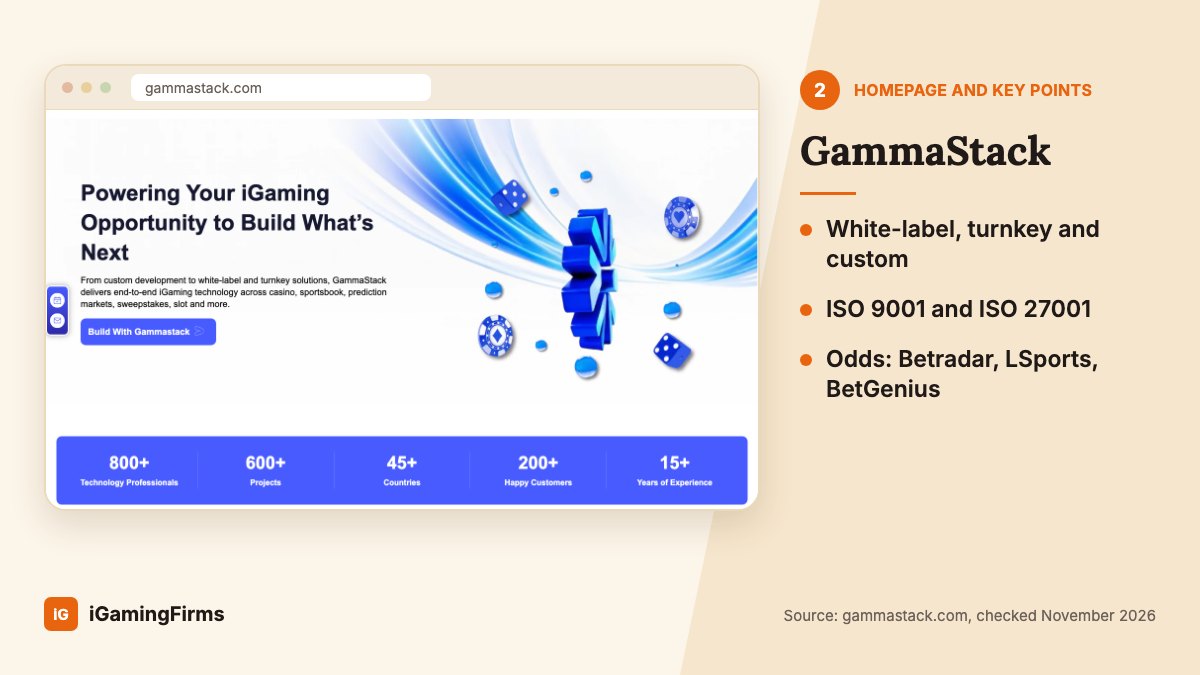
GammaStack sells GammaBet in three depths and lists offices in Riga, Wilmington (Delaware), St. Julian’s, Indore and Bengaluru. It claims 80+ sportsbooks launched across 45+ countries, ISO 9001:2015 and ISO/IEC 27001:2022 certificates and GLI-33 certified platforms. Named integrations include Betradar, LSports and BetGenius for odds plus Sumsub, Veriff, IDcomply and Seon for KYC.
Its own page is useful for setting expectations. White label launches in 2 to 8 weeks but GammaStack owns the system. Turnkey takes 3 to 6 months. A custom build takes 6 to 12+ months, with full ownership handed over at delivery. The page claims 0% revenue share in one place and a low revenue share for white label and turnkey in its FAQ. Get the model that applies to you written into the contract.
GammaStack suits founders who want one supplier to price all three routes side by side before they commit to a custom build.
8. Kambi
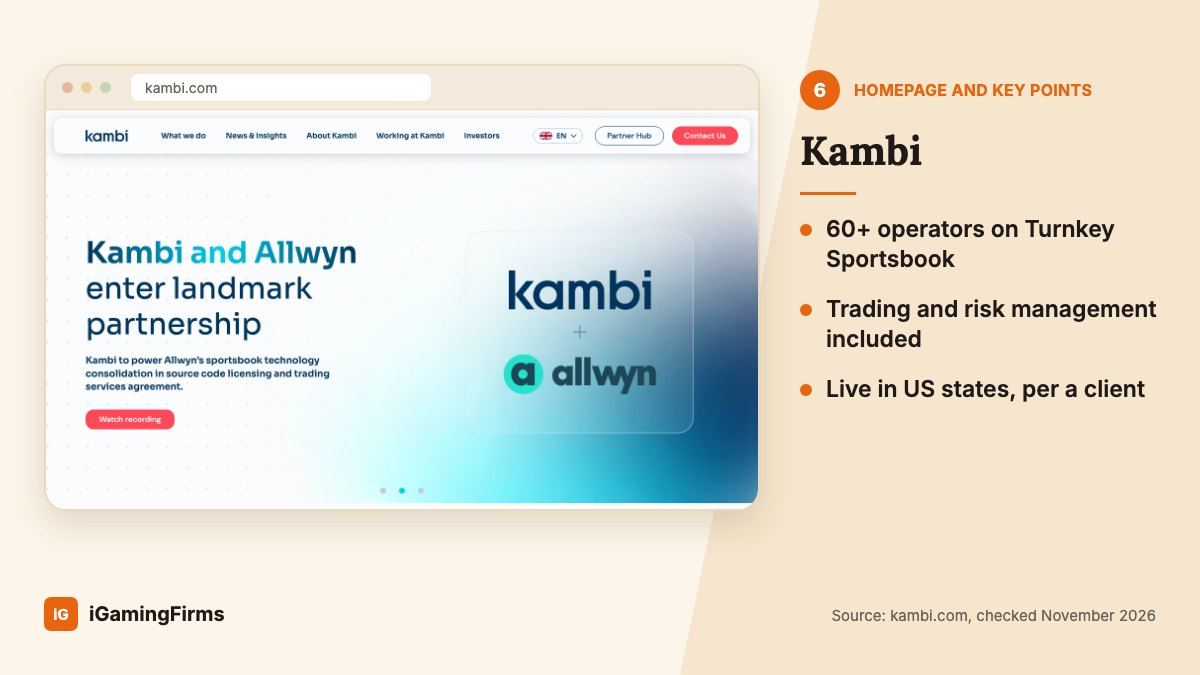
Kambi is not a development agency. It licenses its Turnkey Sportsbook to more than 60 operators and says its partners operate in 100+ regulated jurisdictions. It also sells Odds Feed+ through one API. Its site says it has taken Bally’s Intralot live in fourteen US states and two Canadian provinces since 2023. Operators can use Kambi’s PAM or bring their own.
It belongs in a custom-build guide because of a deal announced on 10 November 2026. Allwyn takes a perpetual, global licence to Kambi’s sportsbook source code, with an upfront payment in early 2027 and milestone payments later. Kambi will build and train a team that moves to Allwyn after implementation. A separate long-term agreement keeps Kambi’s AI-powered trading and risk management in place. Kambi expects the agreements to add about €45 million to €50 million to operating profit over 2027 to 2031.
That model is out of reach for a startup. It still shows how a large operator gets code ownership without writing a sportsbook from zero.
9. Digitain
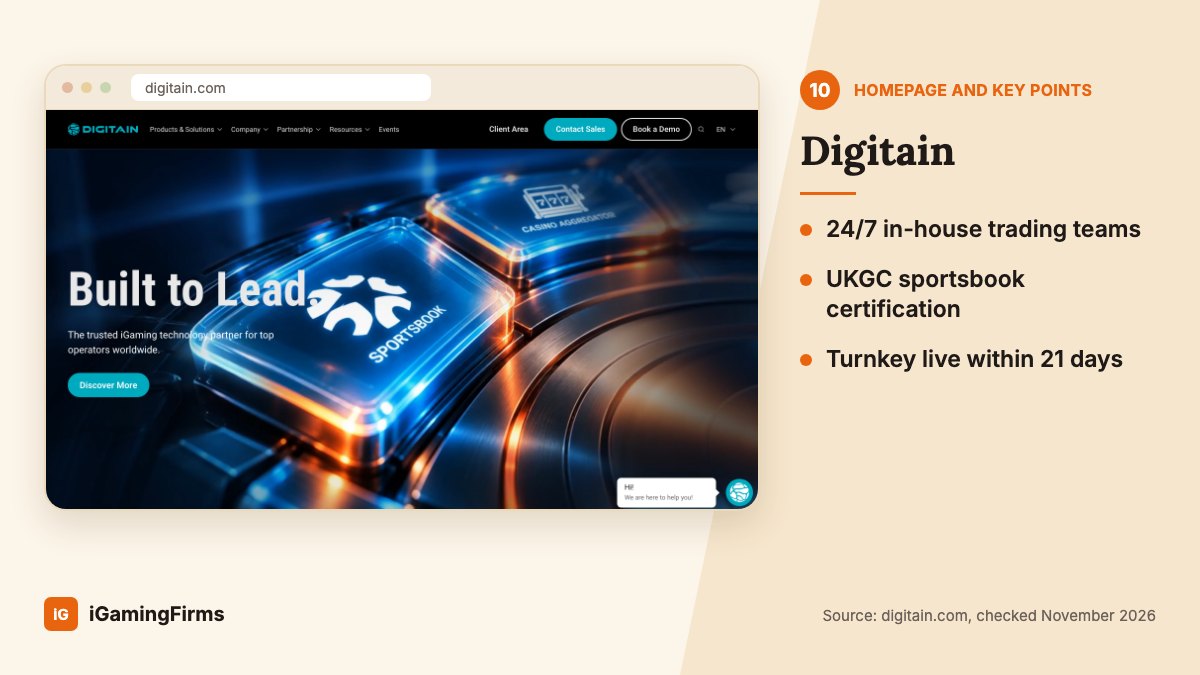
Digitain offers its sportsbook through four models: Turnkey, iFrame API, Bespoke API and region-specific solutions. It lists 180,000+ live events a month, 4,000+ betting markets and more than 5,000 employees. Trading is its main difference from a studio. It says multiple in-house trading units work 24/7 across major events and time zones. It also cites a team of 1,300+ traders and risk managers.
Its licences are public. Digitain (MT) Limited is regulated by the UK Gambling Commission under account 63601. Digitain also holds Belgian Class E licence E 719242. Its sportsbook page cites GLI-19 and GLI-33 standards and licences in Malta, Romania, Greece, Curaçao, Sweden, Peru, Denmark and Ontario.
For a custom-build founder, the Bespoke API is the relevant route. You build your own frontend and PAM, then plug in a certified sportsbook core with trading attached. Ask how trading is priced and whether you can move it in-house later.
10. SoftGamings
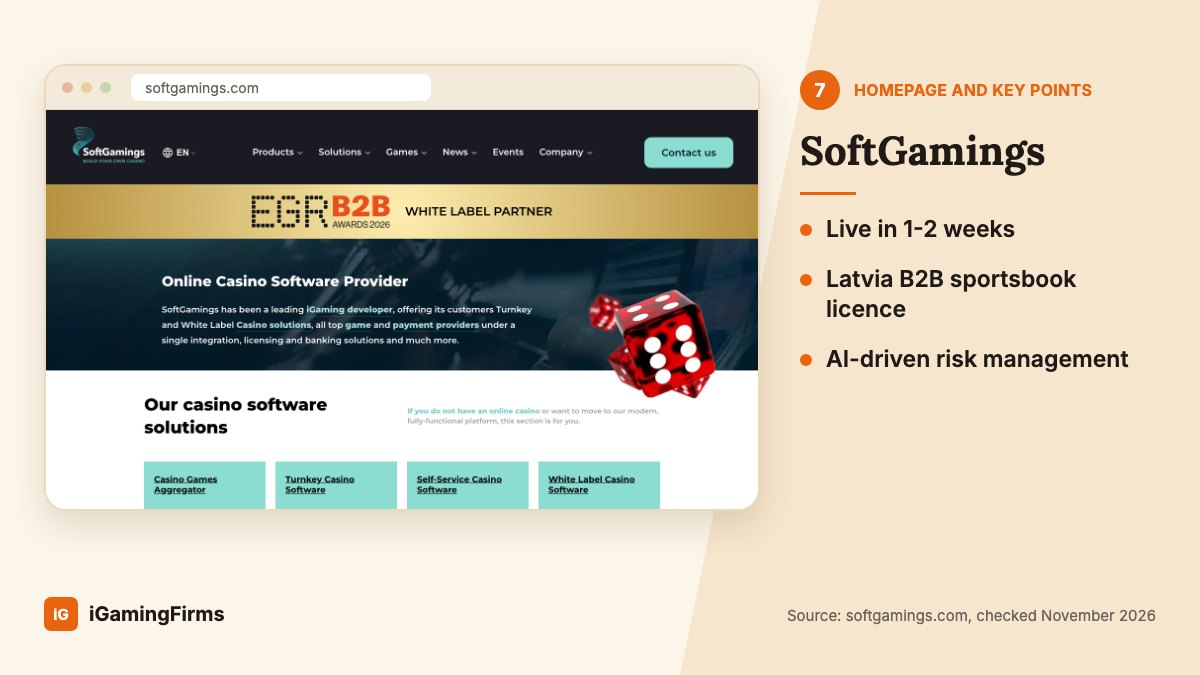
SoftGamings cites 19+ years in the industry and 500+ clients. Its Sportsbook Solution comes as a turnkey business under your own licence, live in 1 to 2 weeks, or as a unified API for operators that already run a platform. The API route leaves you in control of UX, SEO and content. You can also switch or add engines without a new integration. It lists 240,000+ live events a month across 40+ sports.
Risk is handled by AI-driven checks: every wager is validated against current odds before acceptance, alongside anti-fraud, bonus abuse and limit tools. No managed trading team is described. SoftGamings says its sportsbook is licensed as a B2B supplier by the Lotteries and Gambling Supervisory Inspection of Latvia. It also says it holds Malta B2B and B2C licences and is ISO 27001 compliant.
The API route is the one to weigh against a custom build. You pay a studio for the frontend only and license the betting engine behind it.
Engagement models: fixed price, dedicated team or time and materials
How you pay an agency shapes who carries the risk of a slipping schedule. There are three common models.
- Fixed price. You agree a scope and a price before work starts. It works for a well-defined MVP or a single module, such as a bet slip or a cashout feature. Every change after sign-off becomes a change request with its own quote. CrustLab’s milestone-based delivery after a discovery phase is close to this model.
- Time and materials. You pay for hours actually worked at agreed rates. It suits a product whose scope will move as you learn from regulators and players. You carry the risk of overruns, so insist on sprint-level reporting and a monthly cap.
- Dedicated team. You rent a standing team for a monthly fee and direct its backlog. Chetu, Software Mind and GammaStack all offer this. Symphony Solutions splits it further into managed augmentation (you lead) and managed team (Symphony leads).
Many sportsbook projects mix models. A fixed-price discovery phase produces the specification. A time-and-materials or dedicated-team phase then builds it. Whatever you choose, tie payments to accepted deliverables, not to calendar dates.
What a custom sportsbook build includes
A quote that covers only the apps and the bet slip is not a sportsbook. The draft GLI-33 version 2.0 splits a wagering system into the platform, player accounts, remote wagering and retail wagering. Use the same split to check what your agency has priced.
- Front end and apps. Web, iOS and Android, with bet slip, cashout and live betting screens. App store review adds work that web builds do not need.
- Player account management. Registration, wallet, limits, bonuses and statements. If you plan to add casino later, the sportsbook and casino should share one account and wallet. Our explainer on what a PAM is in iGaming covers the parts.
- Odds feed integration. Pre-match and live prices from a supplier such as Betradar, LSports or Genius Sports. The feed licence is a separate contract with its own fee.
- Trading and risk. Liability limits, market suspension, voids and settlement. A studio builds the tools. Someone still has to run them.
- Payments. Deposits, withdrawals and reconciliation through licensed payment providers.
- KYC, AML and geolocation. Identity checks at sign-up and location checks before each wager in US states. See our guide to iGaming KYC requirements for what regulators expect.
- Back office and reporting. Regulator reports, liability reports and audit logs.
How much does it cost to build a sports betting app?
Only a few agencies publish numbers. They differ widely. Biz4Group’s service page says $25,000 to $350,000+. Its cost guide gives $20,000 to $45,000 for an MVP, $90,000 to $160,000 for a multi-state sportsbook and $160,000 to $250,000+ for an enterprise build. Suffescom puts a mid-level sports betting product at $60,000 to $150,000.
Those are build prices only. Biz4Group’s own guide lists extra costs on top: odds and data feeds at $3,000 to $25,000+, geolocation at $2,000 to $12,000, lab certification at $5,000 to $25,000+ and 15% to 25% of the build price each year for upkeep. Licence fees and gaming taxes are separate again. Our guide on how to start a sportsbook covers those launch costs.
Compare that with a licensed platform. GammaStack’s own comparison table says traditional providers take 10% to 25% of GGR. A custom build costs more up front but has no revenue share. The break-even point depends on the gross gaming revenue you expect.
How long does a custom sportsbook take?
Studio estimates range from weeks to a year. Biz4Group gives 2 to 4 weeks for an MVP and 4 to 6 months for an enterprise sportsbook. Suffescom says 3 to 12 months. GammaStack says 6 to 12+ months for a fully custom build, against 2 to 8 weeks for its white label. CrustLab’s minimum engagement is three months.
The build is rarely the slowest step. Biz4Group notes that state licence approval can take about 7 to 13 months after a law passes. Lab testing also needs its own slot in the plan. Schedule certification from the start rather than after code freeze.
Can I create my own sports betting app?
Yes, but you cannot run it for real money without a licence where your players are. In regulated US states the operator needs a state licence. The platform supplier and its system also need approval. A custom build therefore makes you responsible for something a platform vendor usually handles: getting your own software certified.
If you only want your own brand and apps, there is a cheaper route. Build the frontend with a studio such as CrustLab and license the core from a vendor such as Digitain or SoftGamings through their APIs.
Do you need a licence to make a gambling app?
Writing the code does not need a gambling licence. Operating it does. Many regulators also license or register the companies that supply wagering systems. A developer that only builds to your order may not need its own licence. In that case, the system you own must pass testing in each market. Ask your agency in writing who will apply for any supplier licence your target regulator requires.
Certification work for a custom platform
A platform vendor arrives with lab certificates already issued. A custom build does not. This is where many first-time founders under-budget.
GLI released GLI-33, its standard for event wagering systems, on 7 August 2018. Several US regulators write it into law. Massachusetts rule 205 CMR 243 adopts GLI-33 version 1.1 with local changes. Among them: geolocation checks every 20 minutes instead of 30, no credit card deposits, a technical security audit within 90 days of launch and an independent audit at least every two years.
That means a custom build for Massachusetts must meet both the GLI text and the state amendments. Ask your agency for a requirements matrix that maps each clause to a feature and a test. Our comparison of GLI, BMM and other testing labs explains how labs differ on scope and turnaround.
IP ownership: what you actually get
“You own the code” means different things in different contracts. The companies above show four versions.
- Full transfer of bespoke work. CrustLab transfers bespoke code and IP but keeps reusable components under a perpetual licence. GammaStack hands over full ownership on custom builds.
- Source code licence. BetSymphony gives full source code access under a licence. Kambi’s Allwyn deal is a perpetual licence too, not a sale.
- Licensed platform. On GammaStack’s white label, Digitain or SoftGamings, the vendor owns the system and you own your brand and players.
- Third-party layers. Odds feeds, KYC tools, geolocation and SDKs stay under their own suppliers’ terms whatever your contract says.
Before you sign, confirm five points in the contract. Who owns the repository from day one? Which components are licensed rather than assigned? Can you hand the code to another developer? Is there a source code escrow? Does the agency keep a right to reuse your features for other clients?
How to vet a sports betting development agency
- Check the portfolio against regulators. If an agency names a client, check that the client’s brand holds a licence from the regulator it claims. A named regulated client tells you more than a logo strip.
- Ask for certificates, not compliance claims. “Complies with GLI standards” is not a certificate. Ask for the lab, the standard version, the certificate number and the system it covers.
- Speak to one live client. Ask how change requests were priced and whether the launch date held.
- Review a code sample or run a paid pilot. A two to four week paid discovery phase shows how the team writes specifications before you commit to a full build.
- Confirm who runs trading on day one. Only Kambi and Digitain in this list supply trading as a service. Every studio expects you to source it.
Which software is best for sports betting?
No single product suits every operator. Choose a custom build when your product is new, such as an exchange, a pari-mutuel product or a market-style format like the SWX build. It also fits when a revenue share would cost you more over five years than the build. Choose a licensed platform when speed to market and supplier-run trading matter more. Many founders do both: a studio-built frontend on a licensed core.
Best sports betting software development company in the USA
Among studios with US bases, Chetu and Biz4Group are in Florida and Suffescom lists a New York address. GammaStack lists a Wilmington, Delaware office. None of them publishes a list of US states where systems it built are approved. Kambi has the clearest US platform record in this list. For a US custom build, the deciding question is which agency has taken a system through lab testing for your target state. Ask each one for that evidence.
Changing standards, hidden build costs and code ownership
The standard is changing under your build
GLI issued a public comment draft of GLI-33 version 2.0 on 30 June 2026. The draft adds source code access and compilation checks to lab testing. It makes multi-factor authentication mandatory at account creation, adds a full geolocation section and adds separate rules for peer-to-peer and exchange wagering. It also moves security controls into the GLI Gaming Security Framework. A build scoped only against version 1.1 may need rework when regulators adopt the new text.
Published build prices leave out certification and upkeep
Headline quotes cover code. Biz4Group’s own breakdown adds lab certification, geolocation, feeds and 15% to 25% a year in maintenance. Its service page and its cost guide also give different top-end figures. Treat any single price as a range and ask for a line-item quote.
Code ownership is now a deal type for large operators
The Kambi and Allwyn agreement shows a third route between building and renting. You license mature source code, take over a trained team and keep the vendor’s trading under a separate contract. For a smaller operator the same logic applies on a smaller scale through BetSymphony’s source code licence.
Your next step
Write a two-page brief that names your target licence, launch markets, betting formats and who will run trading. Send it to three studios from this list with the same questions: engagement model, IP clauses, the GLI-33 version they will build to and a line-item quote that includes certification. Pay for a short discovery phase with the one whose answers are most specific. Sign the full build only after you have its requirements matrix in hand.