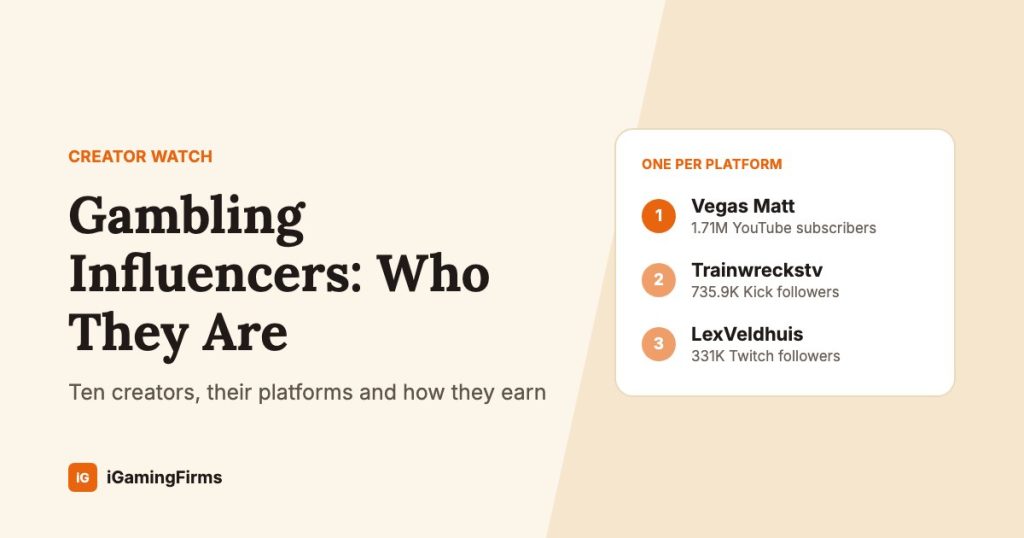
If you are weighing gambling influencers as a marketing channel, the hard part is not finding names but knowing which deals are legal, which platforms allow them and what you can actually measure.
The short answer: gambling influencers are creators who film or stream casino, slots, poker or betting play, mainly on YouTube, Kick and Twitch, with clips spread on Instagram, TikTok and X. For an operator or affiliate, the channel is narrower than audience numbers suggest. X bars gambling from paid partnerships outright, TikTok does not allow gambling marketing outside permitted paid ads and Massachusetts bans sports wagering operators from paying third parties a share of the revenue from players they send. That last rule closes off the revenue-share creator-code deal that is common in online casino streaming.
This guide profiles ten well-known creators by platform, with dated audience figures, the commercial ties visible on their own channels or reported by major news outlets, the platform policies that govern their content and the advertising rules you would sign up to as a brand. Kick follower counts were read from Kick’s public channel data on 27 November 2026. YouTube and Twitch counts are as displayed on each channel page when it was checked in November 2026. No creator paid to be included. Nothing here is a recommendation to gamble or to use any site mentioned.
Gambling influencers compared: platform, audience and commercial ties
Serial numbers match the profile order below. “Commercial ties” covers only what the creator’s own page shows or what reputable outlets have reported. Where neither exists, the cell says so.
| # | Creator | Main platform | Audience (date) | Content | Commercial ties shown or reported |
|---|---|---|---|---|---|
| 1 | Vegas Matt | YouTube @VegasMatt | 1.71 million subscribers (Nov 2026) | High-stakes slots and table games in Las Vegas | Fontainebleau Las Vegas in the collaboration section; own merchandise store |
| 2 | NG Slot | YouTube @NGSlot | 1.3 million subscribers (Nov 2026) | Land-based slots and high-limit blackjack | Ticketed live event at Hard Rock Tampa; separate sweepstakes channel |
| 3 | Brian Christopher Slots | YouTube @BCSlots | 1.02 million subscribers (Nov 2026) | Casino slots and high-limit challenges | Related betting channel links to a DraftKings subdomain; paid fan program and events |
| 4 | Trainwreckstv | Kick | 742,125 followers (27 Nov 2026) | Slots and casino streams, podcast | Reported Kick adviser (2022); said in 2022 that sponsors paid him $360 million over 16 months |
| 5 | The Big Jackpot | YouTube @TheBigJackpot | 689,000 subscribers (Nov 2026) | Land-based slot videos and livestreams | Seminole Hard Rock venue posts; branded cruise with Virgin Voyages |
| 6 | ROSHTEIN | Kick | 425,897 followers (27 Nov 2026) | Online slot streams | Stake chat-command tag in stream titles; Stake-linked streams reported by Bloomberg |
| 7 | LexVeldhuis | Twitch | 331K followers (Nov 2026) | High-stakes online poker tournaments | Left PokerStars in January 2026 after 17 years; listed in the GGPoker Stream Team |
| 8 | Xposed | Kick | 189,075 followers (27 Nov 2026) | Online slots and casino streams | Directs viewers to play under his code on Roobet |
| 9 | Casino Kelly | YouTube @CasinoKelly | 77.7K subscribers (Nov 2026) | Slots, video poker and table games | #ad-tagged Quick Hits social casino post; AGS game premiere |
| 10 | Slot Traveler | YouTube @SlotTraveler | 46.3K subscribers (Nov 2026) | Slot play and jackpot handpays | Video labelled as sponsored by Slots.lv |
Follower and subscriber counts are not comparable across platforms. A Kick follow, a YouTube subscription and a Twitch follow measure different levels of commitment. None tells you the age or country of the audience. Treat the table as a map of who works where, not a ranking of value.
Gambling influencers as a marketing channel, platform by platform
Where a creator publishes decides what you are allowed to buy from them. The rules below come from each platform’s own policy pages and from reporting on policy changes. They differ more than the audience numbers do.
YouTube
YouTube is the home of land-based casino creators. Its illegal or regulated goods and services policy prohibits facilitating access to an online gambling or sports betting site that is not certified by Google. The policy covers clickable links and verbally directing viewers to another site, so a spoken promo code for an uncertified casino counts. It also bans promising viewers guaranteed returns from online gambling, even on certified sites. Content that promotes or depicts online gambling can be age-restricted. For a regulated operator, YouTube works if your brand holds Google certification in the target market. For an offshore brand it is a takedown risk for the creator.
Kick
Kick launched in late 2022, shortly after Twitch narrowed its gambling rules. The Washington Post reported that Kick confirmed Stake co-founder Ed Craven “is involved in Kick” while saying Stake itself was not an investor. A 2026 Bloomberg Businessweek investigation describes Kick and Stake as closely linked through their founders. In November 2024 Kick announced it would limit gambling streams to approved sites, with further changes phased in the following year. Kick’s Slots & Casino category is the main home of the online casino streamers in this list. Many brands promoted there are not licensed in the US, UK or other regulated markets, which is the main brand-safety issue for a licensed operator.
Twitch
In September 2022 Twitch announced a ban on streaming slots, roulette and dice games from sites not licensed in the US or other jurisdictions with consumer protections. According to the Washington Post, the named sites were Stake, Rollbit and Duelbits. Sports betting, poker and fantasy sports remained allowed. That is why poker creators such as LexVeldhuis still stream on Twitch while many slot streamers moved to Kick.
X
X is the strictest of the five for creator deals. Its paid partnerships policy lists gambling products and services, including lotteries, social casinos and sports betting, as a prohibited industry for paid partnership promotion. Every other paid partnership post must carry #ad. In practice X is useful for organic clips and community, not for paid gambling endorsements.
Instagram and Facebook allow gambling advertising only for approved advertisers. Meta’s ad standards require prior written permission to run online gambling ads, plus targeting that respects local age limits. Trainwreckstv, ROSHTEIN, Xposed and Slot Traveler all list Instagram accounts. For a licensed brand, a paid gambling ad there needs Meta’s permission first.
TikTok
TikTok’s regulated commercial activities guidelines say it does not allow the facilitation or marketing of gambling. Content that shows or glamorises gambling is restricted to adult viewers and removed from the For You feed. The exception is paid gambling ads from advertisers with TikTok’s explicit permission. A creator’s organic gambling clip on TikTok therefore reaches less of the audience than the follower count implies.
The 10 gambling influencers, reviewed
1. Vegas Matt
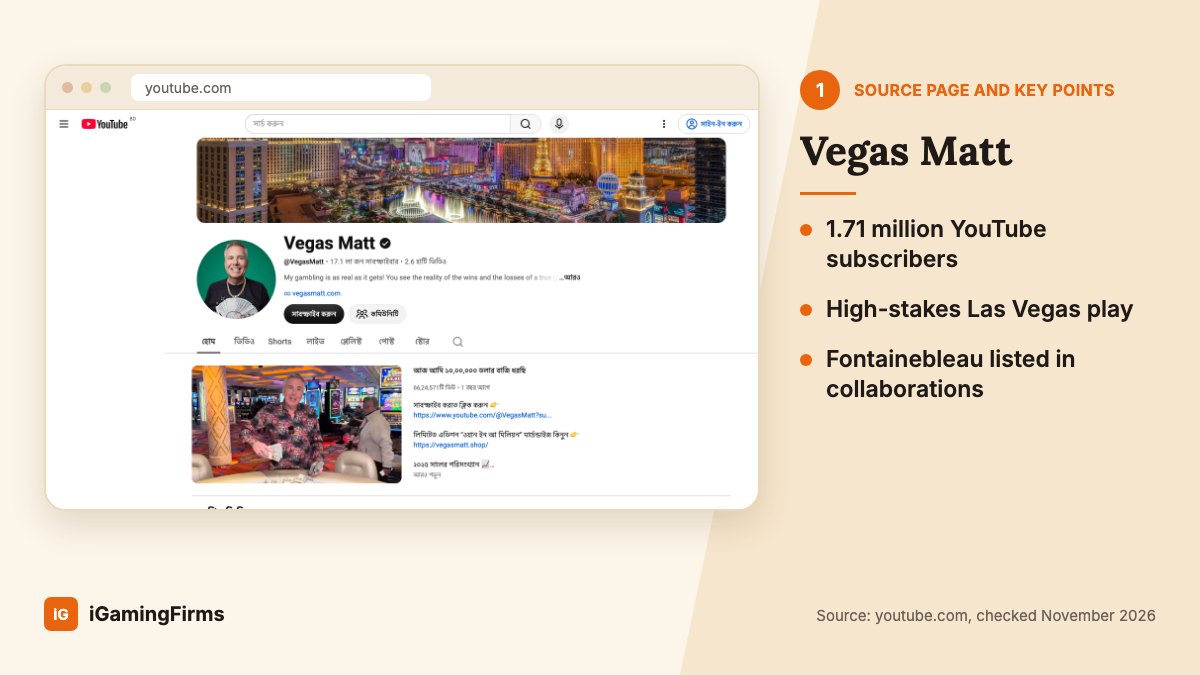
Vegas Matt runs one of the largest casino channels on YouTube, built on high-stakes slots and table games filmed in Las Vegas. The channel description says the gambling is “as real as it gets” and shows “the reality of the wins and the losses.” When checked in November 2026 the channel displayed 1.71 million subscribers and about 2,600 videos. Titles include spins at $750 each and a playlist of table game bets from $6,500 to $10,000.
The commercial picture is visible but not priced. The channel’s collaboration section lists Fontainebleau Las Vegas without saying whether it is paid. The channel sells its own merchandise and says it has created 12 jobs. For a marketer, this is the template of a land-based creator who has become a small media business. Venue partnerships fit naturally. Online casino promotion would run into YouTube’s certification rules.
2. NG Slot
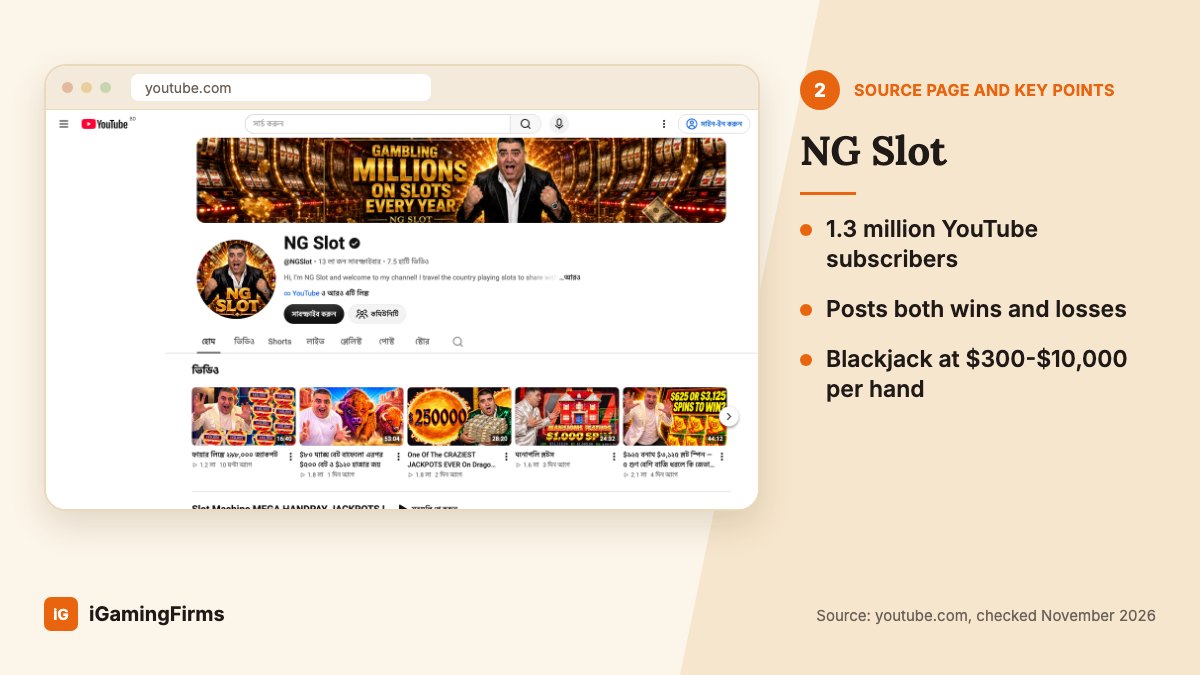
NG Slot films slot and blackjack play in casinos, from ordinary bets to high-limit sessions. Its description says it posts wins and losses so viewers do not get “the illusion that gambling is a winning proposition.” In November 2026 the main channel showed 1.3 million subscribers and about 7,500 videos. A blackjack playlist covers mainly six-deck games at $300 to $10,000 per hand.
The creator runs secondary channels, including one named NG SLOT Sweepstakes. That matters for brand fit because sweepstakes casinos face a fast-changing state map. The sweepstakes casino legal states guide tracks which states have restricted them. A community post promoted a ticketed event at Hard Rock Tampa. The channel does not describe the commercial terms of that event.
3. Brian Christopher Slots
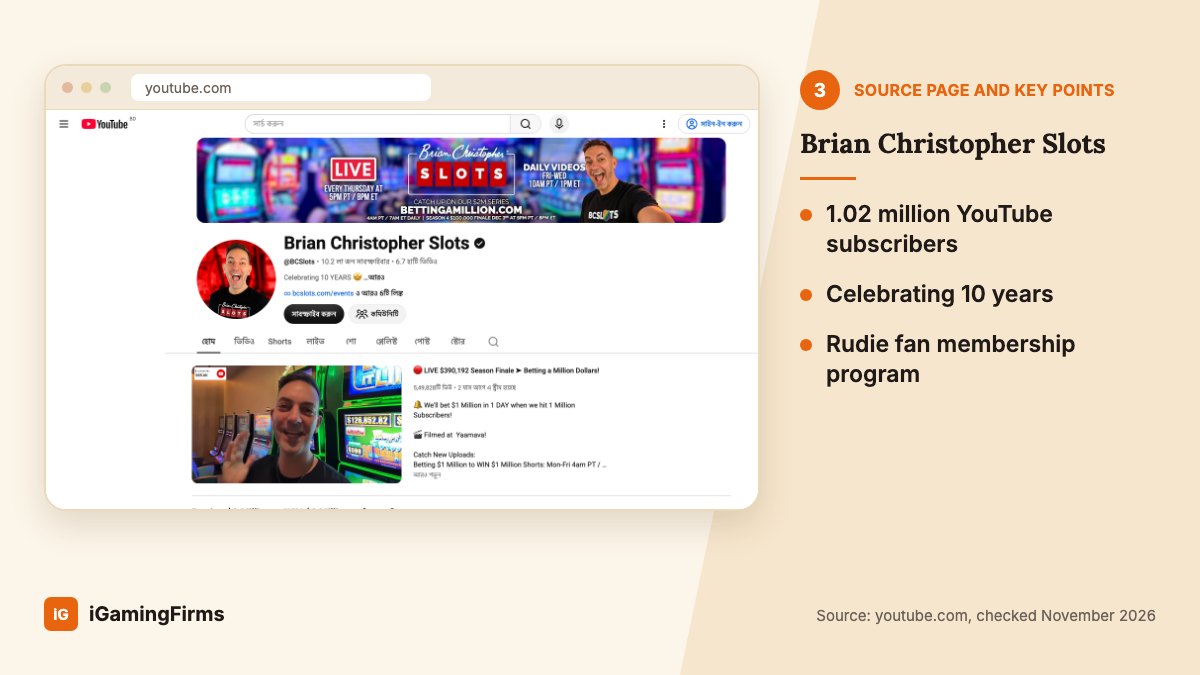
Brian Christopher Slots is a slot channel marking ten years on YouTube, with 1.02 million subscribers displayed in November 2026. Its large-stake specials include a $1 million live slot session at Foxwoods. Live streams run on Wednesday and Thursday evenings US time. The content is credited to BC Ventures, LLC, which is the entity a brand would contract with.
This channel shows the fan-community model at its most developed. A paid “Rudie” membership offers exclusive streams and discounts. Merchandise sells through CasinoSwag.com and an events page promotes group pulls, slot tournaments and cruises. The header of the related Brian Christopher Bets channel links to a DraftKings subdomain (draftkings.bcslots.com). The page does not describe the arrangement. If you are a regulated US operator, this is the kind of creator whose audience already expects venue and brand tie-ins.
4. Trainwreckstv
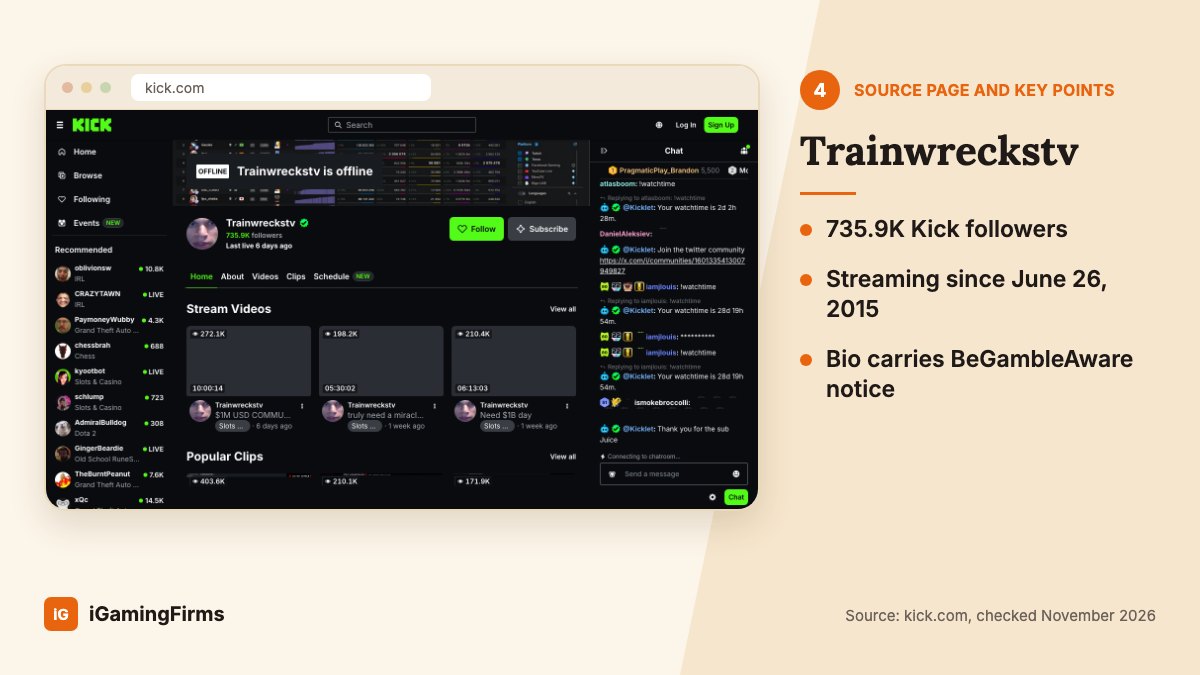
Trainwreckstv (Tyler Niknam) had 742,125 Kick followers on 27 November 2026. His channel mixes Slots & Casino streams with talk content. His Kick bio now promotes a podcast. He is one of the most documented gambling influencers. In December 2022 the Washington Post reported he was advising Kick in a non-ownership role and that he said he had no contract with Stake at that time.
Bloomberg Businessweek reported that Niknam said he accepted $360 million in the 16 months before October 2022. It also reported his $37.5 million win on a $6,000 bet in July 2025. The same report notes that Niknam has acknowledged on stream that some streamers work under “fill” deals, where the casino supplies the balance. For a licensed operator, this creator illustrates the scale of the offshore crypto casino streaming market rather than a usable partner. Stake’s main site is blocked in the US according to Bloomberg. Its US sweepstakes site faces lawsuits. The guide to whether Stake.us is legal covers that status by state.
5. The Big Jackpot
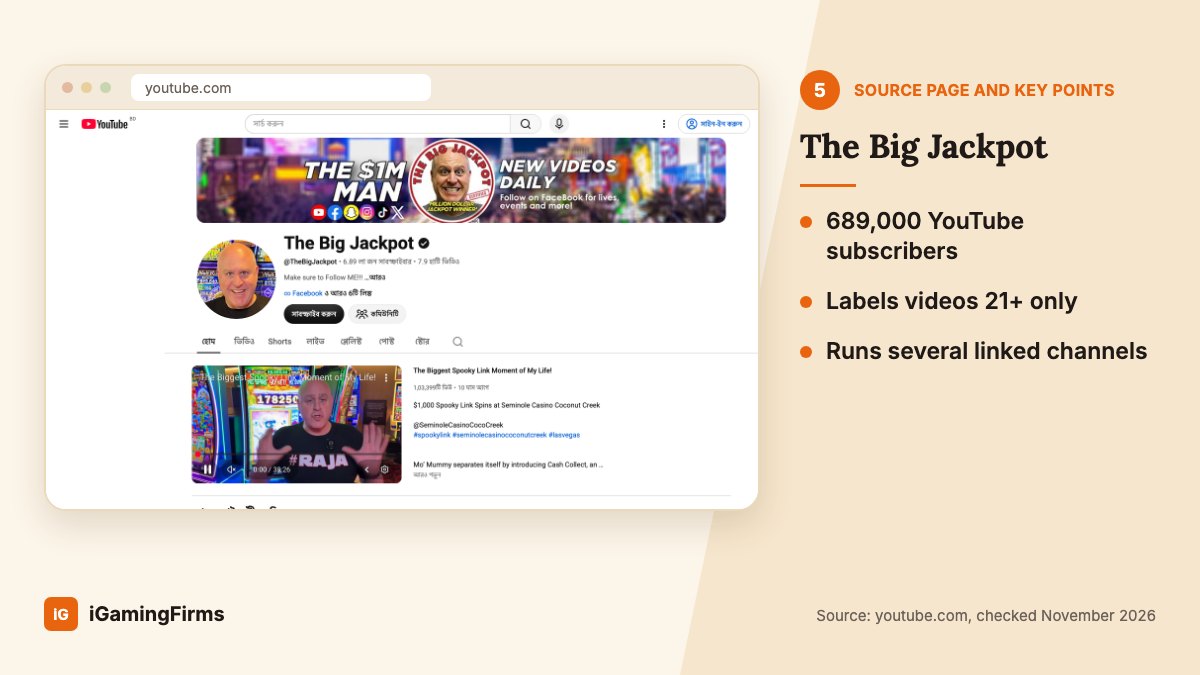
The Big Jackpot posts slot videos and livestreams from US casinos, with 689,000 subscribers displayed in November 2026. The host is known on the channel as “The Raja.” Secondary channels carry best-of edits and archived streams from more than ten years of high-limit play. Content features venues such as Seminole Hard Rock Hollywood in Florida and Seminole Casino Coconut Creek.
The creator’s commercial model leans on events. He says he sold out a theatre show with NG Slot and Vegas Matt. The channel also promoted The Big Jackpot Cruise, a seven-night Virgin Voyages sailing from Los Angeles. Videos are labelled as intended for viewers 21 and over, with a message pointing to gambling help. For casino resorts, this is the event-led partnership format: a ticketed meet-up or tournament rather than a promo code.
6. ROSHTEIN
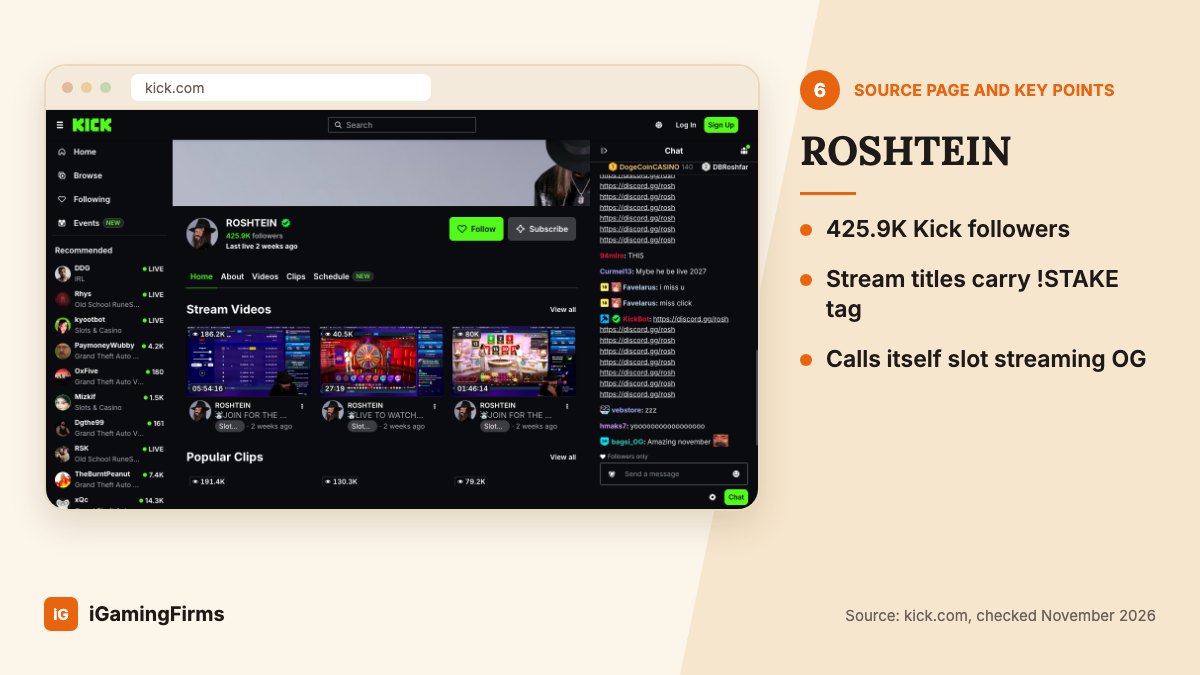
ROSHTEIN (Ishmael Swartz) is a verified Kick channel with 425,897 followers on 27 November 2026. His bio calls him “The first. The longest-running. The slot streaming OG.” Stream titles carry a Stake chat-command tag. Bloomberg Businessweek reported that he won $45.4 million on a $10,000 bet in July 2025. Former Stake employees told the publication that some streamers, including Swartz, start streams with hundreds of thousands of dollars preloaded.
For marketers, ROSHTEIN shows the online slot streaming format in its purest form: long sessions, bonus buys and big-win clips that travel on social media. Stake is not licensed by any US state regulator. Bloomberg reports that its main site blocks US players. Treat this channel as market context. Any brand that appears next to these streams in regulated markets risks breaching rules on promoting unlicensed gambling.
7. LexVeldhuis
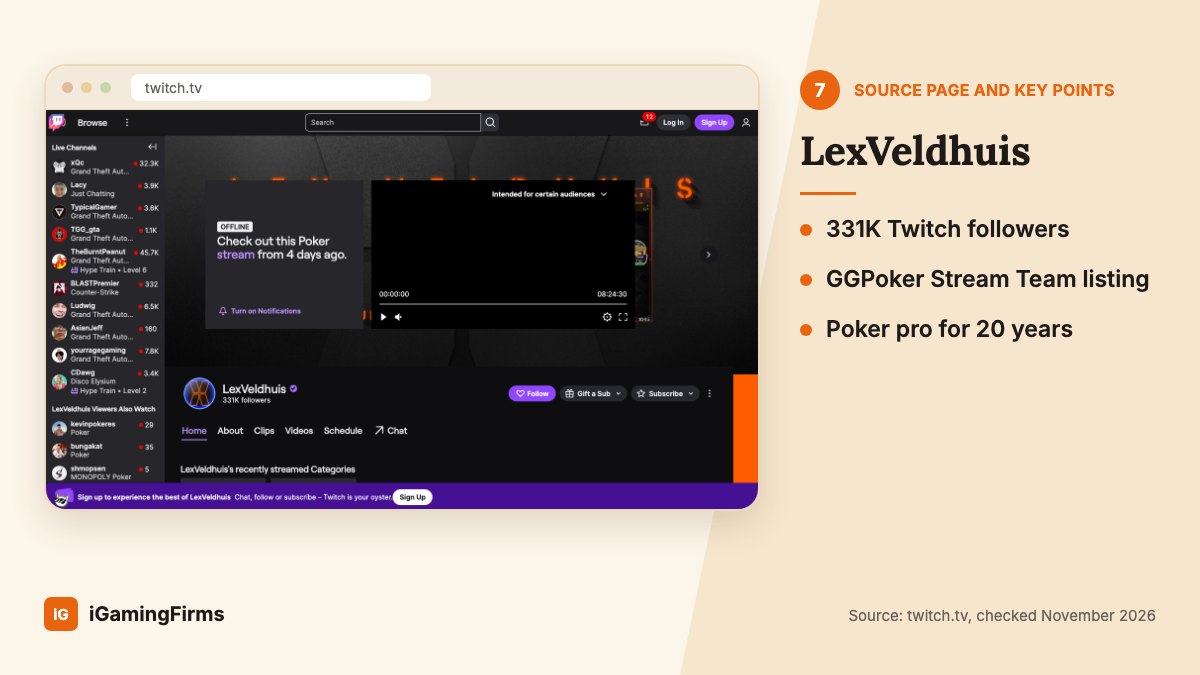
LexVeldhuis is a Dutch poker pro who streams high-stakes online tournaments on Twitch, with 331K followers shown in November 2026. His page says he has played professionally for 20 years and streamed for ten. Poker Industry News reported that he announced his departure from PokerStars on 3 January 2026, ending a 17-year ambassador partnership. He returned to streaming that month on GGPoker, which holds a Dutch licence. In January 2026 he ranked first in Twitch’s Poker category with about 2,034 average viewers.
When his page was checked in November 2026 it listed him in the GGPoker Stream Team. He says he invests about $100,000 of his own money each month in tournament buy-ins. For poker operators, this is the clearest example in the list of a long-term ambassador deal tied to a licensed brand in the creator’s home market. His switch also shows how licensing can force a partnership change. PokerStars’ exit from the Netherlands in 2021 left him streaming from Belgium for nearly three years.
8. Xposed
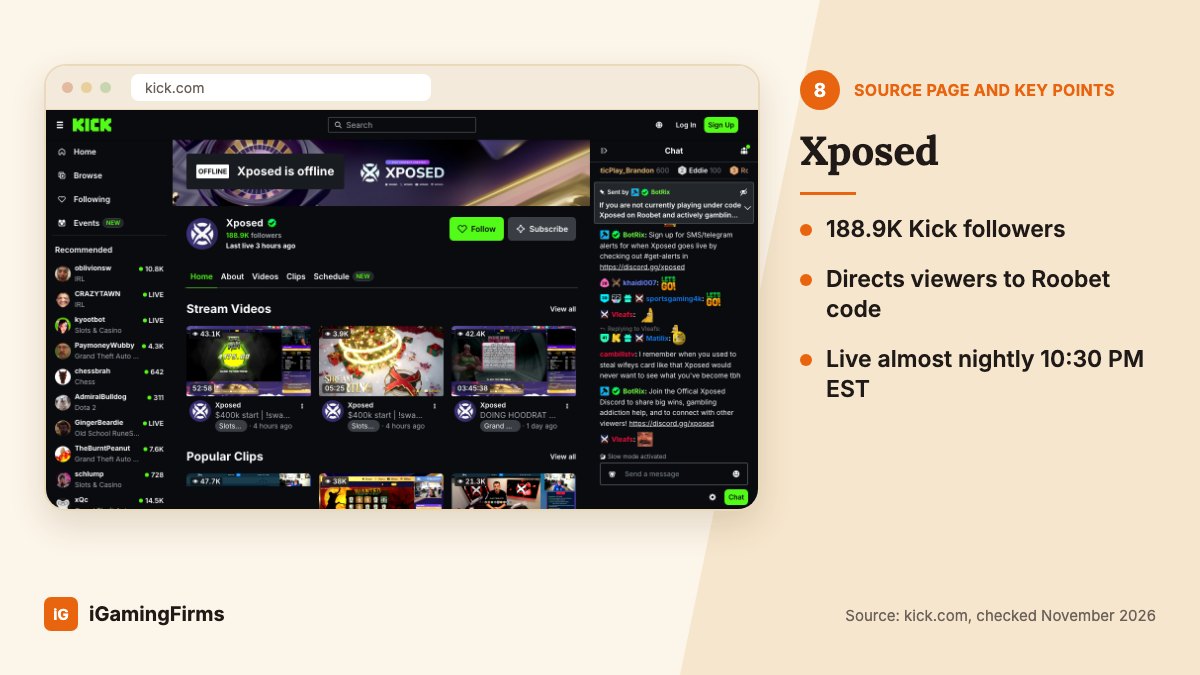
Xposed is a verified Kick channel with 189,075 followers on 27 November 2026. His bio introduces him as Cody, aged 28, streaming online gambling content in a “high energy, realistic and giving back” style, live most nights from 10:30 PM Eastern. He says he has given more than 6,000,000 back to his community, without naming a currency. Stream titles have cited starting balances from $400,000 to $580,000 and a multi-day “gambling detox” series.
His page directs viewers to play under his code on Roobet. Roobet’s site footer names Raw Entertainment B.V. as operator under a Curaçao licence. That is the creator-code model: attribution through a code or link, usually paid as revenue share or CPA. The model is efficient to track. It is also the model that some US states restrict, as the regulation section below explains.
9. Casino Kelly
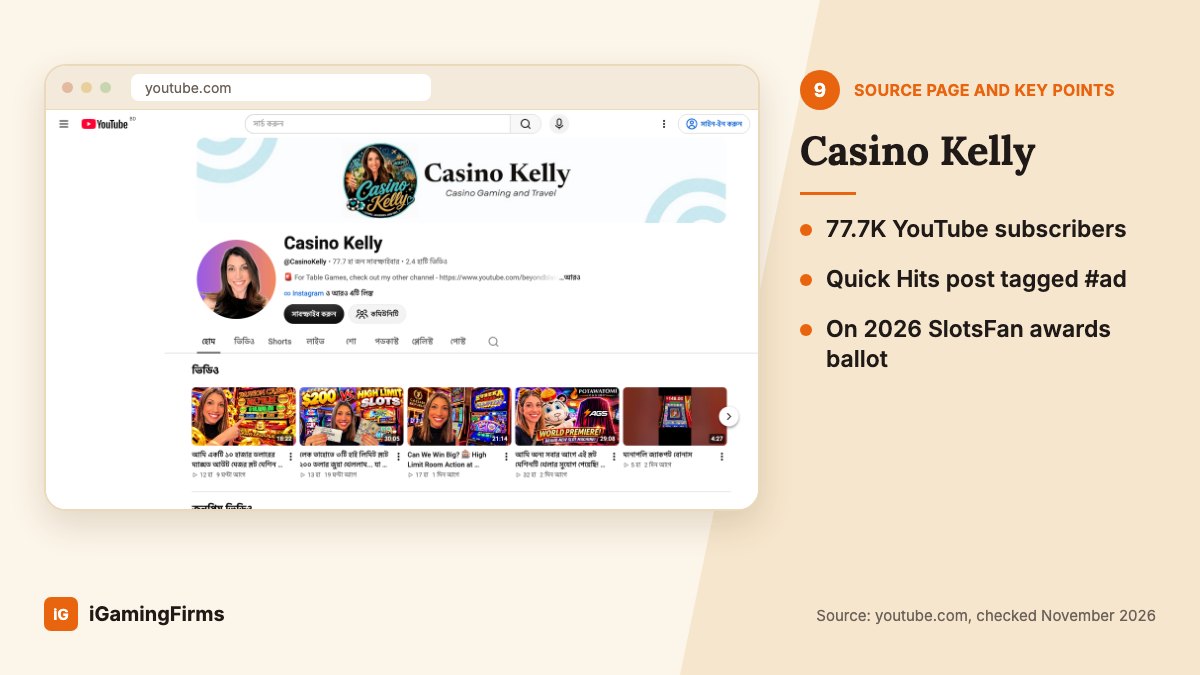
Casino Kelly posts slots and video poker, with table games on a second channel called Beyond Blackjack. The main channel showed 77.7K subscribers and about 2,400 videos in November 2026. Content features US casinos such as Atlantis Casino in Reno. The channel played the world premiere of a new AGS game at Potawatomi Casino.
This is the clearest supplier-side example in the list. One post links a Quick Hits social casino download and is tagged #ad. Another video carries a #SciPlay tag. A community post refers to a presentation at G2E. The channel also appeared on the 2026 SlotsFan Players’ Choice Awards ballot. Smaller channels like this often suit game studios and social casino brands better than mega-channels do, because their audience is already interested in specific titles.
10. Slot Traveler
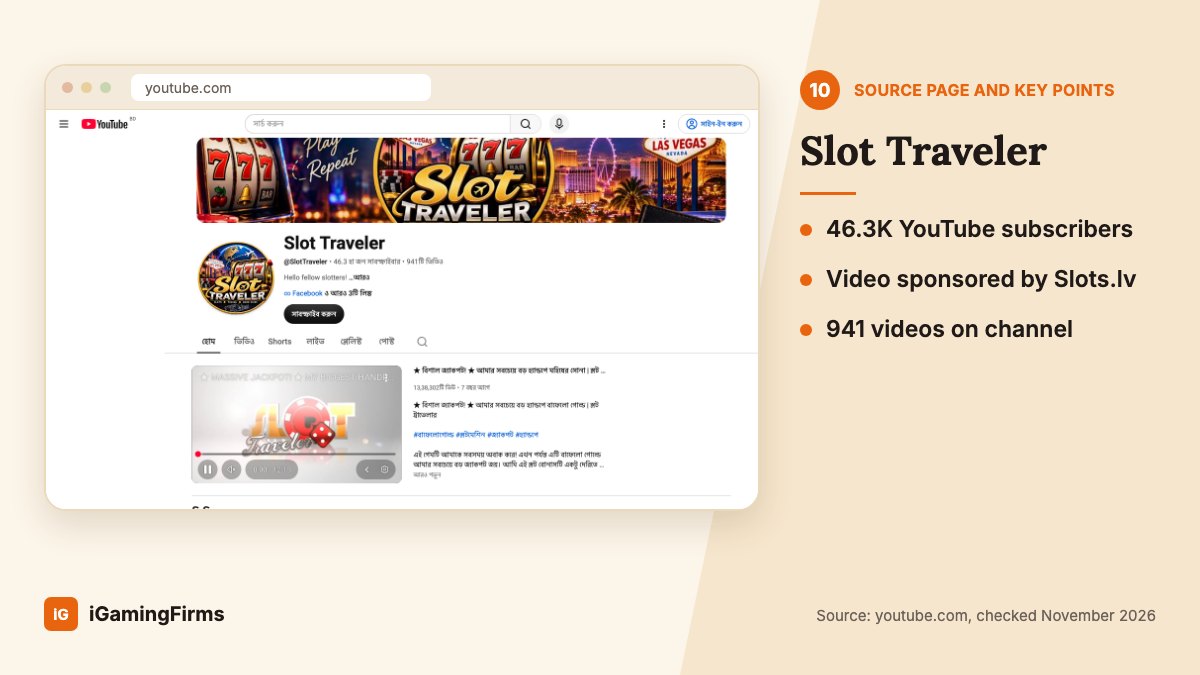
Slot Traveler posts casino floor slot play, bonus rounds and jackpot handpays, including a Buffalo Gold handpay at Wild Horse Pass Casino in Arizona. It showed 46.3K subscribers and 941 videos in November 2026. The channel also runs a Spanish-language playlist and lists an Instagram account.
One online live-play video is labelled as sponsored by Slots.lv. The Slots.lv footer names Arbol Media B.V. as operator under a Curaçao Gaming Authority licence. The site is not licensed by any US state regulator. Its sign-up form defaults to the United States. A clear sponsorship label meets one part of disclosure rules. It does not make the promotion lawful where the brand is unlicensed. The guide to offshore betting legality explains the US position.
Advertising rules that apply to gambling influencer deals
Once you pay a creator, their content becomes your advertising. Regulators in the US and UK treat it that way. Several US states hold the operator responsible for whatever its affiliates and agents publish.
FTC Endorsement Guides (United States)
The FTC’s Guides Concerning the Use of Endorsements and Testimonials in Advertising (16 CFR Part 255) were last revised in July 2023. Section 255.5 requires disclosure of any material connection between an endorser and a brand. The FTC’s guidance for influencers says a disclosure in a video description is not enough. For livestreams it suggests a continuous, clear and conspicuous disclosure because viewers join at any time. It also says tagging a brand is not a disclosure and that a platform’s built-in label may not be sufficient. Endorsements must reflect the creator’s honest experience, which raises questions when a casino funds the balance being played.
UK CAP Code: strong appeal to under-18s
In the UK, rule 16.3.12 of the CAP Code gambling section bars marketing that is likely to be of strong appeal to children or young persons. It also bars featuring anyone whose example is likely to be followed by under-18s or who has strong appeal to them. The stricter “strong appeal” test has applied since October 2022. It catches many streamers and footballers whose audiences skew young. Rule 16.3.14 adds that no one who is, or seems to be, under 25 may be featured gambling or playing a significant role. Before booking a UK creator, you need audience age data that shows under-18 appeal is low, not just a creator’s word.
US state rules on influencer and affiliate marketing
State regulators set the binding rules for licensed US sportsbooks and casinos. Four examples show the range:
- Massachusetts: 205 CMR 256.01 makes the operator responsible for third-party and affiliate advertising. It bans advertising deals that pay a third party a percentage of sports wagering revenue from users it directs. It also requires ads to disclose any financial relationship between an endorser and the operator. 205 CMR 256.05 bans ads aimed at people under 21 and celebrity endorsements designed to appeal primarily to them. It bars ads on social media or video platforms where 25% or more of the audience is reasonably expected to be under 21, unless adequate age controls are in place.
- New York: the State Gaming Commission’s advertising rules (9 NYCRR 5329.37) require affiliate partners to disclose any agreement to promote a licensee in a reasonably prominent manner. They require licensees to follow FTC endorsement rules and bar ads where the foreseeable share of underage viewers exceeds that age group’s share of the state population. Social media pages with sports betting content must carry a reminder of the legal betting age.
- Ohio: Ohio Admin. Code 3775-16-08 bars sports gaming ads that target people under 21 and campus advertising. The Ohio Casino Control Commission can require a sportsbook to end an affiliate contract if the marketer breaks the rules.
- New Jersey: standards announced in April 2023 by the Attorney General and the Division of Gaming Enforcement bar gambling ads in media whose primary demographic is underage, with youth-oriented social media given as an example.
The industry’s voluntary American Gaming Association Responsible Marketing Code says no sports betting message should be designed to appeal primarily to people below 21. Minimum ages vary by state and product. The legal gambling age by state guide lists them.
Do gambling influencers get paid?
Yes. Gambling influencers are paid through four main routes. The amounts are rarely public. The first is sponsorship: a flat fee for a branded video or stream, as with Slot Traveler’s labelled Slots.lv video. The second is affiliate commission: a creator code or link paid per depositing player (CPA) or as a share of net gaming revenue, which is the model behind Xposed’s Roobet code. The third is ambassador or stream team deals, such as LexVeldhuis’s long PokerStars partnership and his later GGPoker Stream Team listing. The fourth is platform and fan income: ad revenue, Kick and Twitch subscriptions, memberships, merchandise, cruises and ticketed shows.
The few deal sizes in the public record come from investigative reporting, not from creators. Bloomberg Businessweek reported that Trainwreckstv said he accepted $360 million over 16 months. It also reported that Adin Ross received at least 26,000 Ether from Stake between November 2021 and March 2025, based on blockchain analysis. Those figures describe the offshore crypto casino market. Regulated operators work with far smaller budgets and, in states like Massachusetts, without revenue share. The iGaming affiliate marketing guide explains how CPA, revenue share and hybrid deals are structured.
Who are some famous YouTube gamblers?
By subscribers displayed in November 2026, the largest YouTube gambling channels in this list are Vegas Matt (1.71 million), NG Slot (1.3 million), Brian Christopher Slots (1.02 million) and The Big Jackpot (689,000). All four focus on slot play in land-based US casinos. Vegas Matt and NG Slot also cover high-limit table games. They also work together on live shows, which means their audiences overlap more than the separate numbers suggest. Smaller channels such as Casino Kelly (77.7K) and Slot Traveler (46.3K) are more niche and often more supplier-focused.
What celebrities advertise gambling?
Mainstream celebrity gambling advertising is concentrated in sports betting, where operators have used athletes, actors and musicians. The fastest-growing crossover is between celebrities and streaming casinos. Bloomberg Businessweek reported that Drake streams Stake play on Kick and that a California lawsuit filed in August 2025 named Drake and Adin Ross. Trainwreckstv has also streamed blackjack with Drake.
For a licensed brand, celebrity and influencer deals fall under the same youth-appeal tests. Massachusetts bans celebrity endorsements designed to appeal primarily to under-21s. The UK CAP Code bans anyone with strong appeal to under-18s. A celebrity with a large teenage fan base is a regulatory problem, whatever their reach.
Online gambling influencers vs land-based creators
The ten creators split into two business types. Online gambling influencers stream play on internet casinos or poker rooms. In this list that means Trainwreckstv, ROSHTEIN and Xposed on Kick and LexVeldhuis on Twitch. Their commercial ties run through codes, stream title tags and ambassador deals with online brands. Land-based creators film on casino floors. Vegas Matt, NG Slot, Brian Christopher Slots, The Big Jackpot, Casino Kelly and Slot Traveler belong here. Their ties run through venues, game suppliers, merchandise and events.
The split matters because the legal risk sits in different places. A land-based creator promoting a licensed resort carries little licensing risk but must still meet age and disclosure rules. An online creator promoting an offshore casino creates risk for any regulated brand that also pays them. Massachusetts 205 CMR 256.02 bars anyone advertising for a licensed operator from promoting illegal gambling in the state. Ohio’s rule 3775-16-08 applies the same bar to affiliate marketers.
How to vet a gambling influencer before you sign
- Get dated, first-party audience data. Ask for screenshots or exports from YouTube Studio, Kick or Twitch dashboards showing country, age and gender splits for the last 90 days. Public counts like those in the table show size, not who is watching. Under Massachusetts rules you need to show that fewer than 25% of viewers are reasonably expected to be under 21, or that age controls are in place.
- Audit every brand they promote. List the casinos, sportsbooks and codes that appear in titles, overlays, descriptions and pinned chat commands over the past three months. Check each against the relevant regulator’s licence register. Massachusetts and Ohio bar those who market for licensed operators from promoting illegal gambling.
- Ask who funds the balance. Bloomberg’s reporting on preloaded balances and “fill” deals shows why. Under the FTC Guides an endorsement must reflect honest experience. Wins played with casino money are not a typical player’s experience.
- Check disclosure habits. Look for #ad labels, spoken disclosures and continuous on-screen labels during streams. Tagging alone does not count.
- Review conduct and chat. Watch several full streams, not highlight clips. Look at how the creator talks about losses, chasing and debt. Check whether chat moderation removes underage or problem-gambling comments.
- Confirm the contracting entity. Many creators trade through companies, such as BC Ventures, LLC for Brian Christopher Slots. Make sure the contract binds the creator to your compliance rules and lets you end it if a regulator asks.
How to measure ROI on gambling influencer campaigns
Influencer traffic is easy to count and hard to value. A workable measurement plan has three layers.
Direct attribution. Give each creator a unique code and tracked link. Record registrations, first-time depositors (FTDs), deposits and net gaming revenue per player cohort. Compare 30-, 90- and 180-day value against other channels, because streamer audiences often register in spikes during big-win moments and churn faster. The iGaming affiliate platforms comparison covers tools that track creator codes alongside regular affiliates.
Geo and age filtering. Count only players from markets where you hold a licence and who pass KYC. A campaign that generates thousands of blocked registrations from unlicensed regions is a compliance signal, not a success.
Incremental lift. Codes miss viewers who sign up later through search or app stores. Track branded search volume and direct app installs in the creator’s main markets during and after the campaign. Compare against a period or region without activity. Where state rules ban revenue-share deals, such as Massachusetts for sports wagering, use flat fees or CPA and judge them against this blended view.
Set a cost per FTD ceiling before launch and a review point after the first month. Creator audiences change fast, so a renewal should depend on fresh audience data, not on last quarter’s numbers.
Payment models, platform bans and whose money is on screen
Revenue share is banned in at least one US state
The creator-code-plus-revenue-share model is treated as the default in gambling influencer marketing. Massachusetts 205 CMR 256.01(3) prohibits sports wagering operators from paying third parties a percentage of revenue from users they direct. New York rule 5329.37 bars affiliate compensation methods prohibited by state law. If your plan depends on revenue share, check each state before launch.
Two major platforms close the door on paid gambling endorsements
TikTok and X followers are not sellable reach for gambling brands. X’s paid partnerships policy prohibits gambling paid partnerships, including social casinos. TikTok does not allow gambling marketing outside permitted paid ads and keeps gambling content out of the For You feed. Followers on those platforms are an organic asset, not inventory you can buy.
The wins on screen may not be the creator’s money
Big-win clips drive the format’s reach. Bloomberg Businessweek reported that some Stake streamers start with preloaded balances and that “fill” deals exist where the casino supplies the stake. Under the FTC’s endorsement guidance, an endorsement must reflect honest experience and material connections must be disclosed. A regulated brand that copies that format without disclosure takes on the same risk.
Your next step
Start with the licence map, not the follower list. Write down the markets where you hold licences, then shortlist two or three creators whose verified audience sits mainly in those markets and above the legal age. Ask each for 90 days of dashboard demographics, a list of every gambling brand they promoted in that period and their disclosure practice. Choose a deal model your regulators allow, such as a flat fee or CPA where revenue share is banned. Agree tracking before the first stream so the ROI review at day 30 rests on data you control.