Last updated: 15 October 2026
iGaming fraud detection is the real-time screening of registrations, logins, bonus claims, deposits and withdrawals to stop multi-accounting, bonus abuse, account takeover, payment fraud and money mules before they cost you money or your licence. No single tool does all of it: a working stack layers pre-KYC risk scoring, identity verification and continuous monitoring across the player journey.
Your welcome offer is converting well, until the fraud team notices half the new accounts share three devices and a residential proxy pool. Or a dormant VIP account wakes up on an unfamiliar phone and requests a withdrawal to a new e-wallet. Most operators already have some fraud detection in place. The harder question is which signals actually catch these patterns, at which point in the journey, and which vendors cover which gaps.
This guide is written for heads of fraud, risk, payments and compliance at operators. It covers the fraud types that cost the most in 2026, how detection works, the signals that expose each pattern, a comparison of eight vendors by what they really do, the metrics to track and a worked cost example built on published list prices.
The short answer
A working fraud stack usually combines three layers:
- Pre-KYC risk scoring (device fingerprint, IP and proxy checks, email and phone footprint) at registration, to stop multi-accounting before you pay for a full identity check.
- Identity verification (documents, liveness, deepfake detection, AML screening) at the point your licence or risk level requires it.
- Continuous monitoring (login, bonus claim, deposit and withdrawal events) to catch account takeover, dormant account abuse and mule activity after onboarding.
Vendors such as SEON and Sumsub now sell all three layers, while specialists like Fingerprint (device intelligence) and GeoComply (geolocation) go deeper on one. Which mix fits depends on your markets, volumes and how much tuning your team can do.
Why fraud detection got harder in 2026
Three things changed the picture this year.
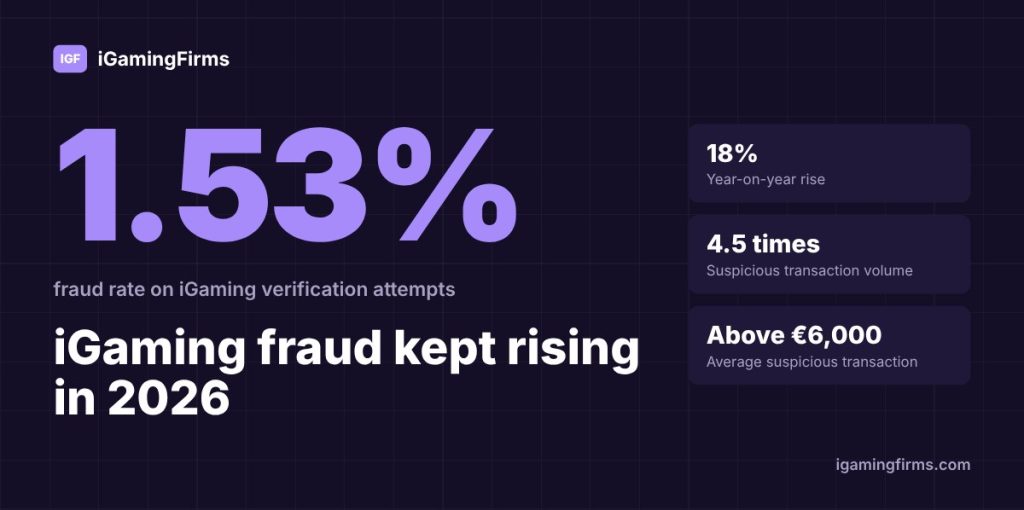
Fraud rates kept rising. Sumsub’s iGaming Fraud Report 2026 puts the fraud rate on iGaming verification attempts at 1.53% in Q1 2026, up 18% year on year, with suspicious transaction volume up 4.5 times since Q1 2025 and the average suspicious transaction value above €6,000, nearly double a year earlier. Africa had the highest regional rate at 2.5%. Bonus and promotion abuse is consistently reported as one of the largest fraud categories in iGaming. These are vendor network figures, so treat them as directional rather than an industry census.
Fraud moved from new accounts to trusted ones. SEON’s Global iGaming Risk and Fraud Report describes rings buying aged, verified accounts, keeping them dormant past normal review windows, then claiming retention bonuses, which are often worth more than welcome offers. The giveaways are an unrecognised device or foreign IP on a previously verified account and a sudden jump from inactivity to high-frequency transactions. A KYC check at signup does nothing here, because the account is already verified.
UK rules removed an old defence. Since 19 January 2026, the UK Gambling Commission caps bonus wagering requirements at 10 times and bans mixed-product promotions (UKGC announcement). High wagering used to make bonuses expensive to clear. At 10x or less, a bonus is easier to extract value from, so the job of stopping abusers shifts to detection at signup and at bonus claim.
The regulator is also watching. In its 2026 money laundering risk assessment for remote casino (published 30 July 2026), the UKGC added “inappropriate controls relating to linked or duplicate accounts” as a new high risk. It also flags AI-generated documents, deepfake videos and face swaps used to bypass due diligence, and “withdrawing after minimal play” as a high-risk wagering pattern. One case study describes a customer, previously blocked over suspected money laundering, who opened a new account because the operator’s controls missed small discrepancies in signup data. That is a fraud detection failure with a compliance consequence. For what each regulator expects at onboarding, see our breakdown of iGaming KYC requirements by jurisdiction.
What are the main types of iGaming fraud?
| Fraud type | What it looks like | Where it hurts |
|---|---|---|
| Bonus abuse and multi-accounting | One person or ring opening many accounts (sometimes with friends’ or family members’ details, known as gnoming) to claim welcome or referral offers | Marketing budget, CPA payouts, skewed acquisition data |
| Account takeover (ATO) | Stolen credentials or purchased aged accounts used to claim retention bonuses or withdraw balances | Player funds, reimbursement costs, trust |
| Payment fraud and chargebacks | Stolen cards, or players disputing deposits they made themselves | Chargeback fees, PSP relationships, acquiring risk |
| Synthetic and deepfake identities | AI-generated documents or face swaps used to pass KYC | Regulatory exposure, mule activity |
| Mule and third-party accounts | Accounts run on behalf of others to move funds, often with similar signup dates and wagering patterns | AML compliance, licence risk |
| Affiliate fraud | Fake traffic, self-referrals and low-quality FTDs sold as real players | Affiliate spend, partner disputes |
| Collusion and bots | Players sharing information or automated play, especially in peer-to-peer poker | Game integrity, honest players |
Arbitrage betting is often mentioned alongside these, but it usually breaches sportsbook terms rather than the law, so most operators handle it through trading and risk teams rather than the fraud stack.
How does iGaming fraud detection work?
Every tool on the market combines some of the same five techniques. Knowing which one a vendor leads with tells you what it will and won’t catch.
- Device fingerprinting and IP analysis: builds a near-unique ID from browser, OS and hardware traits, then flags reuse across accounts, emulators, VPNs, proxies and Tor. This is the main defence against multi-accounting.
- Digital footprint checks: looks up the age and history of an email address and phone number. Real players usually have years of footprint; throwaway identities don’t.
- Link analysis: groups accounts that share devices, payment methods, addresses or signup patterns, so you see a ring rather than 40 unrelated players.
- Behavioural analytics and velocity checks: compares current activity with the player’s own history and with peer groups, which is how account takeover, bots and dormant account abuse show up.
- Rules plus machine learning: rules give you explainable decisions a regulator can follow; models catch patterns nobody wrote a rule for. Most operators run both and let models suggest new rules.
Each check costs money and adds friction, so where you run it in the journey matters as much as which technique you use.
Signals that catch each fraud type, by journey stage
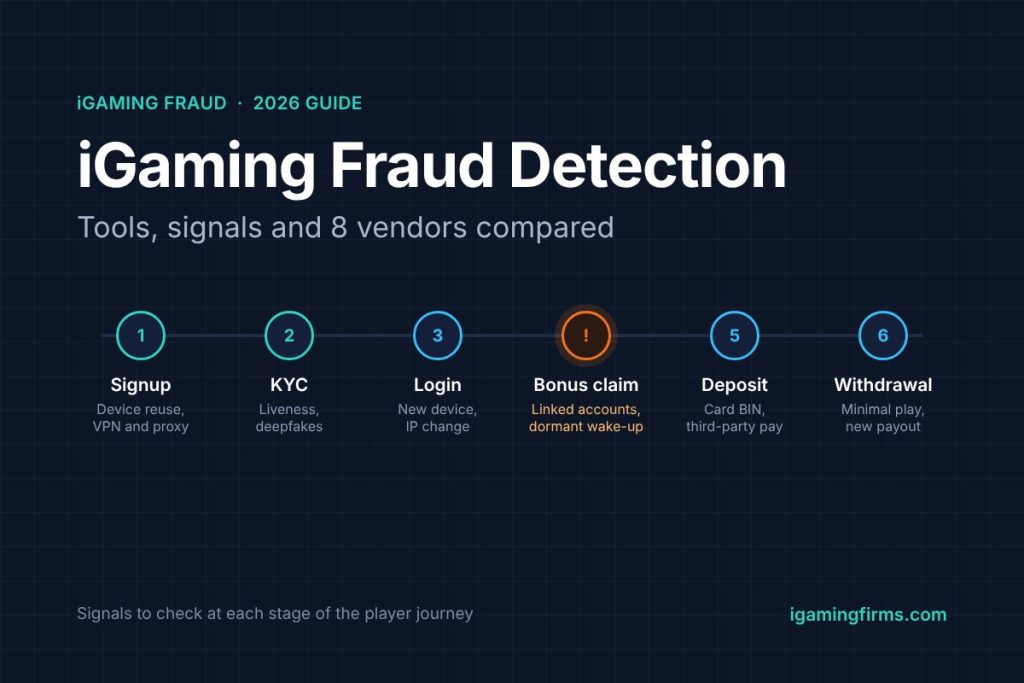
Here is how the main signals map to the player journey. Your platform or player account management system has to send each of these events to the fraud engine in real time for the map to work.
| Journey stage | Signals to check | Catches |
|---|---|---|
| Registration (before KYC) | Device ID reuse, emulator or virtual machine flags, VPN, proxy and Tor detection, email and phone age and footprint, small mismatches in signup fields | Multi-accounting, bonus rings, blocked players returning, bots |
| KYC and onboarding | Document authenticity, liveness, deepfake and injection detection, sanctions and PEP screening, age and address checks | Synthetic identities, deepfakes, underage and sanctioned users |
| Login | New or unrecognised device, IP or country change, failed login velocity, behavioural patterns such as typing cadence | Account takeover, brute-force attacks, scripted logins |
| Bonus claim | Device and IP links to other bonus claimants, dormant account suddenly active, same payment method across accounts | Bonus abuse, dormant account abuse |
| Deposit | Card BIN, third-party payment methods, prepaid cards, deposit velocity, geolocation versus licence area | Payment fraud, mule funding, out-of-jurisdiction play |
| Withdrawal | Withdrawal after minimal play, new payout destination, device change since deposit, linked-account clusters | Cash-out fraud, money laundering, ATO cash-out |
Two practical points come out of this map. First, the cheapest place to stop a multi-accounter is registration, before you pay for a full identity verification. Second, withdrawal is the last chance to catch a problem before money leaves, so device and behaviour checks there are worth the cost even for players who passed KYC months ago.
What is the best fraud detection tool for iGaming? Eight vendors compared
There is no single best tool; the right one depends on which fraud type costs you most. The vendors below were chosen because they actively sell to gambling operators. The comparison is built from each vendor’s own product pages, pricing pages, reports and published case studies. Results quoted from case studies are the vendor’s or customer’s claims, not independent tests. For a wider list of identity and AML vendors, see our comparison of KYC providers for iGaming.
| # | Vendor | Core strength | Covers | Published pricing |
|---|---|---|---|---|
| 1 | SEON | Pre-KYC scoring, device and digital footprint | Fraud, AML, IDV modules | Starter $699/month; Premium custom |
| 2 | Sumsub | KYC, liveness and deepfake detection | KYC, AML, device, transaction monitoring | From $1.35 per verification; fraud prevention on custom plan |
| 3 | Fingerprint | Device identification and smart signals | Device intelligence only | Free tier; Pro Plus from $99/month |
| 4 | GeoComply | Compliance-grade geolocation | Geolocation, fraud, KYC (IDComply), chargebacks | Not published |
| 5 | LexisNexis ThreatMetrix | Shared digital identity network | Device, identity, behavioural (BehavioSec) | Not published |
| 6 | TransUnion TruValidate | Device reputation consortium (formerly iovation) | Device risk, identity proofing | Not published |
| 7 | Featurespace (Visa) | Behavioural ML on transactions | Payment fraud, AML monitoring | Not published |
| 8 | Fraudnetic | Gambling-focused modular platform | Fraud, KYC, AML, affiliate fraud | Not published |
1. SEON
SEON scores email, phone, IP and device signals before full KYC, which is why it shows up so often in iGaming. Its iGaming report cites 900+ first-party risk signals, 240+ prebuilt rules and a 14-day implementation, and the platform now includes identity verification, AML screening and transaction monitoring as optional modules.
- Best for: operators who want to stop multi-accounting and bonus abuse at signup and tune rules themselves.
- Pricing: Starter is $699 a month for 2,500 fraud checks, 10 users and 50 custom rules. Premium is custom and adds unlimited API calls, users and custom rules, plus case management, AML and 24/7 support (SEON pricing, checked 15 October 2026). Starter’s check allowance is small for a busy casino, so most operators will end up on Premium.
- Customer results (from SEON’s site): Lottoland is quoted with 32x ROI and a 190% increase in multi-accounting detection at registration; Soft2Bet with a 40% reduction in manual queries.
- What users say: SEON shows a 4.6 G2 rating from 380+ reviews and 4.9 on Capterra on its own site. Customer quotes there highlight fast integration and responsive support; the trade-off is that results depend on how well your team builds and maintains rules.
2. Sumsub
Sumsub started in KYC and has pushed into a combined KYC, AML and fraud offer, with liveness and deepfake detection as a headline feature. It also publishes the most widely cited iGaming fraud data, and Gambling IQ ranked it the number one iGaming fraud prevention provider in its 2026 report.
- Best for: licensed operators who need strong identity verification and AML screening in one contract, especially in markets with heavy deepfake activity.
- Pricing: Basic is $1.35 per verification with a $149 monthly minimum; Compliance is $1.85 per verification with a $299 minimum and adds AML screening, ongoing monitoring and address verification. Fraud prevention, transaction monitoring and non-doc verification sit in the custom plan. There is a 14-day trial with 50 checks, and you are charged only for completed verifications (Sumsub pricing page, checked 15 October 2026).
- Watch for: per-verification pricing makes it costly to run full KYC on every signup, so pair it with cheaper pre-KYC screening.
3. Fingerprint
Fingerprint does one thing: identifies devices across web and mobile and returns “smart signals” such as VPN, proxy, browser tampering, emulator, rooted or jailbroken device, virtual machine, geolocation spoofing and bot detection. It is not a full fraud platform, so you need your own rules engine or another vendor to act on its output.
- Best for: operators with in-house fraud or data teams who want accurate device IDs feeding their own models.
- Pricing: free up to 1,000 web and iOS calls a month; Pro Plus is $99 a month for 20,000 calls, then $4 per 1,000, with up to 500,000 Android calls free each month. Enterprise is custom and adds an SLA and 90-day data retention (Fingerprint pricing, checked 15 October 2026).
- Watch for: Pro Plus keeps data for 30 days, which is short if you want to link a returning abuser to an account from months ago. Store visitor IDs in your own database.
4. GeoComply
GeoComply is the geolocation standard for US state-regulated markets, with FanDuel, DraftKings and BetMGM among its listed customers. Beyond location checks it now sells fraud detection, promo abuse prevention, KYC (IDComply), VPN and proxy detection (GeoGuard) and a chargeback evidence product. It cites 820+ location, device and behavioural signals and up to 99.7% pass rates.
- Best for: operators in US states, Ontario, Alberta and Brazil where geolocation is a licence condition, and who want fraud signals from the same SDK.
- Pricing: on request.
- Watch for: in markets without strict geolocation rules, you may be paying for compliance-grade location you don’t need.
5. LexisNexis ThreatMetrix
ThreatMetrix builds a digital identity from device, connection and behaviour data shared across its Digital Identity Network, and can see through hidden proxies and VPNs. Paired with BehavioSec, it adds behavioural biometrics. LexisNexis Risk Solutions also reports that new account creation bot attacks against gaming and gambling operators rose 345% year on year.
- Best for: large, multi-market operators who want cross-industry identity intelligence and enterprise support.
- Customer results (from LexisNexis’s site): bet365 is quoted with a 50% reduction in synthetic identity fraud attempts within two months and 20% of customers in selected markets onboarded through a light-touch journey.
- Watch for: enterprise sales cycles and pricing, which suit tier-one brands more than start-ups.
6. TransUnion TruValidate
TruValidate Device Risk is the product formerly known as iovation, one of the original device reputation tools in online gambling. Its strength is a consortium of confirmed fraud reports that links devices to accounts across many businesses. TransUnion states a 95% device capture rate, with 81% of devices previously recognised.
- Best for: operators who want device reputation backed by a large shared network, often alongside TransUnion’s identity and responsible gambling data.
- Pricing: on request.
7. Featurespace (Visa)
Featurespace’s ARIC Risk Hub models how each customer normally behaves and flags deviations in transactions. Visa completed its acquisition of Featurespace in December 2024, and the product now sits within Visa’s risk offering.
- Best for: larger operators or payment teams focused on transaction fraud and AML monitoring rather than signup abuse.
- Watch for: it is payments-first, so it won’t replace pre-KYC device and footprint screening for bonus abuse.
8. Fraudnetic
Fraudnetic markets itself specifically to gambling, with modules for device intelligence, multi-accounting link analysis, VPN, proxy and Tor detection, transaction monitoring, KYC, sanctions screening, chargeback defence and affiliate and marketing fraud.
- Best for: smaller and mid-size operators who want a gambling-specific tool with affiliate fraud coverage in one platform.
- What users say: reviews on GetApp come from gambling and casino users and praise the design and feature set.
How to choose: a decision guide
- Your biggest loss is welcome bonus abuse: start with pre-KYC device and footprint scoring (SEON, Fraudnetic, or Fingerprint plus your own rules).
- You operate in US states, Ontario or Alberta: GeoComply is close to mandatory; check what its fraud modules cover before buying a second device tool.
- Deepfake KYC attempts are rising in your markets: prioritise liveness and injection detection (Sumsub or your IDV provider) and test pass rates on real traffic.
- ATO and dormant account abuse are the problem: add device change and behaviour checks at login, bonus claim and withdrawal, not just at signup.
- You run a tier-one, multi-market brand: network-based tools such as ThreatMetrix or TruValidate give you cross-industry history that smaller vendors can’t.
- You have a data team: raw device intelligence plus your own models is often cheaper and more flexible than a full platform.
Whatever you shortlist, ask each vendor the same five questions: which signals are first-party versus resold, how long data is retained, how decisions can be explained to a regulator, what false positive rate they see in gambling specifically, and how pricing scales with your event volume.
How to measure whether fraud detection is working
There is no universal benchmark, because targets depend on your markets, products and risk appetite. Track the same handful of numbers before and after any change, and ask vendors to report them on a trial using your own traffic.
| Metric | What it tells you | Watch for |
|---|---|---|
| Detection rate | Share of confirmed fraud the system flagged | Only measurable if your team labels confirmed cases consistently |
| False positive rate | Share of genuine players wrongly flagged or blocked | Lost deposits and VIP complaints; the cost most vendors don’t quote |
| Manual review rate | Share of decisions that need an analyst | Headcount cost and withdrawal delays |
| Chargeback rate | Disputed deposits as a share of volume | Card scheme monitoring thresholds and PSP relationships |
| Time to detection | How long a ring or ATO runs before it is stopped | Losses grow with every day a cluster stays open |
| Bonus cost per genuine depositor | Promotion spend divided by depositors who pass fraud checks | A rising figure means abusers are getting through |
Worked cost example: a mid-size casino
Published prices only tell you so much, so here is a rough model. The assumptions are illustrative, not benchmarks.
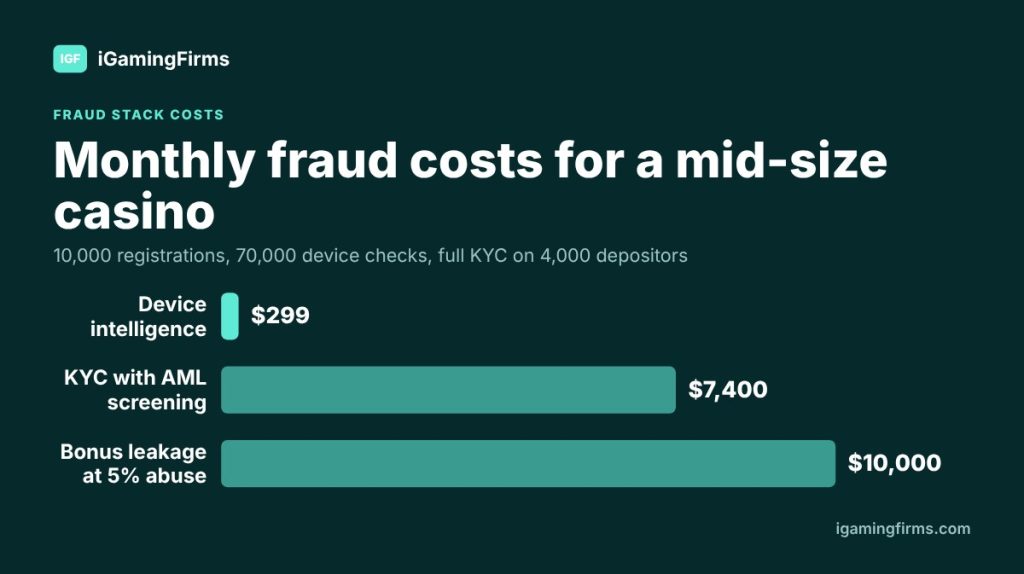
Assumptions (per month): 10,000 registrations, 40,000 logins checked, 15,000 deposits and 5,000 withdrawals, so 70,000 device checks in total. Full KYC runs on 4,000 players (those who deposit). A $20 welcome bonus is on offer.
| Item | Calculation | Monthly cost |
|---|---|---|
| Device intelligence (Fingerprint Pro Plus) | $99 for 20,000 calls + 50,000 × $4 per 1,000 | $299 |
| KYC with AML screening (Sumsub Compliance list price) | 4,000 × $1.85 | $7,400 |
| Bonus leakage if 5% of signups are abusers who clear the bonus | 500 × $20 | $10,000 |
Three things stand out. Device checks across every journey stage are cheap compared with identity verification. Running full KYC on all 10,000 signups instead of 4,000 depositors would push the KYC line to $18,500, which is why screening before KYC matters. And at a 5% abuse rate, bonus leakage alone costs more than the tools. A platform like SEON on a custom plan replaces the device line and adds rules, case management and AML, so its quote should be compared against the combined cost of the pieces plus the team time to build rules yourself.
Red flags when buying
- Detection claims (“catches 90% of fraud”) with no definition of fraud, sample or false positive rate.
- Black-box scores you can’t explain to a regulator or use in a chargeback dispute.
- Short data retention that stops you linking a returning abuser to an old account.
- Pricing per check with no volume tiers, which punishes you for checking more journey stages.
- No coverage after onboarding. A tool that only checks signups won’t catch dormant account abuse or ATO.
- No integration path with your platform provider, payments stack or CRM, so bonus rules and fraud flags never meet.
Who investigates gambling fraud?
Responsibility is split, and your detection stack feeds every part of it.
- Your own fraud, risk and AML teams investigate first: they close accounts, void bonuses, hold withdrawals and decide whether to report.
- Financial intelligence units receive suspicious activity reports where you suspect money laundering. In Great Britain, operators report to the National Crime Agency; EU licensees report to their national FIU.
- Gambling regulators such as the UKGC and the Malta Gaming Authority don’t chase individual fraudsters, but they investigate operators whose controls failed, which is where fines and licence conditions come from.
- Police handle criminal cases such as identity theft, organised bonus rings and card fraud, usually on evidence you supply.
- Card schemes and PSPs review chargeback disputes, so device and session evidence from your fraud tools decides whether you win them.
The practical takeaway: keep decision logs and evidence in a form someone outside your team can follow, because the regulator, the police or your acquirer may be the one reading it.
Where fraud detection fits in the wider stack
Fraud tooling touches almost every other supplier you work with. Your platform has to pass events (login, bonus claim, withdrawal) to the fraud engine in real time, so check this when you choose an iGaming platform provider. Your PSPs and cashier affect chargeback exposure and which payment signals you can see, which is covered in our guide to iGaming payment solutions. And your affiliate programme should receive fraud flags, so high multi-accounting rates from a partner trigger a CPA review rather than a payout; check whether your affiliate tracking platform can ingest them.
Start by mapping where your losses actually happen across the journey stages above, then buy the signals that cover the most expensive gap first.
Compare KYC, AML and fraud-prevention vendors in the directory.