Last updated: 11 October 2026
Ontario is the only Canadian province where a private operator could run a regulated online casino and sportsbook for most of the last four years, and it is still the biggest prize in the country. The catch is that the process looks nothing like a classic gaming licence. Two separate provincial bodies are involved, the “licence” is really a registration, and the fee you see first is not the cost that matters most.
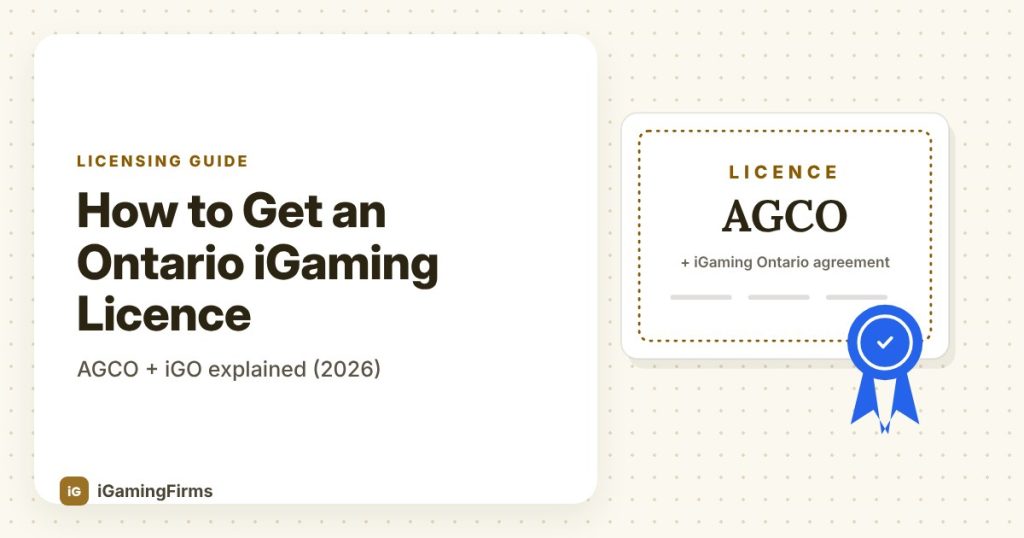
The short answer: to get an Ontario iGaming licence you register each gaming site with the Alcohol and Gaming Commission of Ontario (AGCO) as an internet gaming operator, paying CAD 100,000 per site per year, and then sign an operating agreement with iGaming Ontario (iGO), which keeps roughly 20% of the gaming revenue your site generates. Only after both steps can you go live.
This guide walks you through who does what, the full application package, the real fee schedule, a year-one cost model, how long it takes, and the rules you sign up to once you are live. It is written for operators weighing Ontario entry, and it is useful for affiliates and B2B suppliers who need to know where they fit.
Ontario iGaming at a glance
| Item | What applies in 2026 |
|---|---|
| Regulator | AGCO (registers operators and suppliers, sets the Registrar’s Standards, enforces) |
| Commercial counterparty | iGaming Ontario, a stand-alone Crown agency since 12 May 2025 |
| What you hold | An AGCO internet gaming operator registration plus an iGO operating agreement |
| Operator fee | CAD 100,000 per gaming site per year (one- or two-year term), non-refundable |
| Supplier fees | CAD 15,000 (manufacturer), CAD 3,000 (other gaming-related supplier), CAD 2,000 (non-gaming-related supplier) per year |
| Revenue split | iGO pays operators a variable share of gaming revenue, reported as 80%, so about 20% stays with iGO |
| Market size | 48 operators, 83 sites, CAD 9.88 billion wagered in July 2026 |
| Player age | 19+ |
AGCO vs iGaming Ontario: who does what
Most confusion about Ontario comes from treating the AGCO and iGO as one body. They are not, and since 2025 they are not even parent and subsidiary.
| AGCO | iGaming Ontario (iGO) | |
|---|---|---|
| Role | Regulator | Conducts and manages the private iGaming market for the Crown |
| Legal basis | Gaming Control Act, 1992 and Regulation 78/12 | iGaming Ontario Act, 2024 (in force 12 May 2025) |
| What it gives you | Operator or supplier registration certificate | Operating agreement that lets you offer games on its behalf |
| Sets | Registrar’s Standards for Internet Gaming (integrity, AML, responsible gambling, advertising) | Commercial terms, revenue reconciliation, its own AML program and responsible gambling requirements, BetGuard self-exclusion |
| Handles | Eligibility checks, compliance monitoring, sanctions up to revocation | Player disputes, operator reporting, payments to the Province |
The order matters: iGO signs operating agreements only with operators the AGCO has already registered. The AGCO’s own roles page sets out that split.
Is iGaming Ontario a Crown corporation?
Yes, in effect. iGO is a Crown agency and a corporation without share capital. It was created on 6 July 2021 as a subsidiary of the AGCO and was continued as a stand-alone agency when the iGaming Ontario Act, 2024 came into force on 12 May 2025. According to its annual report, oversight moved at the same time to the Ministry of Tourism, Culture and Gaming. Some operator guides published as late as May 2026 still describe iGO as an AGCO subsidiary, which is out of date.
Who owns Ontario gaming?
The Province. Three provincial bodies split the work: the Ontario Lottery and Gaming Corporation (OLG) runs lotteries, land-based casino gaming and its own OLG.ca site; iGO manages the competitive online market where private operators offer casino and sports betting; and the AGCO regulates all of it. When you enter Ontario, you are not buying a licence to run your own business so much as becoming iGO’s agent: under the operating agreement, your site accepts wagers and pays winnings on iGO’s behalf.
Do you need an operator or a supplier registration?
The AGCO decides by activity, not by job title. An operator is the entity with ongoing responsibility for a gaming site as a whole: key decisions, compliance, and the authority to choose its gaming-related suppliers. That entity registers, and every distinct site needs its own application and fee. The AGCO looks at shared login credentials, a common wallet, branding and who runs each site when deciding whether two sites are “distinct”.
Gaming-related suppliers (B2B) register separately. Examples the AGCO lists include platform providers, game developers and suppliers that run games or game systems, customer e-wallet providers, odds makers, sports integrity monitors and independent test labs. Manufacturers pay CAD 15,000 a year and other gaming-related suppliers CAD 3,000.
Affiliates: the current supplier guide lists certain “marketing affiliates” (sites that send traffic to operators for a commission) among businesses that may not need registration, but the AGCO makes that call case by case. Check with the AGCO before assuming you are exempt, and remember that the operator stays responsible for advertising run on its behalf.
This matters if you are thinking of a turnkey or white label route. A provider can supply the platform, but the entity that controls the site still has to register as the operator, so a “skin under someone else’s licence” model does not carry over to Ontario the way it does offshore. Our breakdown of white label casino costs covers how those deals are usually priced elsewhere.
How to get an Ontario iGaming licence, step by step
The process below follows the AGCO’s Internet Gaming Operator Application Guide and iGO’s published description of the operating agreement.
- Stop any grey-market activity in Ontario. Since 31 October 2022, applicants and registrants must cease unregulated iGaming in Ontario and must not contract with unregistered providers for anything that would need registration. A brand still serving Ontario players offshore will hit this wall first.
- Map your sites and suppliers. Decide how many distinct gaming sites you will run (each costs CAD 100,000 a year) and confirm that your platform, game studios, aggregator, wallet and odds providers are AGCO-registered or will be.
- Open an iAGCO account. Everything is filed through the AGCO’s iAGCO portal.
- Prepare the Registrar’s Standards Gap Analysis. This is the core document. You confirm which Standards you would meet if you were already operating, identify the ones you would not, and set out how and when you will close each gap.
- File the disclosures. An Entity Disclosure for the applicant and any corporate shareholder with 5% or more, and Personal Disclosures for directors, officers, partners, 5%+ shareholders, relevant trustees and principal employees. Anyone who lives primarily outside Canada needs a criminal background check from the last 12 months.
- Attach the supporting documents. Constating documents, financial statements, tax returns and assessments, corporate schematics, a supplier list, a gaming site diagram and government ID.
- Pay the regulatory fee. CAD 100,000 per site for a one-year term or CAD 200,000 for two years, by wire or EFT (payments of CAD 30,000 or more cannot go by card). The fee must arrive before the AGCO starts processing, and it is non-refundable. The AGCO may also bill the reasonable costs of investigating you.
- Pass the eligibility review. The AGCO assesses integrity, financial responsibility and competence. If approved, you receive the registration certificate by email and in iAGCO.
- Sign the iGO operating agreement and integrate. You agree the commercial terms, post performance security (cash, letter of credit or surety bond), connect to iGO’s reporting and to the BetGuard self-exclusion API, and complete iGO’s onboarding.
- Certify games and systems. Games and gaming systems must be tested by an independent testing lab registered with the AGCO.
- Launch, then file your Control Activity Matrix. Every operator submits an independently audited Control Activity Matrix (CAM) covering its controls against the Standards, including those run by third-party platforms. It is due within three months of launch, or before launch if the AGCO has assessed you as elevated risk.
What an Ontario iGaming licence really costs
The CAD 100,000 headline is the smallest number you will deal with. The AGCO fee schedule covers registration only:
| Registration | Annual fee (CAD) |
|---|---|
| Internet gaming operator | 100,000 per site |
| Gaming-related supplier, manufacturer | 15,000 |
| Gaming-related supplier, other | 3,000 |
| Non-gaming-related supplier | 2,000 |
| Investigation costs | Billed at reasonable cost, no fixed amount |
Two further costs are less visible. First, the AGCO has said it intends to recover the overall cost of regulating iGaming from the market, and its application guide warns the amount per operator is not yet set and “could be significantly greater” than CAD 100,000 per site. Second, and far bigger, is the revenue split with iGO.
The revenue split, worked out from iGO’s own numbers
Ontario has no gaming tax in the usual sense. Instead, your site collects wagers and pays winnings on iGO’s behalf, remits the net to iGO, and iGO pays you back a share. iGO’s 2024-25 annual report describes this as a variable share, stated as 80%. Its figures for the year to 31 March 2025 bear that out:
- Gaming revenue: CAD 2,901.5 million
- Paid to operators: CAD 2,327.4 million (about 80%)
- Net gaming revenue kept by iGO: CAD 574.1 million (about 19.8%)
- Dividend paid to the Province: CAD 181 million
Individual operating agreements are not published, so treat 20% as the market-wide effective rate rather than a guaranteed contract term.
Year-one cost model for a single-site operator
Assumptions: one gaming site, one-year AGCO term, CAD 10 million gross gaming revenue in year one, iGO share of 20%. Platform, content, payments, marketing and staff costs are left out because they depend on your stack.
| Line | CAD | Note |
|---|---|---|
| AGCO operator registration | 100,000 | Paid up front, non-refundable |
| AGCO investigation costs | Variable | Higher for complex ownership or non-resident principals |
| Cost-recovery charge | Not yet set | AGCO warns it may exceed the registration fee |
| iGO share of GGR (20% of 10m) | 2,000,000 | Retained by iGO before you are paid |
| Independent CAM audit, ITL testing, legal | Quote-based | Not published by the AGCO |
| Revenue reaching you | 8,000,000 | Before your own operating costs and corporate income tax |
The decision rule that follows: at low revenue the fixed CAD 100,000 per site dominates, so running several thin brands as separate sites is expensive. At scale the 20% share dominates, so your unit economics depend on margin after iGO’s cut, not on the registration fee. One consultancy page ranking for this topic quotes “€200k+” for year one; that mixes currencies and leaves the revenue share out, so use your own GGR forecast instead.
How long does it take?
The AGCO publishes no processing timeline, and the regulatory fee must land before review starts. Consultants commonly quote four to six months from filing to launch, but the real drivers are within your control: a complete Gap Analysis, clean disclosures for every 5% holder, suppliers who are already registered, and how fast you complete iGO onboarding. Elevated-risk applicants should also budget time to produce the CAM before launch rather than after.
What you sign up to once you are live
Registration is the start, not the end. The Registrar’s Standards for Internet Gaming apply from day one, and the AGCO uses progressive sanctions up to revocation. The areas operators most often underestimate:
- Advertising. Inducements such as bonuses cannot appear in public advertising, and since 28 February 2024 active and retired athletes cannot appear in gambling ads, with only narrow exceptions for responsible gambling messaging.
- Centralized self-exclusion. iGO launched BetGuard on 14 May 2026, and the AGCO’s new Standard 2.14.1 came into effect the same day. You must check exclusion status in real time through the API, stop marketing to excluded players and promote BetGuard alongside your own tools. The AGCO’s announcement lists the amended Standards.
- Limit setting. Players can set limits at any time, but loosening or removing one only takes effect after a cooling-off period of at least 24 hours.
- AML and KYC. You run your own program and sit inside iGO’s AML regime, so your KYC provider and payment stack need Ontario-ready reporting.
- Sports betting integrity. Sportsbooks must work with an AGCO-recognised independent integrity monitor.
- Player harm. The AGCO expects you to identify and support players at risk and to signpost help such as ConnexOntario (1-866-531-2600, 24/7).
Is online gambling legal in Ontario, and can you sportsbet there?
Yes. Federal law has allowed provinces to offer single-event sports betting since August 2021, and Ontario opened its private iGaming market on 4 April 2022. Licensed sites can offer online casino, live dealer, poker, sports and esports betting, and betting exchange products to players physically in Ontario. Lottery products stay with OLG.
Do players have to be 18 or 19?
19. Ontario’s regulated online market is 19+, so your age verification has to be set to 19, not the 18 that applies in some other provinces.
The iGaming Ontario operators list: who is in the market
iGO reported 48 operators running 83 gaming sites in July 2026, the month wagers hit a record CAD 9.88 billion. Online casino accounted for 89% of wagers and about 80% of gaming revenue that month, so Ontario is a casino-led market with sportsbook on top, not the other way around. In FY2024-25, iGO counted 50 active operators.
The list moves in both directions. Casumo announced its exit in April 2026, which Gaming News Canada counted as the seventh operator to leave since launch. iGO publishes the current list of regulated sites on its website, and that is the source to check before you sign a B2B deal or an affiliate agreement with an “Ontario-licensed” brand.
Ontario vs other licences: is it worth it for you?
| Route | What it gives you | Best for |
|---|---|---|
| Ontario (AGCO + iGO) | Access to one regulated provincial market only | Operators ready for local compliance and a 20% revenue share in exchange for a large, legal market |
| Curaçao | Multi-market B2C licence, lower fees | Operators targeting markets without local licensing; does not let you serve Ontario |
| Isle of Man | Tier-one reputation, low duty | Groups wanting a respected hub licence alongside local ones |
Ontario is a local licence, not a passport. It sits beside your hub licence rather than replacing it. Alberta set 13 July 2026 for the launch of its own competitive market with a centralized self-exclusion system from day one, so operators building Ontario-grade compliance now are building for the next Canadian province too.
Your next step
Start with the gap analysis, not the fee. If you can show today which Registrar’s Standards you meet, which suppliers are already AGCO-registered, and that you have no Ontario grey-market exposure, the rest of the process is paperwork and integration work.